


Features
Topics
Discover

Unlock the potential of your career in the Pharma industry with our online courses and qualifications.

Career Path

Pick a career path, follow its guided course roadmap, and secure industry-verified credentials in a few months.

Courses

Earn career credentials from industry leaders that demonstrate your expertise.

Adverse Event Reporting in 2026: Meaning, FAERS, EudraVigilance, And A Step-By-Step Guide

Adverse Event Reporting feels stressful: people fear deadlines, missing details, or using the wrong portal. This article helps patients, HCPs, and pharma teams report correctly and faster. In one line: AE is any event, ADR is a suspected drug reaction, and SAE meets seriousness criteria. 

Pharmacovigilance, as WHO explains, supports detecting and preventing medicine-related problems. WHO’s PIDM started in 1968 with 10 members and had 160 full members plus 22 associate members by 21 March 2025, showing why shared reporting matters globally and why accurate follow-up information improves signal detection for patients and regulators alike. 

Table of Contents

What Is Adverse Event Reporting?

Adverse event (AE) reporting means documenting and sharing unwanted medical events after medicine use. It helps teams detect risks early and protect patients from further harm during treatment.

An adverse event may happen without proof that a drug caused it. However, reporters must submit complete details quickly to support safety review.

  • Patients, healthcare professionals, and companies all play important roles in reporting.

  • Good reports include product name, event details, patient data, and reporter contact.

  • Clear reporting improves pharmacovigilance decisions, follow-up actions, and better public health communication for everyone.

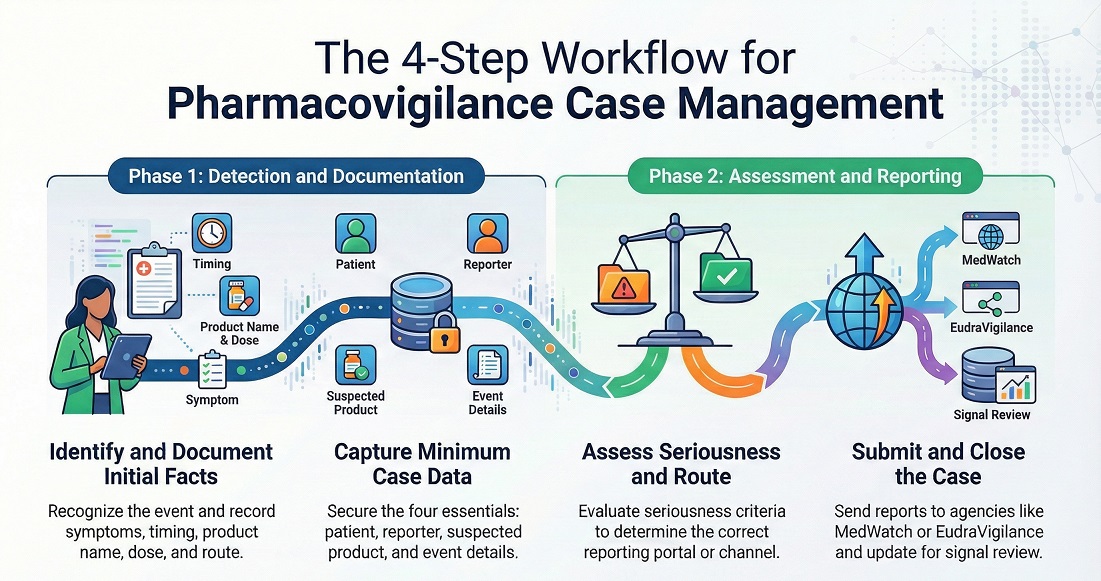
The 4 Step Workflow for Pharmacovigilance Case Management

Key Safety Terms Used in Reports

Safety reports use key terms for fast, accurate, and consistent case handling. However, teams must understand each term before they submit or escalate cases.

  1. Individual Case Safety Report (ICSR): One documented case with required safety details.

  2. SUSAR: An unexpected serious reaction found during a clinical trial.

  3. Safety Signal: A possible new risk that needs review.

  4. Follow-Up Information: New facts that strengthen case review and assessment.

AE Vs ADR Vs SAE

Term Definition Example Reportability
AE (any event)
Any unwanted event after product use; no proven drug link needed
Headache after starting a medicine
Context-based
ADR ( suspected drug reaction)
Suspected harmful reaction to a medicine
Rash suspected from an antibiotic
Usually reportable
SAE (serious outcome)
Serious event (death, hospitalization, disability, etc.)
Anaphylaxis with hospitalization
Priority / expedited

1- Individual Case Safety Report (ICSR): Meaning

An Individual Case Safety Report (ICSR) records patient safety case in detail. It captures the event, suspected product, patient facts, and reporter information.

However, teams also add timelines and follow-up notes to support review. Good ICSRs use 4 minimum elements and help pharmacovigilance teams assess risk faster. They improve consistency, traceability, and faster communication across reporting workflows.

2- SUSAR: Meaning in Clinical Trials

SUSAR means a suspected unexpected serious adverse reaction in a clinical trial. Investigators report SUSARs quickly to protect participants and support safety decisions.

However, teams first check seriousness, expectedness, and possible drug relationship.

  • Serious means death, hospitalization, or disability.

  • Unexpected means labels miss this reaction.

  • Suspected means evidence suggests a drug link.

  • Rapid reporting helps sponsors assess risk.

3- Safety Signal: What It Means

Safety signals show possible new risks linked to a medicine or biologic. Teams review patterns across reports before confirming any causal relationship. However, FDA began daily FAERS public data publication on August 22, 2025. This process helps protect patients and supports risk communication. 

  • A signal starts as a pattern, not proof.

  • Teams investigate frequency, seriousness, and follow-up details.

Where To Report Adverse Events

Report adverse events through the correct national or regional safety portal. Patients, HCPs, and companies may use different routes. However, all reporters should submit complete details quickly.

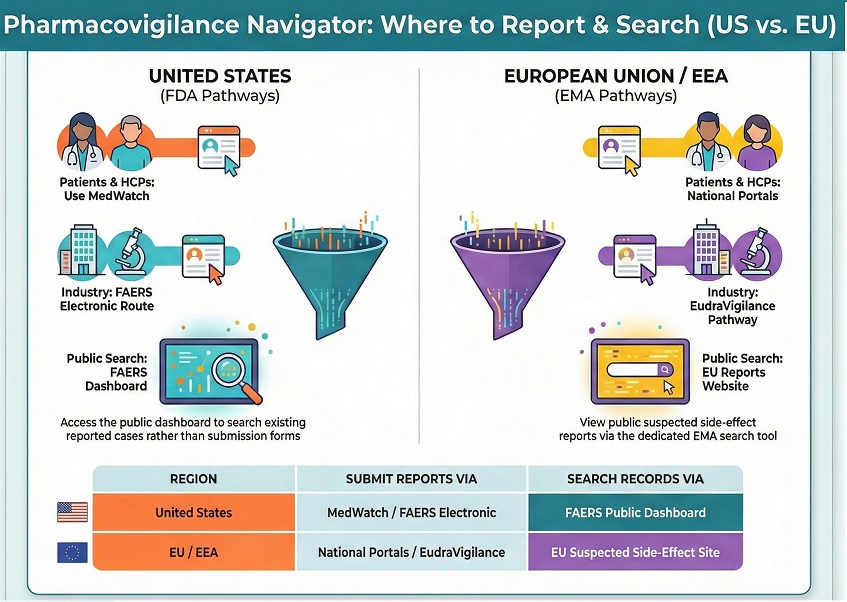
1) Use  FDA MedWatch or FAERS pathways in the United States.

2) Use  EudraVigilance or national EU portals in Europe.

Follow up with new information when case details change later. ICH guides reporting standards, but it does not receive reports directly.

The Global Pharmacovigilance Regulatory and Reporting Navigation Map

FAERS And MedWatch Reporting in the US

US reporters use several tools for AE reporting and safety review.

1) FAERS stores submitted case data from companies and mandatory reporters.

2) MedWatch helps patients and HCPs report serious product problems directly.

3) FAERS Dashboard lets users search cases by drug, event, and outcomes quickly.

Teams review patterns there, but they do not confirm causation alone yet. Good searches support signal checks, trend review, and better safety discussions internally.

1-FAERS: What It Is and Who Uses It

FDA FAERS is the FDA AE Reporting System for drug and biologic safety reports. It supports postmarketing safety monitoring and helps teams review adverse event patterns.

However, users should know its main uses.

1- FDA receives reports from industry, patients, and HCPs.

2- Reviewers analyze patterns for possible signals.

3- Users search the FAERS Dashboard to explore reported cases, outcomes, and events by product or reaction terms. 

2-MedWatch: When Patients and HCPs Use It

MedWatch helps patients and HCPs voluntarily report serious side effects and product problems. They use it for drugs, biologics, devices, and other FDA-regulated products, including supplements.

However, users choose

1-MedWatch online forms for quick reporting and updates from home. They choose

2-MedWatch when they need direct FDA reporting instead of company channels.

Good reports include dates, product names, clear event details, and reporter contact for safety.

3-FAERS Dashboard: How to Search Existing Cases

FDA FAERS is the FDA AE Reporting System for drug and biologic safety reports. It supports postmarketing safety monitoring and helps teams review adverse event patterns. 

However, users should know its main uses. 1) FDA receives reports from industry, patients, and HCPs. 2) Reviewers analyze patterns for possible signals. 3) Users search the FAERS Dashboard to explore reported cases, outcomes, and events by product or reaction terms. 

Download Now The FDA Safety Information and AE Reporting Program Form (FDA 3500) Here

EudraVigilance Reporting in the EU

EudraVigilance reporting in the EU supports medicine safety monitoring after real-world use. Patients, HCPs, and companies report suspected adverse reactions through national portals or EU routes.

However, reporters must submit complete case details and follow-up updates quickly. EMA requires ICH E2B(R3) formats for electronic ICSR reporting in EudraVigilance. Clear data and timely submissions help regulators review signals faster across EU states. This process improves pharmacovigilance decisions and safety communication. It aligns authorities and marketing authorisation holders across Europe.

Download Now 

EMA GVP Module VI (Rev 2): Collection, Management And Submission Of Suspected Adverse Reaction Reports (PDF)

Report A Side Effect: Step-By-Step

Reporting a side effect becomes easier when you follow clear steps. This guide helps patients and HCPs submit complete information quickly.

However, always act fast and keep your details accurate. Good reports support safety reviews, faster updates, and better protection for everyone involved today.

  1. Confirm the product name, dose, and start date.

  2. Write the event, symptoms, timing, and seriousness clearly.

  3. Add patient details, contact information, and relevant medical history.

  4. Submit the report through the company or authority portal.

  5. Send follow up updates if new tests or outcomes appear.

Final Words

Adverse Event Reporting protects patients by moving safety information to the right teams quickly. This article explained AE, ADR, and SAE terms, where to report in the US and EU, and how to submit complete reports with follow-up updates. It also showed when FAERS, MedWatch, and EudraVigilance routes fit different reporters. 

For practice, use 4 minimum case elements and document 1 clear event timeline. ICH E2A supports expedited safety terms, while ICH E2B(R3) supports ICSR data exchange. Use accurate details, submit through the portal, and add information fast to support pharmacovigilance review and signal detection. 

FAQs

1️⃣ Where Do Patients And HCPs Report In The US?

 Patients and healthcare professionals commonly use MedWatch to report serious product problems and adverse events to FDA. FDA also maintains FAERS for post-marketing safety surveillance of drugs and biologics.

2️⃣ What Is FAERS Dashboard Used For?

The FAERS Public Dashboard helps users search reported cases by drug, event, and outcome. It supports signal review and trend exploration, but reported cases alone do not prove causation.

3️⃣ Where Do Companies Report In The EU?

In the EU/EEA, EudraVigilance supports electronic transmission of ICSRs between EMA, national authorities, MAHs, and clinical trial sponsors. EMA operates the system for the EU medicines regulatory network.

References

Picture of Ershad Moradi
Ershad Moradi

Ershad Moradi, a Content Marketing Specialist at Zamann Pharma Support, brings 6 years of experience in the pharmaceutical industry. Specializing in pharmaceutical and medical technologies, Ershad is currently focused on expanding his knowledge in marketing and improving communication in the field. Outside of work, Ershad enjoys reading and attending industry related networks to stay up-to-date on the latest advancements. With a passion for continuous learning and growth, Ershad is always looking for new opportunities to enhance his skills and contribute to pharmaceutical industry. Connect with Ershad on Facebook for more information.

Share