


Audits demand traceable evidence, not opinions. GxP Validation gives teams proof that systems work as intended. It protects data integrity and audit trails during inspections. WHO TRS 986, Annex 2 links GMP to consistent quality for 194 Member States.
In Good Manufacturing Practices (GMP), define scope fast. Focus on GxP-relevant processes and “fit for intended use.” You will get simple steps, clear examples, and auditor-ready deliverables. Use a traceability matrix for fast evidence retrieval. In the intro, cite FDA 21 CFR Part 11, FDA’s Part 11 Scope and Application guidance, and EU GMP Annex 11.
Table of Contents
What is GxP Validation?
GxP validation proves your regulated process or system works as intended. It confirms you meet GMP, GCP, or GLP expectations. You define intended use, risk, and required controls. You then collect test results and documents that show consistent performance.
Therefore, teams use validation to stay audit-ready and protect patient safety. It also supports data integrity, traceability, and clear decision records for inspectors.
Plan scope and requirements before testing starts.
Run IQ, OQ, and PQ tests and log deviations.
Approve a final report, then manage changes to keep control.
Core GxP Validation Topics and Main Steps
Core GxP validation covers scope, risk, requirements, testing, and documented control. It keeps systems fit for intended use and inspection-ready. Teams use traceability to link user needs, tests, and results. You also manage changes and deviations to maintain control across the system lifecycle.
Therefore, follow these main steps to build audit-ready evidence fast:
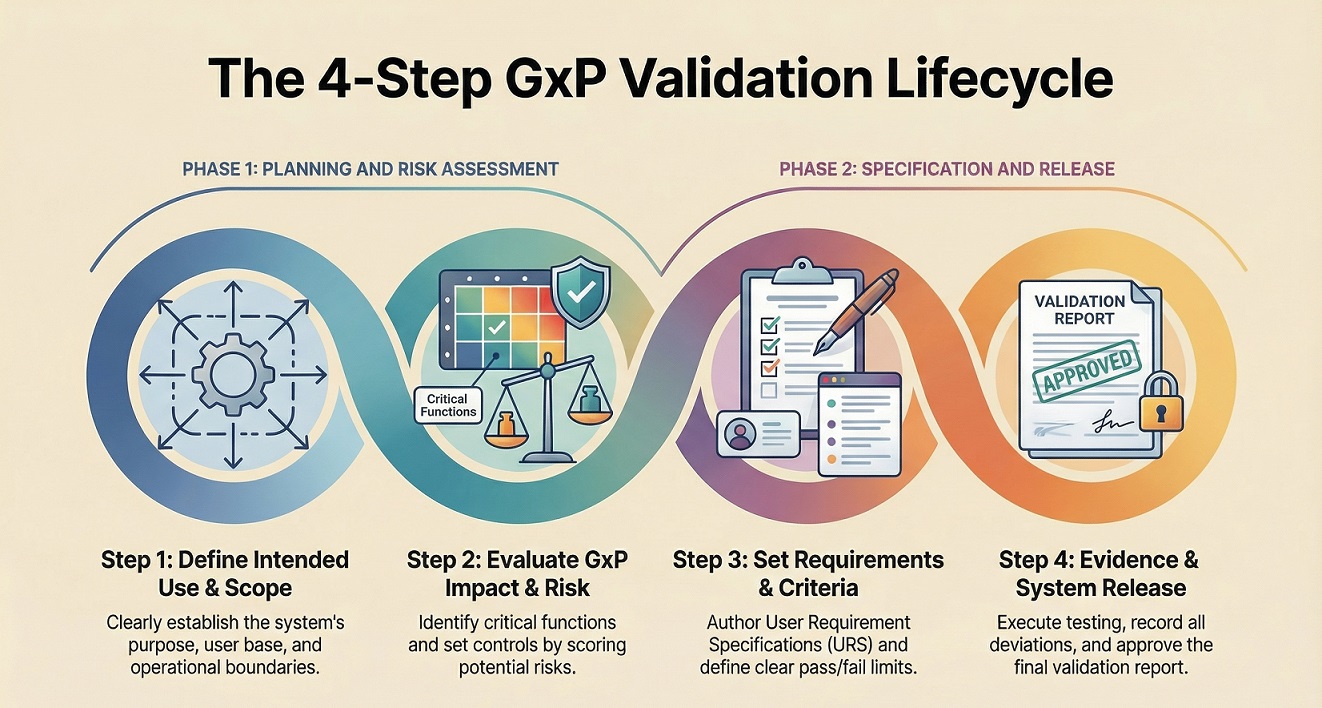
Step 1: Clarify the intended use and scope
Step 2: Define GxP impact and risk level
Step 3: Set requirements and acceptance criteria
Step 4: Document evidence that requirements are met
Step 1: Clarify the Intended Use and Scope
Clarify intended use and scope before you validate anything. Define what the system must do in daily operations. List key users, workflows, and data types. Set boundaries for interfaces, reports, and critical functions. Therefore, write the scope in clear, testable terms.
Describe intended use, key features, and linked processes.
List in-scope modules, out-of-scope items, and interfaces.
Step 2: Define GxP Impact and Risk Level
Define GxP impact and risk level to focus validation effort. First, decide if the system affects product quality or patient safety. Next, map data flows and identify critical records and audit trails.
So, score each risk from 1 to 5 for severity. Then rate probability from 1 to 5 for likelihood. Use the combined score to set testing depth, controls, and review frequency.
Step 3: Set Requirements and Acceptance Criteria
Set clear requirements and acceptance criteria before you test. Use FDA-aligned wording and keep each requirement measurable. Link requirements to intended use, risks, and data integrity needs. Define pass or fail rules for every critical function.
Therefore, document criteria so reviewers decide fast and consistently.
Write a URS with unique IDs and clear outcomes.
Set acceptance limits, including audit trail and access rules.
Map each test case to requirements for full traceability.
Step 4: Document Evidence That Requirements are Met
Document evidence to prove every requirement works in real use. Capture test scripts, results, and screenshots with timestamps. Record deviations, assign owners, and close actions with clear rationale. Store everything in a controlled repository with version history.
Therefore, align records with EU Annex 11 expectations and EMA readiness. Sign and date protocols, reports, and traceability matrices. Link each requirement ID to test evidence and approvals for fast retrieval.
Key Terms That People Confuse in GxP Environment
People often mix key terms in a GxP environment and lose audit clarity. They use “validated” as a label, not a controlled status. They also confuse checks during build with full lifecycle validation. Clear definitions help teams align faster and document decisions better.
Therefore, use this short list to remove confusion and guide training.
Number 1: Define the Validated state
Number 2: Separate Validation from Verification
Number 3: Explain GxP Compliance in Plain Language
Number 4: Map Each Term to a Real Example
Number 1: Define the Validated state
Define the validated state as a controlled, documented condition of a system. It means the system performs as intended, with approved evidence. You also keep control over changes, access, and data integrity during routine use.
Therefore, set 2 anchors to maintain the validated state. First, use change control for every impact. Second, run periodic review at least 1 time per year.
Number 2: Separate Validation from Verification
Separate validation from verification to avoid FDA audit findings. Verification checks you built the system correctly. Validation proves the system supports intended use in routine work. Use both, but document them with different goals and evidence.
Therefore, apply these practical rules to keep your records clear.
Verify configurations, calculations, and controls during build.
Validate end-to-end workflows with real roles and data.
Link evidence to requirements and FDA Part 11 controls.
Number 3: Explain GxP Compliance in Plain Language
GxP compliance means you follow controlled processes that protect patients and data. You show proof through records, training, and controls that work every time.
Therefore, explain it using ICH risk thinking and simple outcomes. For example, ICH Q9 and ICH Q10 help you prioritize controls by risk.
Say who approves, when, and where you store evidence.
Say what you test, what can fail, and how you fix it.
Number 4: Map Each Term to a Real Example
Use real examples to teach GxP terms fast. Pair each term with one workflow and one record. WHO validation guides stress documented proof for consistent quality across GMP and data integrity.
Therefore, map terms to daily tasks your team already performs.
Validated state: change control log plus annual review record.
Verification: unit test of calculations and access roles.
Validation: executed IQ/OQ/PQ and signed summary report.
Validation vs Verification vs Qualification (IQ/OQ/PQ) comparison table
| Topic | Validation | Verification | Qualification (IQ/OQ/PQ) |
|---|---|---|---|
|
Goal |
Fit for intended use |
Built/configured right |
Installed/operates/performs right |
|
Focus |
End-to-end GxP use |
Specs/config/build checks |
Equipment/system readiness |
|
When |
Before go-live + after changes |
During build/config |
During implementation |
|
Evidence |
URS + RTM + report |
Specs + unit tests |
IQ/OQ/PQ protocols + reports |
Why Validation is Required
Why do regulators require validation? Regulators need proof that systems work correctly. It protects patients, product quality, and data integrity. Validation also supports traceability for audits and investigations.
Therefore, use these quick Q&As to explain it clearly:
What problem does validation solve? It prevents errors and undocumented changes.
What does an auditor expect? Requirements, tests, results, approvals, and traceability.
What happens if you skip validation? You risk findings, delays, and costly remediation.
Minimum evidence set for validation
| Evidence item | Purpose | Typical contents | Output |
|---|---|---|---|
|
URS |
Define intended use |
Scope, users, functions, data needs |
Approved URS |
|
Risk assessment |
Set testing depth |
GxP impact, severity/probability, controls |
Risk log + controls |
|
Test evidence |
Prove requirements work |
IQ/OQ/PQ or scripts, results, deviations |
Executed tests |
|
Report |
Summarize proof |
Summary, deviations/CAPA, conclusion |
Signed validation report |
|
Release |
Authorize use |
QA approval, SOPs/training, change control |
Go-live decision |
Validated State and Lifecycle Control
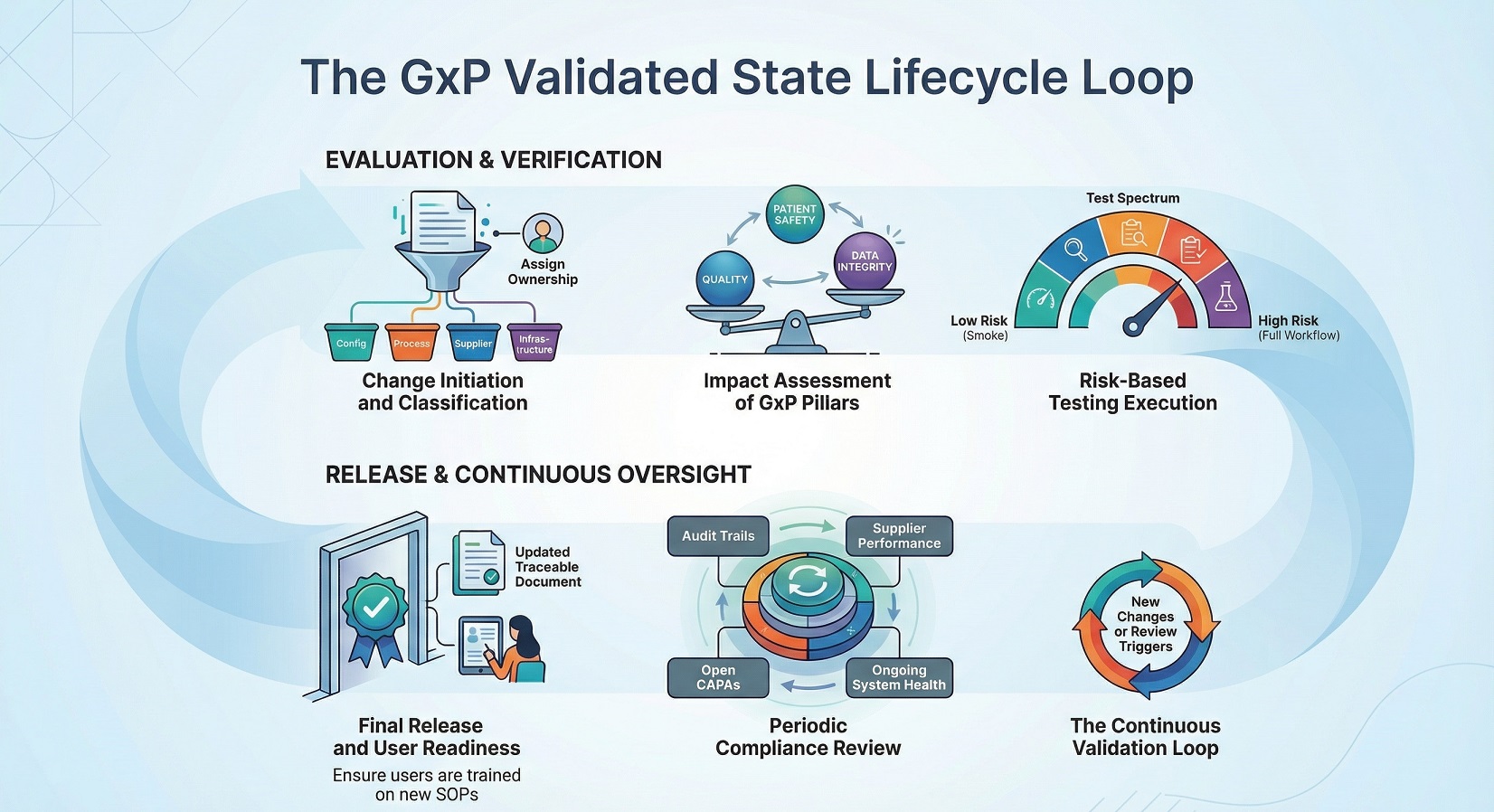
A validated state means your system stays fit for intended use. You keep control after go-live, not only during testing. You manage changes, access, and data integrity every day. You also track deviations and close actions on time.
So, use lifecycle control to protect compliance and reduce audit stress.
Run change control with impact assessments and approvals.
Perform periodic reviews, trending, and supplier monitoring.
Keep training, SOPs, backups, and audit trails up to date.
Final Words
Audits demand traceable evidence, not opinions. GxP Validation proves systems stay fit for intended use. Start by scoping GxP functions and data flows. Then rate risks with severity and probability scores, from 1 to 5, using ICH Q9(R1) principles.
Next, set clear requirements and acceptance criteria, and test end-to-end workflows. Capture evidence in 3 bundles: URS, risk assessment, and a traceability matrix. Use documented decisions to support audits and speed investigations during deviations. Keep control after go-live with change control and periodic review. ICH Q10 links these lifecycle controls to a strong pharmaceutical quality system.
FAQs
It proves a regulated system works as intended, with documented evidence.
They need traceable proof that controls protect records, quality, and decisions.
Scope, requirements, risk assessment, test results, deviations, approvals, and traceability.
References

Ershad Moradi, a Content Marketing Specialist at Zamann Pharma Support, brings 6 years of experience in the pharmaceutical industry. Specializing in pharmaceutical and medical technologies, Ershad is currently focused on expanding his knowledge in marketing and improving communication in the field. Outside of work, Ershad enjoys reading and attending industry related networks to stay up-to-date on the latest advancements. With a passion for continuous learning and growth, Ershad is always looking for new opportunities to enhance his skills and contribute to pharmaceutical industry. Connect with Ershad on Facebook for more information.

Trending Analysis in Pharma Industry 2026: Complete Market Growth & Regulatory Insights
Trending analysis in the pharmaceutical industry highlights an average 12% annual growth in manufacturing capacity and a steady increase in FDA drug approvals. Quality assurance remains paramount, with the FDA conducting over 1,200 inspections each year to ensure product safety. Staying informed through authoritative sources like IQVIA, FDA, and WHO supports better decision-making in this rapidly evolving sector.

Drug Regulatory Agencies Complete Guide 2026: Regulatory Approval & Compliance
This blog explores the vital roles of Drug Regulatory Agencies like the FDA and the EMA Regulatory Standards in ensuring the safety and efficacy of medicines globally. By reviewing thousands of applications each year, these agencies protect public health and facilitate access to life-saving drugs.

Pharma Jobs in Houston in 2026: FDA GMP Manufacturing and Salary Outlook
Houston’s life sciences sector continues to expand across pharmaceutical jobs in Houston, biotech manufacturing jobs Houston, and GMP jobs in Houston, driven by FDA inspections Texas activity, sterile manufacturing compliance standards, and growing clinical research infrastructure.