


Features
Topics
Discover

Unlock the potential of your career in the Pharma industry with our online courses and qualifications.

Career Path

Pick a career path, follow its guided course roadmap, and secure industry-verified credentials in a few months.

Courses

Earn career credentials from industry leaders that demonstrate your expertise.

Pharma Job Recruiters: Who Hires Pharma Specialists and Where to Look in 2026

Pharma job recruiters now account for more than 60% of mid-to-senior hires across the European pharmaceutical and life sciences industry, as workforce demand continues to outpace available talent. In 2025, multiple industry workforce reports highlight persistent shortages in GMP manufacturing, clinical operations, regulatory affairs, and quality functions, where a single mis-hire can delay inspections, disrupt clinical timelines, or cost companies millions in remediation and compliance risk.

As a result, pharmaceutical employers increasingly rely on specialized pharmaceutical recruitment agencies and life sciences hiring partners to secure experienced talent faster, reduce time-to-hire by up to 40%, and minimize regulatory exposure. Understanding where these recruitment firms operate and which organizations rely on them helps professionals navigate hiring pipelines more efficiently.

This article explains how pharmaceutical recruitment works, where candidates are placed across manufacturing, clinical research, and healthcare, and which organizations actively hire pharma specialists today. By the end, you will gain a clear, practical view of how hiring demand is structured across the industry and how to use that insight to make smarter career decisions.
You can explore current opportunities via Pharma Jobs.

Table of Contents

What Are Pharma Job Recruiters?

Pharma job recruiters connect pharmaceutical and life sciences professionals with regulated employers across manufacturing, clinical research, quality, and regulatory functions.

These pharmaceutical recruiters work in highly regulated environments and understand requirements such as GMP compliance, clinical trial frameworks, regulatory submissions, and quality systems. Their role goes beyond CV matching, focusing on defining hiring criteria.

In practice, recruitment operates through agency-based models, in-house hiring teams, and project-based support for clinical and validation work.

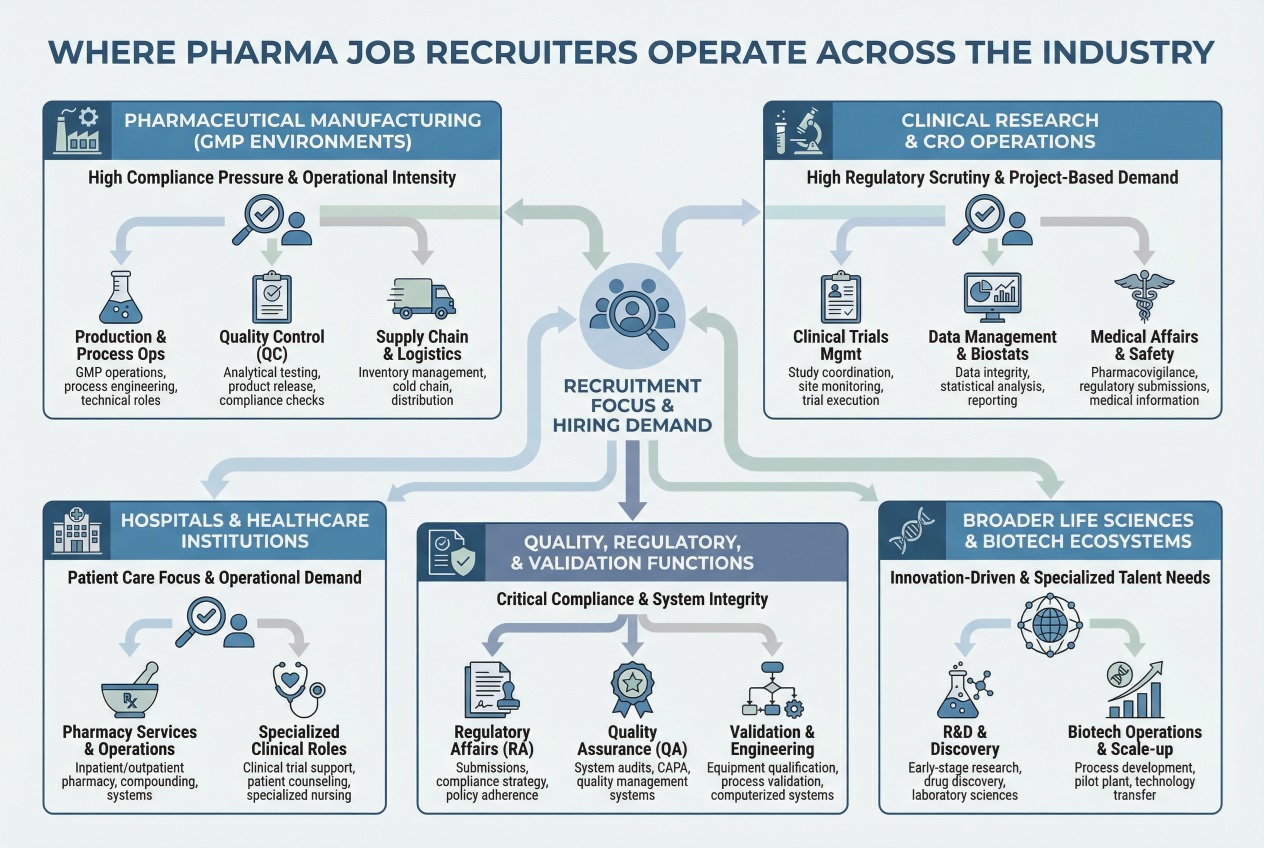
Where pharma job recruiters hire across the industry

Pharmaceutical recruiters and pharma recruitment agencies primarily support hiring for manufacturers, CROs, hospitals, laboratories, and regulated service companies.

Connecting talent with pharma industry leaders
Recruiting across biotech and pharmaceutical sectors

The table below summarizes where recruiter demand is strongest across the pharmaceutical and life sciences sectors.

Company Type Typical Roles Hired Why Recruiters Are Used
Pharma Manufacturers
QA/QC, Validation, Production, GMP Managers
Compliance risk, audit readiness
CROs
CRAs, Clinical PMs, Regulatory Specialists
Trial timelines, project-based hiring
Hospitals & Clinics
Hospital Pharmacists, Clinical Analysts
Patient safety, accreditation
Laboratories
QC Analysts, Quality Managers
Inspection pressure
Pharma Services & Distributors
Regulatory Consultants, Trainers
Niche expertise

Life sciences recruitment teams and clinical recruitment firms place candidates across the pharmaceutical value chain, with hiring activity shaped by regulatory exposure, and clinical demands.

Across the industry, recruiter activity clusters around four core hiring environments, each shaped by distinct regulatory exposure, operational risk, and workforce demand.

  • Pharmaceutical Manufacturers and Pharma Hiring Companies
  • CROs and Clinical Research Organizations Hiring Pharma Specialists
  • Hospitals and Laboratories Hiring Pharma Professionals
  • Distributors, Education, and Pharma Service Companies

Pharmaceutical Manufacturers and Pharma Hiring Companies

Pharmaceutical and biotech manufacturers recruit primarily for GMP-critical roles such as quality assurance, validation, and production management, where inspection readiness and documentation accuracy are essential. These positions require hands-on GMP experience and familiarity with audit-driven manufacturing environments.

CROs and Clinical Research Organizations Hiring Pharma Specialists

Contract Research Organizations (CROs) engage recruiters for project-based clinical roles including CRAs, regulatory specialists, and clinical project managers. Hiring is closely tied to trial phases and regulatory milestones, requiring candidates who can integrate quickly into active studies.

Hospitals and Laboratories Hiring Pharma Professionals

Hospitals and diagnostic laboratories hire pharmaceutical professionals for patient-facing and analytical roles where safety, accuracy, and accreditation standards must be maintained. Common positions include hospital pharmacists, laboratory analysts, and quality specialists.

Distributors, Education, and Pharma Service Companies

Pharma distributors, service providers, and training organizations recruit specialists with regulatory, quality, or technical expertise to support compliance, controlled distribution, and professional upskilling across the supply chain.

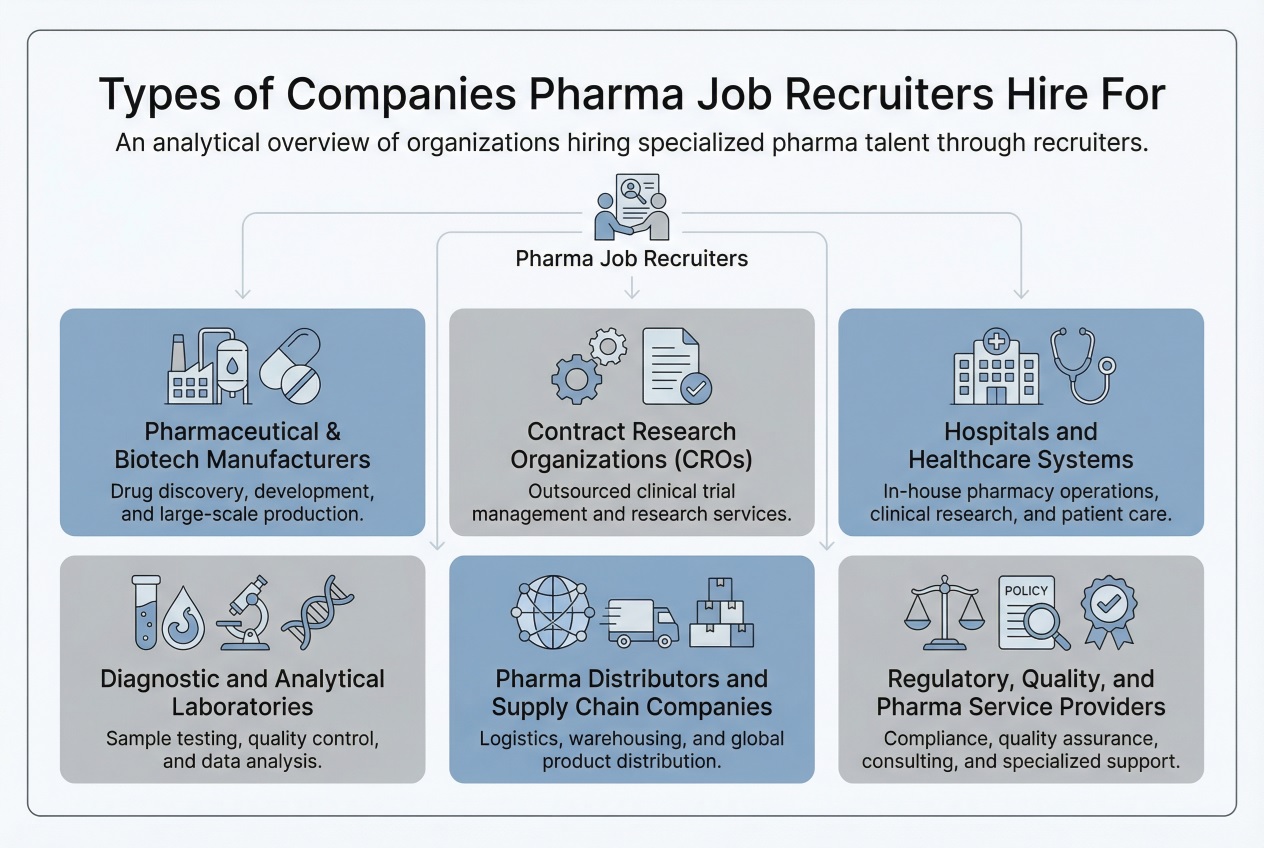
Types of Companies That Pharmaceutical Recruiters and Pharma Hiring Companies Support

Recruitment demand in the pharmaceutical industry concentrates in organizations where regulatory pressure, operational risk, and talent scarcity intersect, such as GMP manufacturing sites facing inspections. In these environments, hiring delays can directly affect compliance and clinical progress, making recruiter-led hiring a strategic necessity.

Pharma, biotech, and CRO recruitment specialists.
Diffenert Companies That Pharmaceutical Recruiters

Pharma recruiters most frequently place candidates in:

  • Pharmaceutical and biotech manufacturers (highest demand) due to GMP and inspection requirements
  • Contract Research Organizations (CROs) supporting time-sensitive clinical trials and regulatory submissions
  • Clinical research institutions and trial centers data integrity
  • Hospitals and healthcare systems employing pharmacists and clinical specialists
  • Diagnostic and analytical laboratories operating under continuous inspection pressure
  • Pharma distributors and supply chain organizations managing quality and regulatory compliance
  • Regulatory, quality, and compliance consultancies providing audit and remediation expertise
  • Life sciences education and training providers supporting ongoing GMP and regulatory upskilling

Together, these categories show where pharmaceutical expertise is most critical and why recruiter demand when talent gaps affect compliance.

Pharma Hiring Companies Across Manufacturing, Clinical, and Life Sciences

Pharmaceutical recruitment professionals operate across manufacturing, clinical research, quality, regulatory affairs, and the broader life sciences sector. In manufacturing environments, recruitment prioritizes GMP talent hiring and inspection readiness. In clinical research, the focus shifts to trial execution, regulatory timelines, and data integrity.

Life sciences recruitment also extends into biotech, medical devices, and CRO recruitment, where interdisciplinary expertise is increasingly valued. Recruiters adapt sourcing strategies based on sector-specific compliance risk, and project urgency.

Core pharma manufacturing skills required for GMP compliance

Achieving consistent GMP performance requires balanced development across multiple skill categories:

  • Technical execution skills for manufacturing and aseptic operations
  • GMP decision-making and deviation handling capability
  • Documentation and data integrity awareness
  • Quality risk recognition and escalation judgment
  • Right-first-time manufacturing discipline

Together, these skills form the foundation of a compliant and inspection-ready workforce.

Where Pharmaceutical Job Recruiters Operate in the Industry

Recruiter activity is not evenly distributed across the industry. Pharmaceutical job recruiters are most active where hiring delays directly affect compliance, revenue, or patient outcomes:

  • GMP manufacturing sites with frequent inspections
  • CROs managing multi-country or late-phase trials
  • Regulatory affairs teams handling submissions and variations
  • Quality assurance and validation departments
  • Life sciences hubs with concentrated biotech activity
  • Healthcare institutions expanding clinical or laboratory capacity

Understanding where recruiters focus their efforts allows candidates to align their job search with real hiring demand rather than relying solely on public postings.

Final Words

Industry hiring data shows that over 60% of mid-to-senior pharmaceutical roles are filled through recruiters, with average time-to-hire reduced by 30–40% compared to direct applications. Knowing where pharma job recruiters hire and which sectors depend on them most enables more targeted applications, faster interviews, and better long-term career alignment.

Professionals who understand recruiter-driven hiring patterns by focusing on high-demand, compliance-critical roles. To take the next step, Explore Pharma Jobs and align your search with where the industry is actively hiring.

FAQs

1️⃣ Which roles are recruiters most often used for in regulated life sciences environments?

Recruiters are most often used for roles tied to GMP operations, clinical programs, quality systems, and regulatory submissions, where hiring delays or mis-hires can directly impact inspections, trial timelines, or compliance outcomes.

2️⃣ Why do regulated employers rely on recruiters even when roles are publicly advertised?

In inspection-driven and clinical environments, employers use recruiters to pre-screen compliance readiness, validate hands-on experience, and shorten time-to-hire for roles where operational risk is high and internal sourcing is slow.

3️⃣ What increases a candidate’s chances of being shortlisted in inspection-driven and clinical environments?

Candidates with direct exposure to audits, quality systems, clinical timelines, or regulated workflows combined with the ability to perform under regulatory pressure—are significantly more likely to be shortlisted.

References:

Picture of Mahtab Shardi

Mahtab Shardi

Mahtab is a pharmaceutical professional with a Master’s degree in Physical Chemistry and over five years of experience in laboratory and QC roles. Mahtab contributes reliable, well-structured pharmaceutical content to Pharmuni, helping turn complex scientific topics into clear, practical insights for industry professionals and students.

Share

A brand of Zamann Pharma Support

© All rights reserved

Address: Zamann Pharma Support GmbH, Siedlerstraße 7 | 68623 Lampertheim, Germany

Get the app

Stay in touch

Address: Zamann Pharma Support GmbH, Siedlerstraße 7 | 68623 Lampertheim, Germany

© All rights reserved