


Features
Topics
Discover

Unlock the potential of your career in the Pharma industry with our online courses and qualifications.

Career Path

Pick a career path, follow its guided course roadmap, and secure industry-verified credentials in a few months.

Courses

Earn career credentials from industry leaders that demonstrate your expertise.

Dechallenge in Pharmacovigilance: Meaning, ADR Causality, and ICSR Documentation

Dechallenge in pharmacovigilance means the patient’s reaction improves after stopping the suspected medicine. It matters because symptom change after withdrawal supports ADR causality and guides follow-up. It supports a time link. ICH E2A sets a 15-calendar-day window for expedited reporting of serious, unexpected ADRs.

In Pharmacovigilance, contrast this with rechallenge: symptoms return after re-starting, which strengthens causality. Example: a rash fades 2 days after stopping amoxicillin (positive dechallenge); dizziness persists after stopping (negative). In the EU, EMA GVP Module VI / EudraVigilance uses 15 days for serious ICSRs and 90 days for non-serious.

Table of Contents

What Do You Mean By Dechallenge In Pharmacovigilance?

Dechallenge means symptoms change after you stop a suspect drug. It supports causality assessment in pharmacovigilance case review. You check dates, actions, and outcomes to confirm the pattern. Then you decide if dechallenge looks positive, negative, or unknown. However, you still rule out disease and other medicines.

  • Stop the suspect drug and record the exact stop date.
  • Track symptom change within 72 hours, if clinically plausible.
  • Document confounders like infections, comedications, and dose changes.

Dechallenge in simple words: what you observe after stopping a suspect drug

Dechallenge means you stop a suspect drug and watch what happens next. You check if symptoms improve, stay the same, or worsen. First, record the exact stop date and time. Then, track symptom changes over the next 24–72 hours.

  • If symptoms improve after stopping, you call it positive dechallenge.
  • If symptoms persist after stopping, you call it negative dechallenge.

However, also check other causes, like disease progression or new medicines. In complex cases, follow up within 7 days for missing dates and outcomes.

  • Positive dechallenge: symptoms improve after stopping
  • Negative dechallenge: symptoms do not improve after stopping
  • Unknown dechallenge: drug not stopped or data missing
Dechallenge Outcomes
Dechallenge Outcomes: Positive / Negative / Unknown

Positive dechallenge: symptoms improve after stopping

A positive dechallenge means symptoms improve after you stop the suspected drug. You compare the symptom trend before and after stopping. Then you record the stop date, onset date, and outcome.

For example, a rash fades within 48 hours after discontinuation. Therefore, this improvement supports causality in your assessment. However, you still check infection, allergies, and other medicines.

Negative dechallenge: symptoms do not improve after stopping

A negative dechallenge means symptoms do not improve after stopping the suspect drug. You compare the symptom trend before and after stopping. However, you still review timing and clinical course.

  • Record the stop date and the symptom status after stopping.
  • Check other likely causes, like infection or disease progression.
  • Ask for follow-up labs, dose changes, and concomitant medicines.

Unknown dechallenge: drug not stopped or data missing

An unknown dechallenge means you cannot judge symptom change after stopping. This happens when the patient continues the drug. It also happens when key dates or outcomes are missing.

  • Mark the drug action as “not stopped” or “unknown” in the case.
  • Request missing dates, labs, and the symptom outcome after follow-up.
  • Note confounders, like new drugs, dose changes, or disease flare-ups.

Types of pharmacovigilance: where dechallenge fits

Pharmacovigilance has several “types,” based on how teams collect safety data. However, dechallenge is not a type. Instead, it is a case-level observation used during causality assessment.

Types of pharmacovigilance and where dechallenge fits

  • Spontaneous reporting (ICSRs): Dechallenge supports the narrative and causality conclusion.
  • Clinical trial safety: Dechallenge helps assess relatedness after dose stop or interruption.
  • Active surveillance (registries, sentinel sites): Dechallenge improves case quality during follow-up.

Dechallenge Outcome Decision Table

Outcome What you observe after stopping What to document
Positive
Symptoms improve / labs trend down
Stop date + outcome date + “improved” note
Negative
Symptoms persist / labs stay abnormal
Stop date + follow-up date + “no change” note
Unknown
Drug not stopped or data missing
Drug action + missing dates/outcome + follow-up request

Dechallenge limitations: what it cannot prove

Dechallenge supports causality, but it never proves it. Symptoms can improve for other reasons.

However, check timing, alternative causes, and co-medications before conclusions.

  • It cannot isolate one drug when several medicines stop together.
  • It cannot confirm causality when the disease naturally fluctuates.
  • It cannot help without stop and outcome dates.

Key pharmacovigilance examples using dechallenge (beginner-friendly)

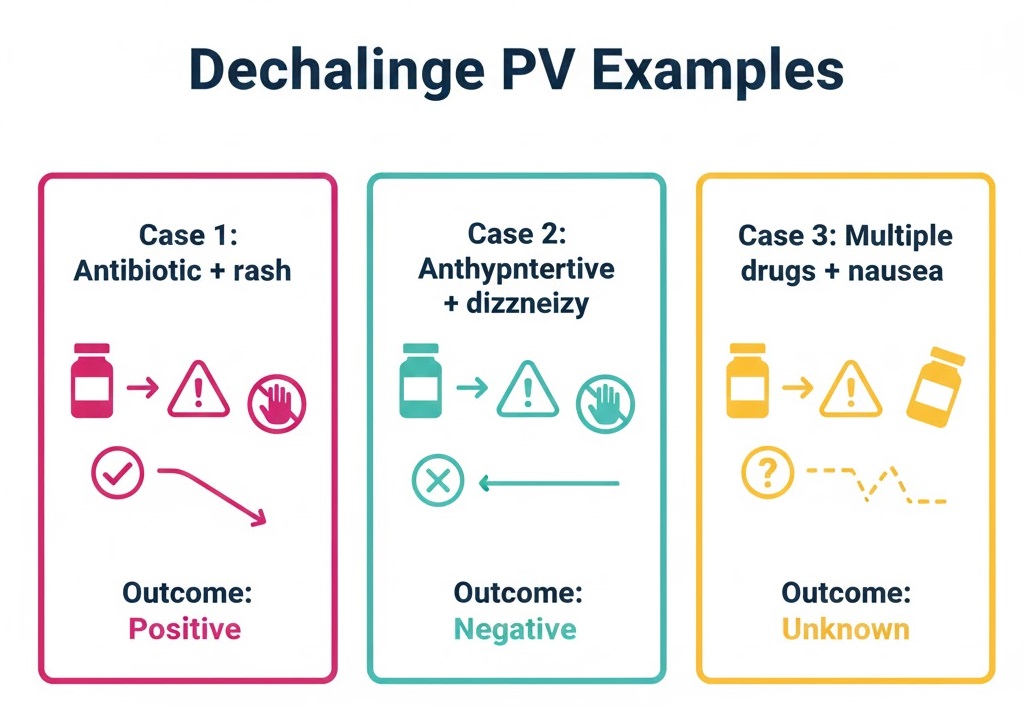
A patient starts amoxicillin and gets a rash. The rash fades after stopping, so you note positive dechallenge. Another patient takes metformin and feels nausea. The nausea continues after stopping, so you note negative dechallenge.

However, you still check timing, labs, and other medicines. Then you update the narrative with clear dates.

  • Rash improves after stopping antibiotic.
  • Dizziness persists after stopping antihypertensive.
  • ALT drops after stopping suspected hepatotoxic drug.


Stop The Suspect Drug, Then Track Symptom Improvement
Dechallenge PV Examples: Record Stop Date, Response Timing, And Alternative Causes

Final words

Dechallenge in pharmacovigilance means symptoms improve after you stop the suspect drug, in real cases. It supports ADR causality when timing and outcome match. Document the stop date, the event trend, and confounders in the ICSR narrative. Link it to rechallenge only when clinically justified; a restart that repeats the event strengthens evidence.

Quick recap: use dechallenge to clean up case logic and ask better follow-ups. For growth, follow a Pharmacovigilance Career Path focused on case processing and reporting. Indeed shows 47 pharmacovigilance jobs in Germany and an average €62,055 yearly salary.

FAQs:

1️⃣ What makes a dechallenge “positive,” “negative,” or “unknown”?

Positive: the event improves after stopping. Negative: it does not improve. Unknown: you lack stop dates, outcome dates, or the drug was not stopped

2️⃣ How do I document dechallenge in an ICSR?

Record the drug action (stopped/continued), dates, and reaction outcome. Then state the before/after change in the narrative. Also meet EU timelines: 15 days serious, 90 days non-serious.

3️⃣ What is the difference between dechallenge and rechallenge?

Dechallenge checks improvement after stopping. Rechallenge checks recurrence after restarting. WHO-UMC notes “Certain” often expects rechallenge evidence, while “Probable” does not.

References

Picture of Ershad Moradi
Ershad Moradi

Ershad Moradi, a Content Marketing Specialist at Zamann Pharma Support, brings 6 years of experience in the pharmaceutical industry. Specializing in pharmaceutical and medical technologies, Ershad is currently focused on expanding his knowledge in marketing and improving communication in the field. Outside of work, Ershad enjoys reading and attending industry related networks to stay up-to-date on the latest advancements. With a passion for continuous learning and growth, Ershad is always looking for new opportunities to enhance his skills and contribute to pharmaceutical industry. Connect with Ershad on Facebook for more information.

pharmaceutical analytical method development (
Method Validation in Pharma: 5 Steps to Accurate, GMP-Compliant Results in 2026

Method Validation in Pharma proves your analytical results stay accurate and GMP-ready in [year. First, you define scope, risk, and acceptance criteria. Then, you confirm specificity, accuracy, precision, and linearity. Next, you set LOD/LOQ and verify robustness under small method changes. Finally, you document everything for audits and stronger scientific rigor.

Read More »

Share