


Features
Topics
Discover

Unlock the potential of your career in the Pharma industry with our online courses and qualifications.

Career Path

Pick a career path, follow its guided course roadmap, and secure industry-verified credentials in a few months.

Courses

Earn career credentials from industry leaders that demonstrate your expertise.

Concurrent Validation in Pharma 2026 Guide: Meaning, Acceptance, and Execution Steps

Concurrent validation in pharma means you confirm process performance while manufacturing and releasing routine batches under a pre-approved protocol. WHO notes that at least 10% medicines in low- and middle-income countries are substandard or falsified, and countries spend about US$30.5 billion yearly on these products.

In this Pharma Validation guide, We’ll cover the rules (WHO GMP validation guidance), the justification package (risk assessment, supply urgency), and how to run it (CQA/CPP plan, sampling, enhanced monitoring, deviation handling, QA/QP disposition, and a final validation report that feeds CPV, with clear acceptance criteria and timelines).

Table of Contents

Concurrent Validation Meaning in Pharma

Concurrent validation checks a process during routine production, while you release batches. You use it when you must supply patients fast. QA leads the plan, and production follows it.

However, therefore, and also, you add extra controls and close monitoring. You document risks, define tests, and confirm results in a report. Then you update the control strategy and continue verification.

  • Plan 3 batches with clear acceptance criteria.
  • Set sampling points for CQAs and CPPs, then review data.
  • Log deviations fast, and start CAPA before the next run.
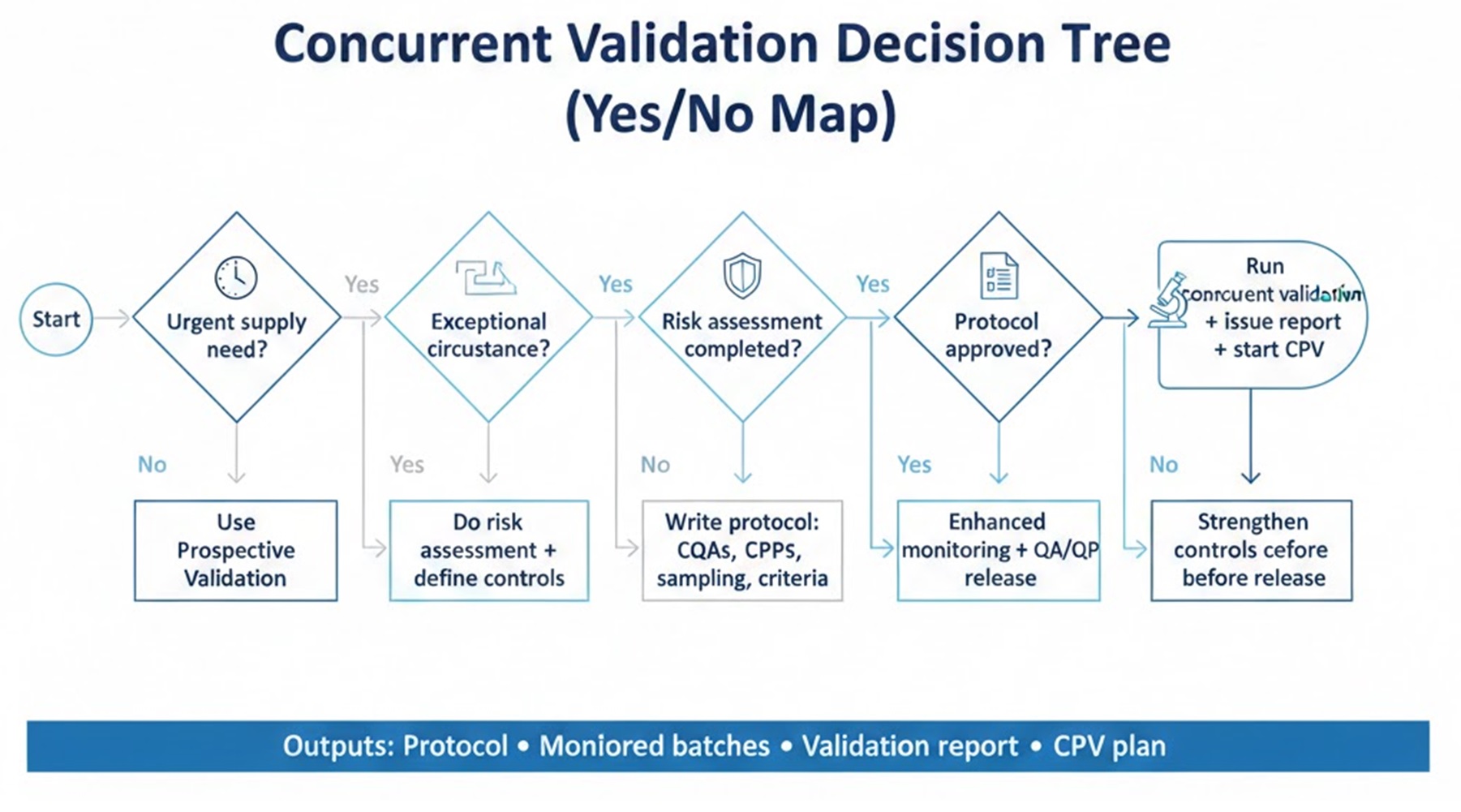
A fast Yes/No map to choose concurrent validation with confidence
Use urgency + risk to decide, then lock controls and document proof

Concurrent Validation Simple Explanation

Concurrent validation checks your process during real production. You make product and verify the process at once. You use it when urgent supply matters.

However, therefore, you add tighter controls and extra testing. You review results fast and decide batch release.

Use these comparisons to see how concurrent validation differs by timing, evidence, and release risk.

  • Concurrent validation vs prospective validation
  • Concurrent validation vs retrospective validation

Concurrent vs Prospective vs Retrospective (Purpose, Timing, Risk, Evidence)

Type Purpose Timing Risk
Prospective
Prove before use
Before routine
Low
Concurrent
Prove during use
During routine
Med–High
Retrospective
Prove from history
After production
High

Concurrent Validation vs Prospective Validation

Prospective validation proves the process before routine commercial release. Concurrent validation proves the process during routine production. You choose based on supply urgency and risk. Most firms prefer prospective validation.

However, therefore, concurrent validation needs tighter controls and faster review.

  • Prospective: qualify process, then release routinely.
  • Concurrent: release with extra testing and oversight.

Concurrent Validation vs Retrospective Validation

Concurrent validation uses real-time data from planned commercial batches. Retrospective validation reviews past batch records and trends. You use concurrent validation when supply matters and you need proof now.

However, therefore, retrospective validation fits stable legacy processes with strong history. Plan concurrent batches with predefined acceptance criteria.

  • Concurrent: define sampling, tests, and review steps before manufacturing.
  • Retrospective: analyze historical CQAs, CPPs, deviations, and capability trends.

Core Terms Used in Pharma Validation Documents

Validation documents use shared terms to keep teams aligned. For example, the VMP sets the site validation strategy. Then protocols define scope, tests, and acceptance criteria. Reports summarize results, deviations, and conclusions.

However, therefore, you must define technical terms consistently.

CQAs describe critical product quality needs.

CPPs control process conditions that impact CQAs.

IPC describes checks during production.

CAPA fixes root causes and prevents repeats.

CPV tracks ongoing performance after validation.

Protocol Requirements vs Evidence Produced (Document → Output)

Protocol requirements (Document) Evidence produced (Output)
Objective + scope
Approved protocol with version control and signatures
Product + process description
Process flow map and defined unit operations
Equipment and utilities list
Qualified equipment list with IQ/OQ references
Roles and responsibilities
Named owners for execution, QA review, and release
CQA list and targets
CQA table linked to specs and test methods

Concurrent Process Validation Protocol IQ OQ PQ Linkage

A good protocol links IQ, OQ, and PQ to one validation story. It shows installed equipment, tested functions, and proven performance. Then it protects product quality.

Therefore, build clear linkages in your protocol.

  • IQ confirms installation, utilities, and calibration readiness.
  • OQ verifies alarms, ranges, and controls for key functions.
  • PQ confirms CQAs during routine runs with defined sampling.
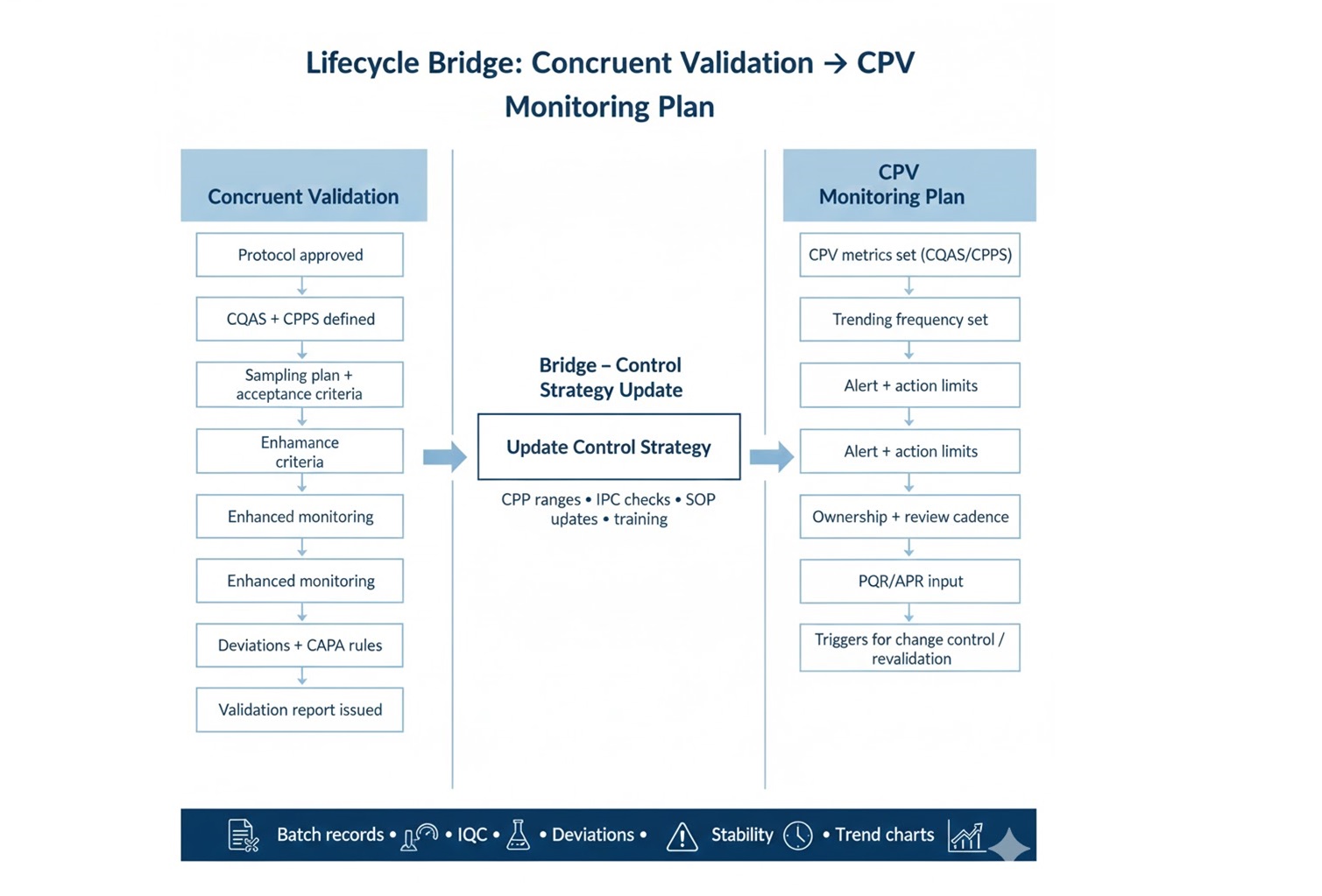
Bridge Stage 2 results to Stage 3 trending, limits, and action triggers
Lifecycle Bridge: Concurrent Validation → CPV (Stage 3) Monitoring Plan

Concurrent Validation Approaches

Concurrent validation runs during routine production under extra controls. You use it when supply urgency prevents waiting. You still follow a written protocol and defined criteria.

You can apply a standard, enhanced, or staged approach. Standard uses normal tests plus added sampling. Enhanced adds tighter ranges, more IPC, and faster QA review. Staged starts with limited release while data grows.

  • Standard: stable process, low risk, clear history.
  • Enhanced: higher risk, narrow CPP ranges, added monitoring.
  • Staged: urgent supply, partial release, then expand with evidence.

Worst Case Approach Concurrent Validation

Worst-case concurrent validation tests your process at limit settings. It proves control. You pick high-risk CPPs and run at limits. You track CQAs.

  • Use max batch size and longest hold time.
  • Use worst raw material lots and tight ranges.
  • Review trends fast and start CAPA.

Bracketing Matrixing Concurrent Validation

Bracketing and matrixing reduce testing while you keep coverage. Bracketing tests the extremes, like smallest and largest batch size. Matrixing tests selected combinations of factors, not every combination. You still protect CQAs and control CPPs.

However, therefore, use bracketing and matrixing only with strong risk logic. Define factors, groups, and sampling upfront. Then justify why skipped runs add low risk. Confirm trends during each concurrent batch and expand testing if results drift.

Final Words

This guide explains concurrent validation in pharma using the ICH lifecycle approach. It splits the work into 3 parts: rules, justification, and execution steps today. ICH Q8(R2) builds product and process understanding, and ICH Q9(R1) drives risk-based decisions. ICH Q10 connects validation to a Pharmaceutical Quality System with 4 elements and 2 enablers.

Final words: use it only with strong justification, tight controls, and fast QA review. Start here checklist: 1) define CQAs/CPPs, 2) write a protocol and criteria, 3) run monitored batches, 4) trend results in CPV, 5) manage post-approval changes using ICH Q12.

FAQs:

1️⃣ What is concurrent validation in pharma?

Concurrent validation means you collect validation evidence during routine production and you may release batches while you run the protocol, in exceptional cases.

2️⃣ When do regulators accept concurrent validation?

Regulators accept it only in exceptional circumstances, such as limited or infrequent batches or strong patient need. You must justify it, and you must document the decision and controls in your validation system.

3️⃣ How do you release batches safely during concurrent validation?

You define strict acceptance criteria, add enhanced sampling and monitoring, and run fast QA review for deviations and trends. Then you document the outcome in a validation report and feed learning into ongoing verification.

References

Picture of Ershad Moradi
Ershad Moradi

Ershad Moradi, a Content Marketing Specialist at Zamann Pharma Support, brings 6 years of experience in the pharmaceutical industry. Specializing in pharmaceutical and medical technologies, Ershad is currently focused on expanding his knowledge in marketing and improving communication in the field. Outside of work, Ershad enjoys reading and attending industry related networks to stay up-to-date on the latest advancements. With a passion for continuous learning and growth, Ershad is always looking for new opportunities to enhance his skills and contribute to pharmaceutical industry. Connect with Ershad on Facebook for more information.

Share