


Reliable analytical data drives every major decision in the pharmaceutical industry. QC teams rely on well-designed methods to release batches, investigate deviations, confirm stability trends, and maintain GMP compliance. Because of this, method validation remains one of the most critical scientific responsibilities inside the laboratory—ensuring that every reported value reflects true analytical performance rather than noise or uncontrolled variation.
Industry reviews continue to show that more than 60% of QC deviations stem from weak, poorly controlled, or insufficiently monitored analytical procedures. This is exactly why strong validation practices matter now more than ever. In this guide, you will learn what method validation in pharma involves, why it forms the backbone of GMP operations, and how teams apply a practical five-step validation framework in 2026. There is also an aspect discussed in Pharma Validation that highlights how lifecycle management and continuous performance verification strengthen long-term data reliability.
Table of Contents
What Is Method Validation in Pharma?
A validated analytical method shows that the procedure performs reliably under defined conditions. It demonstrates the method’s ability to measure identity, potency, purity, and overall quality with consistency. When the validation is done properly, the resulting data can be confidently used by QA, QC, and regulatory teams across development and commercial manufacturing.
Purpose of Method Validation
A validated method helps QC teams:
- generate accurate results
- maintain stable precision over time
- distinguish analytes from impurities or excipients
- withstand normal day-to-day variation
- create complete, traceable data packages that meet GMP expectations
Together, these objectives support analytical reliability across the entire product lifecycle.
Regulatory Basis for Method Validation in Pharma
Because analytical results influence regulatory decisions, global authorities require pharmaceutical companies to validate methods using harmonized scientific standards. Although regional guidance varies slightly, the core principles remain fully aligned.
Regulation Summary Table
| Regulatory Source | Key Focus | Why It Matters |
|---|---|---|
|
ICH Q2 (R1/R2) |
Validation characteristics & study design |
Global benchmark for method validation |
|
FDA Guidance |
Documentation, robustness, data integrity |
Critical for U.S. inspections and submissions |
|
EU GMP + EMA |
Risk-based validation & lifecycle management |
Ensures long-term method reliability |
|
USP & |
Compendial method validation & system suitability |
Supports standardized QC performance |
ICH Q2 Overview
ICH Q2 outlines core validation parameters such as accuracy, precision, specificity, linearity, range, detection limits, quantitation limits, and robustness. It also describes how teams assess these values statistically. Because ICH is accepted globally, many companies build their entire validation system around this guideline.
FDA Expectations
FDA inspectors review validation data with a strong focus on scientific justification and data integrity. They expect teams to:
- design and approve validation protocols in advance
- capture complete raw data traceability
- justify acceptance criteria scientifically
- run adequate robustness tests
- define system suitability limits
- document analyst training and execution
Strong FDA alignment reduces inspection risks and increases regulatory confidence.
EU Guidelines
The European Medicines Agency (EMA) follows ICH principles and adds lifecycle and risk-based thinking. EU GMP Annex 15 highlights:
- scientific justification of method ranges
- documented risk assessments
- monitoring of performance over time
This ensures methods remain reliable across development, tech transfer, and commercial manufacturing.
USP Requirements
USP general chapters provide clarity on compendial validation, system suitability expectations, and acceptable method performance limits. These standards help QC laboratories maintain consistency, especially when running global testing networks.
Analytical Validation: Key Parameters in Pharmaceutical Method Development
A strong validation program evaluates several scientific characteristics that define how a method behaves in real laboratory conditions. These parameters ensure long-term reproducibility and protect the quality of analytical decisions.
Parameter Summary
| Parameter | Meaning | Impact |
|---|---|---|
|
Accuracy |
Agreement with the true value |
Prevents potency and assay misinterpretation |
|
Precision |
Repeatability + reproducibility |
Ensures consistent results across analysts and days |
|
Specificity |
Ability to measure analyte without interference |
Required for impurity + degradation studies |
|
Robustness |
Stability under small changes |
Maintains predictable performance in QC workflows |
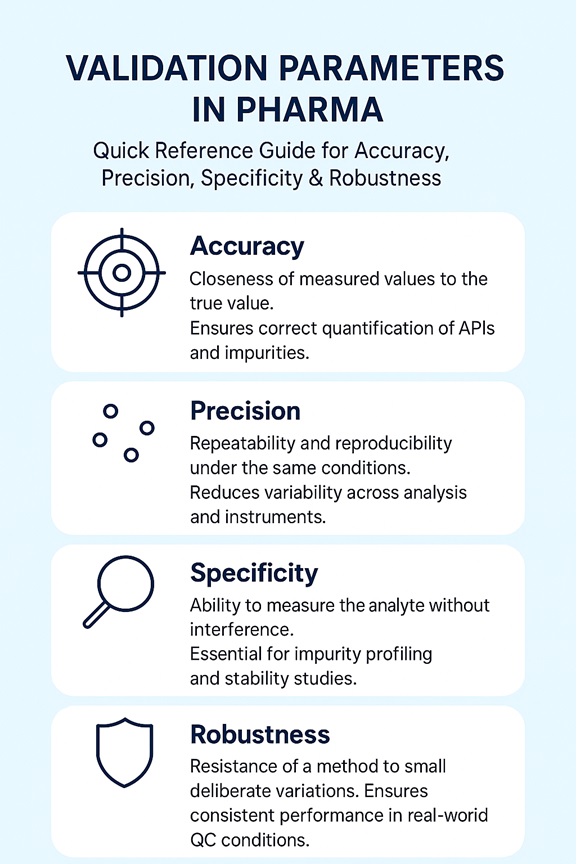
Accuracy, Precision, Specificity, Robustness
Accuracy
Accuracy shows how close a result is to the true value. Analysts use recovery studies or reference standard comparisons to confirm it. When values remain within expected ranges, teams trust their potency and assay results.
Precision
Precision reflects how consistently the method performs. Teams evaluate it under repeatability and intermediate precision conditions. Low variability strengthens confidence in day-to-day QC results.
Specificity
Specificity ensures that the method separates the analyte from impurities, excipients, and degradants. This matters especially in impurity profiling and stability-indicating methods.
Robustness
Robustness demonstrates how well the method tolerates small changes such as shifts in temperature, pH, flow rate, or wavelength. Robust methods continue to perform reliably across real-world QC environments.
5 Essential Steps in Pharmaceutical Industry for an Accurate Method Validation
Now let’s explore the five-step process that QC and QA teams rely on in 2026.
1. Define the Purpose and Validation Scope
A clear scope sets the foundation for the entire validation. Teams define:
- method type
- intended use
- analytical range
- matrix and sample characteristics
- acceptance criteria
Strong planning reduces rework and supports efficient study design.
2. Align with Regulations and Guidelines
Teams compare their plan with ICH Q2, FDA expectations, EMA requirements, and USP chapters. This alignment ensures global consistency and protects the method during regulatory reviews.
3. Evaluate Validation Parameters
Analysts run structured experiments to evaluate:
- accuracy
- precision
- linearity & range
- specificity
- LOD & LOQ
- robustness
They also define system suitability tests to maintain performance once the method enters routine QC.
4. Perform Experiments Under Controlled Conditions
Teams execute validation under standardized conditions. They control:
- sample preparation
- reference standards
- instrument calibration
- environmental factors
- injection orders
Controlled execution reduces variation and strengthens data quality.
5. Complete Documentation and Approve the Validation Report
A complete validation package includes:
- raw data
- statistical results
- acceptance criteria comparisons
- documented deviations
- scientific conclusions
- QA approval
The final report provides a complete, inspection-ready record of method suitability.

Final words
Accurate analytical results form the foundation of pharmaceutical quality. Strong validation reduces deviations, supports regulatory compliance, and strengthens scientific decisions. Industry case studies show that well-designed validation programs can reduce analytical errors by 50% or more. As pipelines expand in 2026, companies that invest in strong practices for method validation in pharma gain faster release cycles, stronger inspection outcomes, and higher analytical confidence.
FAQs:
Our goal is to ensure the method consistently delivers reliable data for QC release, stability work, and compliance with ICH expectations.
Identity checks can be completed within days, while assays or impurity methods—due to precision, linearity, and robustness work under ICH Q2—may require several weeks.
Yes, any method supporting release testing, stability studies, or dossier submissions must be validated in line with GMP and ICH requirements.
Typically during GMP periodic review cycles or whenever significant changes occur in instrumentation, materials, or process conditions.
Validation defines the full performance profile of a new method, while verification confirms that a compendial procedure performs suitably within the lab’s own GMP-controlled setup.
References

Mahtab Shardi
Mahtab is a pharmaceutical professional with a Master’s degree in Physical Chemistry and over five years of experience in laboratory and QC roles. Mahtab contributes reliable, well-structured pharmaceutical content to Pharmuni, helping turn complex scientific topics into clear, practical insights for industry professionals and students.

Pharma Jobs in Sydney in 2026: Salary, GMP and Hiring Trends
Sydney’s pharmaceutical sector continues to expand under strict TGA GMP inspection trends and PIC/S compliance Australia alignment. This article analyzes regulatory hiring growth, salary positioning, and compliance-driven career opportunities across manufacturing, quality assurance, and regulatory functions.

Quality Control (QC) in Pharma Industry: Top Strategies, Tests & Insights in 2026
Quality Control (QC) in the pharmaceutical industry is a vital process that ensures medicines meet stringent safety and quality standards. By detecting defects and contamination early, QC protects patients and supports regulatory compliance worldwide. Implementing strong QC systems safeguards the integrity and trustworthiness of pharmaceutical products.

Pharma Jobs in Melbourne in 2026: GMP Inspection and Salary Trends
Melbourne’s pharmaceutical sector continues to expand under strict TGA oversight. This analysis explores pharmaceutical manufacturing jobs Victoria, GMP inspection trends, salary benchmarks, and regulatory qualification pathways shaping compliance-driven career growth across sterile and biotech operations.