


Features
Topics
Discover

Unlock the potential of your career in the Pharma industry with our online courses and qualifications.

Career Path

Pick a career path, follow its guided course roadmap, and secure industry-verified credentials in a few months.

Courses

Earn career credentials from industry leaders that demonstrate your expertise.

CIOMS in Pharmacovigilance: A Complete 2025 Guide

Harmonized safety reporting is not just a regulatory expectation it’s the backbone of modern drug safety. According to WHO estimates, more than 40% of global adverse event reports are rejected or delayed due to inconsistent data quality.

This fragmentation creates gaps in signal detection and slows down patient access to safe therapies. The need for unified standards is precisely why the Council for International Organizations of Medical Sciences CIOMS became a cornerstone of global pharmacovigilance practice. For anyone entering drug safety for the first time, understanding CIOMS is as fundamental as learning the definition of ICSR or seriousness criteria.
To learn more about the discipline itself, see Pharmacovigilance.

Table of Contents

What Is CIOMS in Pharmacovigilance?

CIOMS is an international council formed to develop globally aligned drug-safety guidance, shaping how companies report adverse events, assess causality, manage signals, and communicate risks across regulatory systems.

Origins of CIOMS: WHO–UNESCO Collaboration

Founded in 1949 through a collaboration between WHO and UNESCO, CIOMS initially focused on ethics and biomedical research but quickly evolved into a leading driver of unified drug-safety principles. Its mandate was simple yet ambitious: establish globally applicable frameworks that reduce variability across countries and improve the quality of safety data.

CIOMS and the Foundations of Modern Pharmacovigilance

Some of the earliest CIOMS outputs introduced the very terminology now considered standard in drug safety. Concepts such as structured case reporting, harmonized seriousness criteria, and causality assessment approaches trace their roots back to CIOMS Working Groups. These foundational principles continue to influence global systems, including E2B(R3), MedDRA terminology use, and modern risk-evaluation strategies.

CIOMS Working Groups

CIOMS Working Groups (WGs) bring together regulators, industry experts, academics, and international organizations to develop harmonized guidance. Their publications often become reference documents not only for companies but also for regulators across Europe, the U.S., and emerging markets.

Early Working Groups: Terminology & Causality

The early WGs shaped essential components of pharmacovigilance practice, including:

  • Standardized reporting formats
  • Early causality frameworks
  • Definitions of seriousness and expectedness
  • Recommendations for post-marketing surveillance

These deliverables helped establish consistency at a time when safety reporting practices differed dramatically between countries.

Modern Working Groups: Signal & Risk Management

More recent WGs have focused on high-impact areas such as:

  • Signal detection and prioritization
  • Vaccine pharmacovigilance
  • Benefit–risk communication
  • Risk-management planning (RMP)
  • Real-world evidence in safety evaluation

Their guidance documents continue to shape how companies structure safety governance systems, perform signal detection, and communicate benefit-risk outcomes.

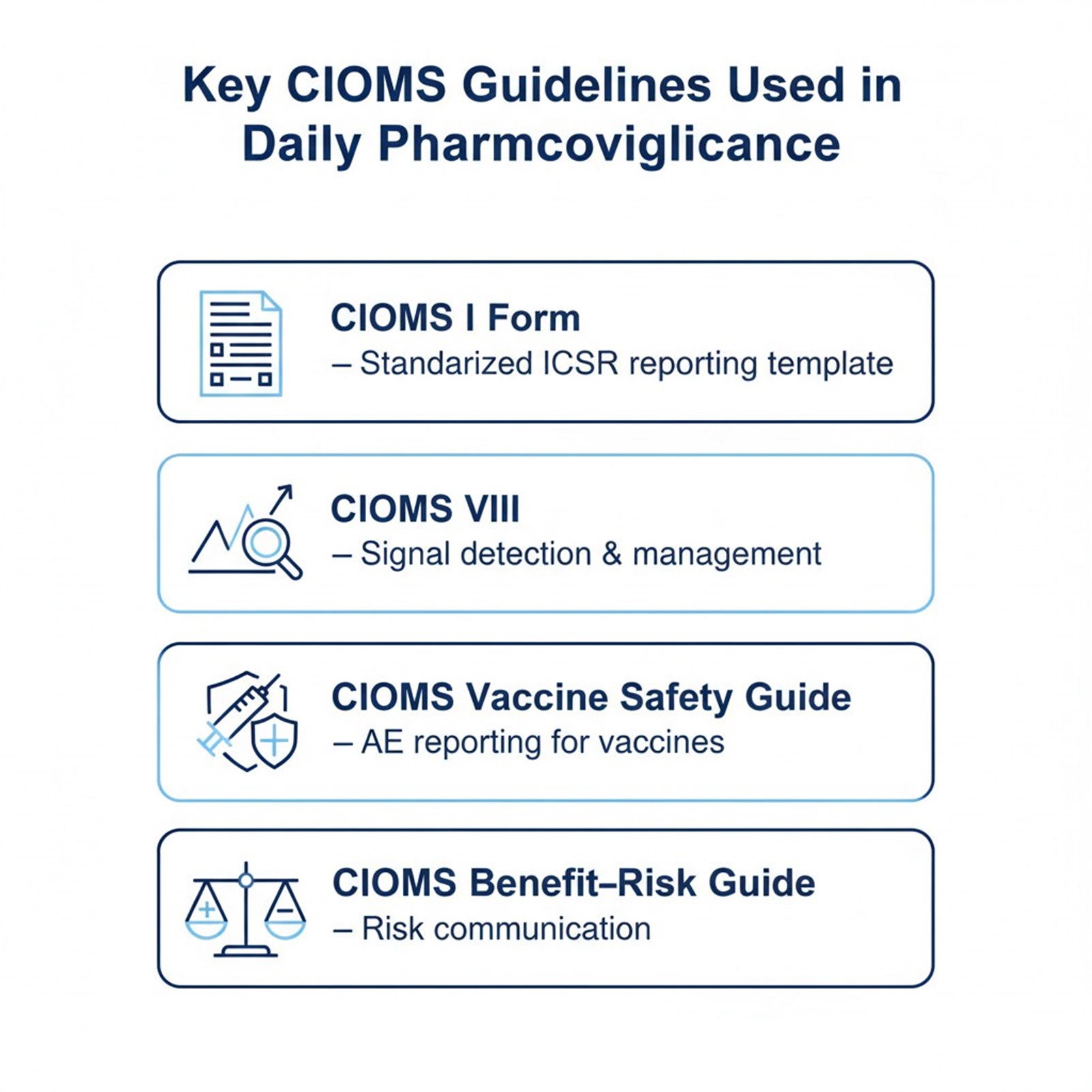
Key CIOMS Guidelines Used Daily

Below is a simplified table of CIOMS documents commonly used in routine PV operations:

CIOMS Guidance Purpose Used By
CIOMS I Form
Standardized ICSR reporting template
Safety specialists, QPPVs
CIOMS VIII
Signal detection & management
Safety scientists, epidemiology teams
CIOMS on Vaccine Safety
Standardized vaccine adverse event reporting
Vaccine manufacturers, regulatory bodies
CIOMS Benefit–Risk
Communication of RMP and safety decisions
Cross-functional safety teams

These deliverables continue to influence how safety teams operate globally—even decades after publication.

Key CIOMS guidelines shape daily PV work, from ICSR to signal review.
Use these CIOMS guidelines daily to stay consistent, audit-ready, and clear.

CIOMS in Daily Pharmacovigilance Practice

In day-to-day drug-safety work, CIOMS guidance appears everywhere: in the questions safety specialists ask when validating a case, the structure of case narratives, the way medical reviewers assess causality, and even in how companies escalate potential signals. The influence is so embedded that many professionals use CIOMS frameworks without realizing their origin.

The CIOMS Form

In day-to-day drug-safety work, CIOMS guidance appears everywhere: in the questions safety specialists ask when validating a case, the structure of case narratives, the way medical reviewers assess causality, and even in how companies escalate potential signals. The influence is so embedded that many professionals use CIOMS frameworks without realizing their origin.

CIOMS Influence on E2B(R3)

Many principles in today’s electronic ICSR format—E2B(R3)—derive from earlier CIOMS recommendations, such as:

  • Standardized data elements
  • Clear definitions of mandatory fields
  • Structured narratives
  • Consistent seriousness attributes

By aligning on these fundamentals early, CIOMS accelerated global adoption of harmonized digital safety-reporting standards.

CIOMS & Global Regulators (EMA, FDA, ICH, WHO)

Regulators worldwide frequently reference CIOMS work when updating guidance or evaluating new safety systems. For example:

  • EMA’s GVP Modules share strong parallels with CIOMS signal-management guidance.
  • FDA uses CIOMS principles to harmonize ICSR expectations for global manufacturers.
  • WHO incorporates CIOMS vaccine-safety frameworks in its international training programs.

This alignment ensures companies can operate globally with fewer discrepancies in reporting requirements.

Why CIOMS Matters for PV Careers

For students, job-seekers, and early-career safety specialists, understanding CIOMS provides a measurable competitive advantage. Recruiters consistently look for candidates who can:

  • Interpret causality frameworks
  • Structure high-quality narratives
  • Apply signal-management principles
  • Understand benefit–risk communication

CIOMS frameworks help candidates demonstrate maturity in safety reasoning—especially during interviews.

CIOMS Topics in PV Interviews

Candidates are often asked about:

  • The purpose of the CIOMS I form
  • Seriousness criteria and case-classification logic
  • Signal detection basics
  • Causality-assessment principles
  • The role of CIOMS in harmonization

A clear understanding of these areas instantly distinguishes strong applicants.


CIOMS and Safety-Data Quality

Using CIOMS principles improves:

  • Narrative clarity
  • Medical relevance
  • Standardized coding
  • Case-processing consistency

This is why CIOMS in pharmacovigilance remains central to global safety operations.

Final words

CIOMS remains a cornerstone of global drug safety. Today, more than 150 regulators worldwide apply CIOMS-aligned principles, and companies using these frameworks report up to 35% fewer ICSR data-quality issues, leading to faster signal detection and smoother audits.

For job-seekers, the advantage is real: in 2024, over 60% of PV job postings specifically mentioned CIOMS-related skills from causality logic to structured case narratives. Understanding CIOMS helps candidates stand out, communicate more clearly, and integrate quickly into safety teams.

To see how this knowledge supports long-term career growth, explore the Pharmacovigilance Career Path

FAQs:

1️⃣ Is CIOMS legally binding?

No. CIOMS guidance is not legally binding, but regulators and companies worldwide use it as a practical reference to shape policy and daily safety operations.

2️⃣ Does CIOMS replace ICH guidelines?

No. CIOMS complements ICH by offering detailed, consensus-based frameworks that support harmonized implementation.

3️⃣ Why do some companies still use the CIOMS form?


Because it remains a globally recognizable, structured ICSR template—especially in regions without full E2B(R3) implementation.

References

Picture of Mahtab Shardi

Mahtab Shardi

Mahtab is a pharmaceutical professional with a Master’s degree in Physical Chemistry and over five years of experience in laboratory and QC roles. Mahtab contributes reliable, well-structured pharmaceutical content to Pharmuni, helping turn complex scientific topics into clear, practical insights for industry professionals and students.

CIOMS in Pharmacovigilance: A Complete 2025 Guide

CIOMS guidelines help pharmacovigilance teams report, assess, and share safety data consistently. They support clear case processing, signal detection, and periodic reporting across regions. Use CIOMS forms and standards to reduce errors, align with regulators, and improve patient safety decisions.

Read More »
Market Access in pharma
Market Access Pharma Courses: Skills, Frameworks & Real-World Applications (2025 Guide)

Market access decides whether patients can actually get a medicine. So, it blends value evidence, pricing logic, reimbursement, and stakeholder alignment. In this blog, you will learn the core market access skills, the main frameworks used in pharma, and how teams apply them in real launches. You will also see how HEOR, payer needs, and local policy rules shape access decisions. Finally, you will learn how structured Market Access Pharma Courses turn theory into practical, job-ready capability.

Read More »

Share