


Features
Topics
Discover

Unlock the potential of your career in the Pharma industry with our online courses and qualifications.

Career Path

Pick a career path, follow its guided course roadmap, and secure industry-verified credentials in a few months.

Courses

Earn career credentials from industry leaders that demonstrate your expertise.

Market Access Pharma Courses: Skills, Frameworks & Real-World Applications (2025 Guide)

How did reimbursement challenges grow so sharply that they now account for 47% of all delayed drug launches in Europe nearly double the rate a decade ago?
With more than 70 active HTA systems worldwide, a 35% increase in payer evidence requirements over the past five years, and oncology treatments now exceeding €92,000 per patient per year, payers are scrutinizing value with unprecedented intensity. As a result, the need for professionals who can navigate the economics, policy frameworks, and pricing dynamics behind access decisions has expanded dramatically.

This surge in complexity explains why interest in market access pharma courses has accelerated across students, early-career analysts, and cross-functional pharma teams seeking structured pathways into one of the industry’s most strategically important functions. For those exploring the learning landscape, the Pharma Courses page offers a curated view of essential training opportunities.

Table of Contents

What Is Market Access in Pharma?

Market access ensures that patients receive therapies that are not only clinically meaningful but also economically justified and approved by healthcare systems within an acceptable timeframe. Situated at the intersection of science, economics, and policy, market access requires both analytical strength and narrative clarity shaping evidence into arguments that resonate with payers.

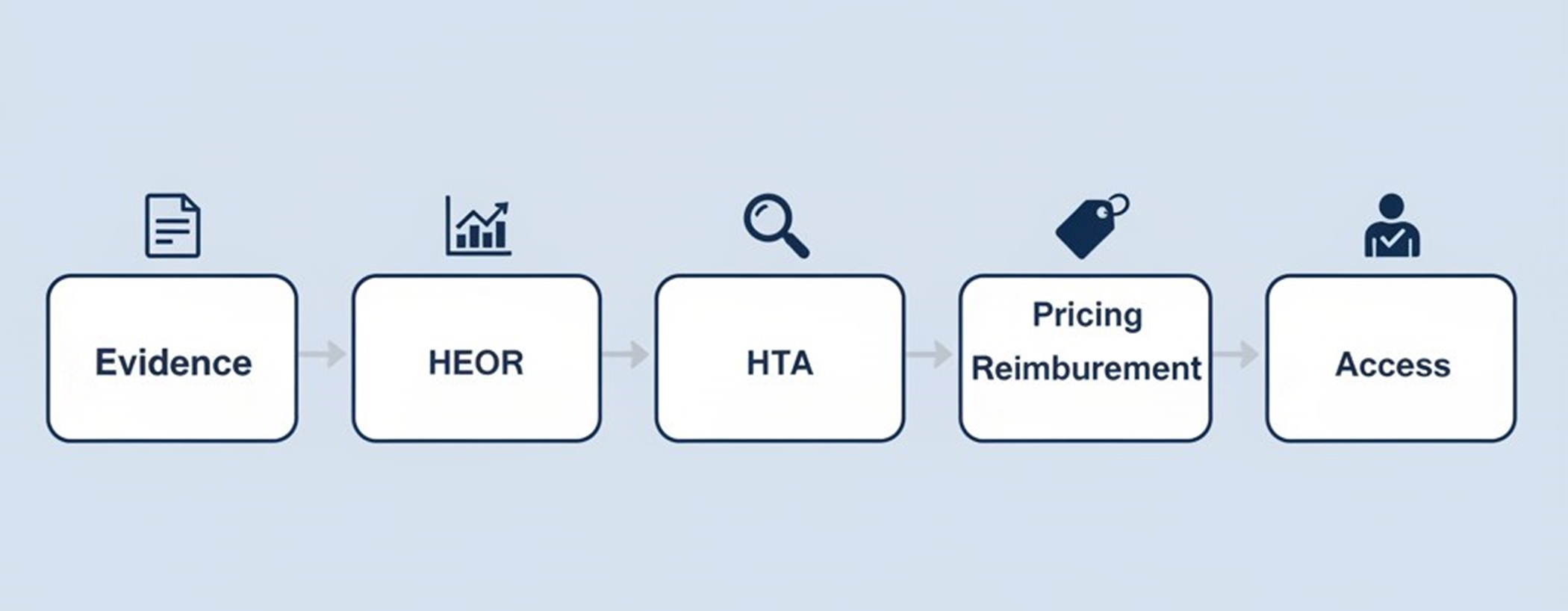
In practice, market access spans HTA submissions, reimbursement strategy, pricing decisions, formulary inclusion, and value communication. It’s a discipline built on translating clinical research into payer-relevant insights that explain why a therapy deserves to be covered, how it will impact budgets, and what value it delivers compared to alternatives.

How Market Access Connects to HEOR & Pricing Strategy

Modern market access work depends heavily on HEOR, because payers increasingly demand transparent, quantitative evidence to justify reimbursement decisions. This is why market access pharma courses often emphasize an integrated understanding of health economics, modelling frameworks, and real-world data.
Tools like cost-effectiveness analysis (CEA), budget impact analysis (BIA), ICER thresholds, QALYs, and RWE help payers evaluate whether a therapy improves outcomes enough to warrant its price. Pricing teams rely on these same insights to determine launch price, shape negotiation strategies, and navigate mechanisms such as ERP and tendering.
Market access, HEOR, and pricing now function less like separate departments and more like interdependent components of a single value engine.

Why Market Access Skills Are in High Demand

The last five years have transformed the global market access landscape. More than 70 countries now use structured HTA processes, biosimilars continue to intensify price competition, and policy reforms—especially the EU’s 2025 HTA regulation—are raising evidence expectations across borders.

Meanwhile, specialty medicines account for 55% of global pharma spending, pushing payers to scrutinize value even more aggressively. This environment has driven a significant rise in demand for professionals who can integrate scientific, economic, and policy thinking into cohesive access strategies. As a result, market access pharma courses are no longer optional—they are foundational.

Types of Market Access Pharma Courses

  1. Foundation Courses

These courses give learners a solid grounding in HTA principles, payer decision-making, introductory pricing concepts, and the fundamentals of HEOR. They are ideal for students and newcomers transitioning from areas like clinical research or regulatory affairs.

  1. Advanced Market Access & HEOR Courses

Advanced programs focus on model-building, uncertainty analysis, ICER interpretation, and real casework. Learners often draft segments of HTA dossiers, work through NICE or HAS appraisals, and build CEA/BIA models—making these courses essential for analytical or strategy-oriented roles.

  1. Pricing & Reimbursement Programs

Pricing courses dive into ERP, tendering behaviors, value-based pricing, discount negotiations, and country-specific launch sequencing. They help learners understand how pricing strategies must adapt to payer constraints and market pressures.

  1. Specialized Micro-Modules

Micro-modules provide targeted skill-building in areas like evidence mapping, payer communication, RWE interpretation, value story development, and objection handling. They are ideal for professionals seeking rapid, applied upskilling without long course commitments.

Explore types of Market Access Pharma Courses and pick your fastest skill path.
From pricing to reimbursement, compare course types that match your role

Who Should Enroll in Market Access Courses?

Market access attracts a broad spectrum of learners because it intersects with so many functions across the industry. Students, analysts, medical professionals, pricing teams, and regulatory specialists all benefit from structured training.

Learner Group Motivation
Students & Graduates
Gaining foundational skills to enter analytical roles
HEOR Newcomers
Applying economic models to real-world payer decisions
MA/RA Professionals
Strengthening strategic thinking and payer negotiation
Pricing Teams
Understanding reimbursement constraints and launch sequencing
Clinicians & Medical Experts
Translating clinical data into payer-relevant value

This diversity highlights why market access pharma courses have become essential across modern biopharma.

How to Choose a High-Quality Market Access Course

A strong market access course should feel practical, not abstract. Look for programs taught by professionals with real industry experience—people who have negotiated with payers, built models, or authored HTA submissions.

The strongest indicators of quality include:

  • Real casework, such as NICE or AMNOG assessments
  • Hands-on modelling exercises
  • Templates and tools, such as value story frameworks or evidence matrices
  • Up-to-date content, aligned with the EU’s changing HTA landscape

When evaluating a course, ask: Will this program give me demonstrable skills, not just theoretical knowledge? If the answer is yes, you’re on the right track.

Final words

From 2021 to 2024, job postings for market access roles in Europe grew by 32%, underscoring the rising strategic importance of pricing, evidence, and reimbursement. As more countries adopt HTA processes and payers intensify their scrutiny of value, professionals who invest now in structured training will lead the conversations that shape access in the coming decade.

To explore structured pathways and upskill with confidence, visit PharmUni’s explore pharma courses page. In an environment where evidence expectations evolve rapidly, continuous learning isn’t just beneficial—it’s essential.

FAQs:

1️⃣ What does a market access role involve?


It blends evidence generation, pricing strategy, reimbursement planning, and payer negotiation.

2️⃣ Which skills matter most?

HTA literacy, modelling awareness, RWE interpretation, value communication, and pricing logic.

3️⃣ How is HEOR different from market access?


HEOR generates economic evidence; market access uses that evidence to influence reimbursement outcomes.

References

Picture of Mahtab Shardi

Mahtab Shardi

Mahtab is a pharmaceutical professional with a Master’s degree in Physical Chemistry and over five years of experience in laboratory and QC roles. Mahtab contributes reliable, well-structured pharmaceutical content to Pharmuni, helping turn complex scientific topics into clear, practical insights for industry professionals and students.

Market Access in pharma
Market Access Pharma Courses: Skills, Frameworks & Real-World Applications (2025 Guide)

Market access decides whether patients can actually get a medicine. So, it blends value evidence, pricing logic, reimbursement, and stakeholder alignment. In this blog, you will learn the core market access skills, the main frameworks used in pharma, and how teams apply them in real launches. You will also see how HEOR, payer needs, and local policy rules shape access decisions. Finally, you will learn how structured Market Access Pharma Courses turn theory into practical, job-ready capability.

Read More »

Share