


Features
Topics
Discover

Unlock the potential of your career in the Pharma industry with our online courses and qualifications.

Career Path

Pick a career path, follow its guided course roadmap, and secure industry-verified credentials in a few months.

Courses

Earn career credentials from industry leaders that demonstrate your expertise.

Pharmaceutical Water Validation: A Practical and Regulatory-Focused Guide in 2025

Have you ever faced a deviation that could have been prevented if your team had stronger pharmaceutical water validation in place? If you’ve spent any time in GMP environments, you know how often water quietly becomes the root cause of costly issues. A global injectable manufacturer reported that 28% of its critical deviations over three years were linked to water system performance—not catastrophic failures, but subtle trend shifts.

A striking 2024 example illustrates this clearly: a biotech site experienced a 2.3 °C weekend drop in its WFI loop. Microbial results still met limits (1 CFU/100 mL), yet the event triggered an 11-day investigation, delayed three batches, and cost over $170,000. No contamination was found—the issue was a circulation pump running below nominal speed. A robust validation and trending strategy would have detected the drift long before it became a deviation.

In GMP manufacturing, water may appear simple—but it behaves like a highly sensitive, tightly controlled utility. For students, QA/QC professionals, and validation engineers preparing for international roles, understanding pharmaceutical validation is not optional—it is essential.

Table of Contents

What Is Pharmaceutical Water Validation

Pharmaceutical water validation is the structured, documented process of proving that a water generation, storage, and distribution system consistently produces water meeting predefined microbial, chemical, and endotoxin criteria. Modern validation goes beyond static testing; it evaluates how the system behaves under routine use, low-flow conditions, seasonal feed-water variation, maintenance cycles, and sanitization routines.

A validated system must demonstrate:

Consistency

Stable water quality despite fluctuations in production load, environmental conditions, and feed-water characteristics.

Control

Design and operation mitigate risks such as biofilm formation, dead-leg stagnation, RO membrane decay, O-ring deterioration, and TOC or conductivity drift.

Compliance

Alignment with USP <1231>, EP monographs, and WHO TRS expectations—not just during PQ, but throughout the system’s lifecycle.

Veteran QA managers often say: “You don’t validate the water; you validate the system’s behavior across time.”

Why Water Quality Matters in GMP

Water participates in formulation, equipment rinsing, CIP, buffer/media preparation, and sterile manufacturing. Because it touches almost everything, deviations can escalate rapidly.

Industry data highlights:

  • Biofilm formation can begin within 6–12 hours when flow <0.7 m/s.
  • WFI loops dipping from 80 °C to ~70 °C—even briefly—show increased microbial recovery.
  • Sampling errors cause over 60% of microbial excursions during PQ.
  • Slow TOC drift often reflects membrane fatigue or sanitization inefficiency.
  • CO₂ ingress raises conductivity in low-use outlets.

Understanding these behaviors is crucial for validating pharmaceutical water systems effectively.

Regulatory Definitions (USP, EP, WHO)

Despite regional differences, all authorities expect lifecycle control and documented system understanding.

  • USP <1231> emphasizes quality attributes; RO, RO-EDI, and distillation are acceptable technologies.
  • EP now permits RO-EDI for WFI when supported by validated microbial control and risk assessments.
  • WHO TRS provides practical, risk-based guidance adaptable to diverse infrastructures.

Regulators increasingly ask: “How do you justify your limits? What trends changed in the past six months?”

Types of Pharmaceutical Water

Different grades support different manufacturing steps, requiring distinct validation strategies.

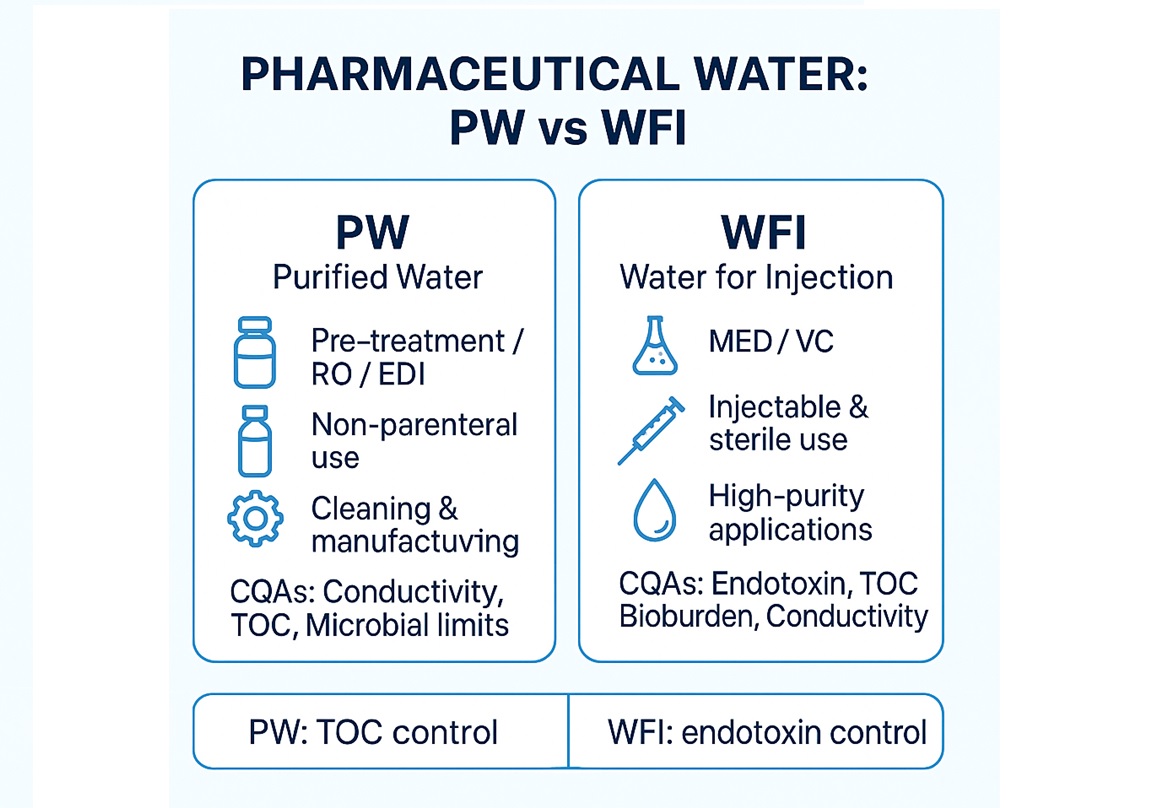
Purified Water (PW)

PW is used in non-sterile operations, CIP/rinsing, and OSD manufacturing.

Parameter Requirement
Uses
OSD, rinsing, cleaning
Production
RO, double RO, RO-EDI
TOC
≤ 500 ppb
Conductivity
Must meet USP
Microbial limit
≤ 100 CFU/mL
Controls
Loop velocity, sanitization, dead-leg removal

Facilities that maintain ≥1–1.2 m/s loop velocity and implement proactive sanitization report fewer deviations—one of the core goals of pharmaceutical water validation.

Water for Injection (WFI)

WFI is the highest-purity water used in sterile injectable manufacturing and biologics.

Parameter Requirement
Uses
Parenterals, sterile products, biologics
Production
Distillation or RO-EDI
Endotoxin limit
≤ 0.25 EU/mL
Microbial limit
< 10 CFU/100 mL
Controls
Hot loop (≈80 °C), validated sanitization

Temperature stability is effectively treated as a CQA because minor fluctuations can shift microbial trends.

WFI and Purified Water: control microbes, control endotoxins, protect every batch
From PW to WFI—monitor, sample, trend, and stay audit-ready

Water Validation Lifecycle (IQ/OQ/PQ)

Validating pharmaceutical water systems requires proof that the system is installed correctly, operates as intended, and performs consistently under real manufacturing conditions.

Installation Qualification (IQ)

Key IQ activities include:

  • P&ID verification
  • 316L stainless steel certification
  • Instrument calibration (TOC, conductivity, pressure, temperature)
  • Dead-leg assessment (≤1.5D hygienic rule)
  • Weld inspection and slope verification

Weak IQ documentation often correlates with recurring long-term system issues.

Operational Qualification (OQ)

OQ ensures the system performs within defined operational ranges.

Activities include:

  • Loop velocity measurement
  • Temperature mapping
  • Alarm/interlock challenge testing
  • Sanitization cycle validation
  • RO-EDI performance checks under load and no-load conditions

Early TOC or conductivity instability frequently appears during OQ.

Performance Qualification (PQ)

PQ confirms sustained, compliant system performance.

Key elements:

  • Daily TOC, conductivity, microbial testing at critical POUs
  • Rotational sampling of all outlets
  • 30-day trend analysis to establish alert/action limits
  • Sampling technique assessment

Most PQ failures stem from poor sampling, not actual system contamination.

Final words

Industry benchmarking consistently shows that strong water validation programs lead to:

  • 40–60% fewer microbial excursions
  • Up to 25% faster deviation closure
  • $300k–$500k annual savings from avoided investigations
  • Fewer regulatory observations related to utilities

A European sterile facility that revalidated its PW loop—by optimizing velocity, eliminating dead-legs, and revising sanitization frequency—reduced water-related deviations from 11 per year to just 2, achieving an 82% improvement without major capital spending.

The takeaway is simple:

A great water system is not one that never experiences issues—it’s one whose issues are predictable, explainable, and controllable thanks to robust pharmaceutical water validation, informed risk-based decisions, and strong lifecycle oversight.

Professionals who master this topic don’t just maintain compliance—they elevate manufacturing reliability and position themselves as indispensable contributors in any GMP organization.

FAQs:

1️⃣ What is pharmaceutical water validation?


A lifecycle process proving that PW/WFI systems consistently meet microbial, chemical, and endotoxin specifications.

2️⃣ How do PW and WFI differ?


PW supports non-sterile operations; WFI is required for sterile and injectable manufacturing.

3️⃣ What causes most water system failures?


Low flow velocity, dead-legs, membrane aging, inadequate sanitization, and sampling errors.

References

Picture of Mahtab Shardi

Mahtab Shardi

Mahtab is a pharmaceutical professional with a Master’s degree in Physical Chemistry and over five years of experience in laboratory and QC roles. Mahtab contributes reliable, well-structured pharmaceutical content to Pharmuni, helping turn complex scientific topics into clear, practical insights for industry professionals and students.

Share