

Features
Topics
Discover

Unlock the potential of your career in the Pharma industry with our online courses and qualifications.

Career Path

Pick a career path, follow its guided course roadmap, and secure industry-verified credentials in a few months.

Courses

Earn career credentials from industry leaders that demonstrate your expertise.

GMP Certified Supplements: Meaning and Proof in 2025 

People buy supplements to feel better, not to gamble. Yet quality varies a lot across brands and categories. In the U.S. alone, 57.6% of adults reported using a dietary supplement in the last 30 days. However, FDA also warns that some products contain hidden drug ingredients, and it has identified over a thousand tainted products in recent years.  That gap creates a real buyer pain: labels look “clean,” but proof feels unclear. So this guide explains what GMP certified supplements really mean, what GMP controls, and what GMP does not guarantee. You will also learn how GMP compares with third-party programs like USP VerifiedNSF, and Informed-Sport—plus a simple checklist to buy smarter. Also, review Pharmuni’s primer on Good Manufacturing Practices (GMP) before you compare seals. 

What GMP certified supplements mean in 2025

GMP certified supplements usually means a supplement brand claims an independent party audited its manufacturing system against GMP expectations. In practice, GMP focuses on consistent quality processes, not marketing promises.

Importantly, GMP certification does not mean “FDA approved.” FDA explains that it does not review many products for effectiveness before sale, and it warns consumers about contaminated products with hidden ingredients. So, treat “GMP certified” as a quality-system signal, not a safety guarantee.

What “GMP” controls in supplement manufacturing

GMP for dietary supplements targets how a company makes a product, step by step. For example, FDA’s dietary supplement CGMP guidance describes expectations like following documented procedures and ensuring products meet specs and label claims.

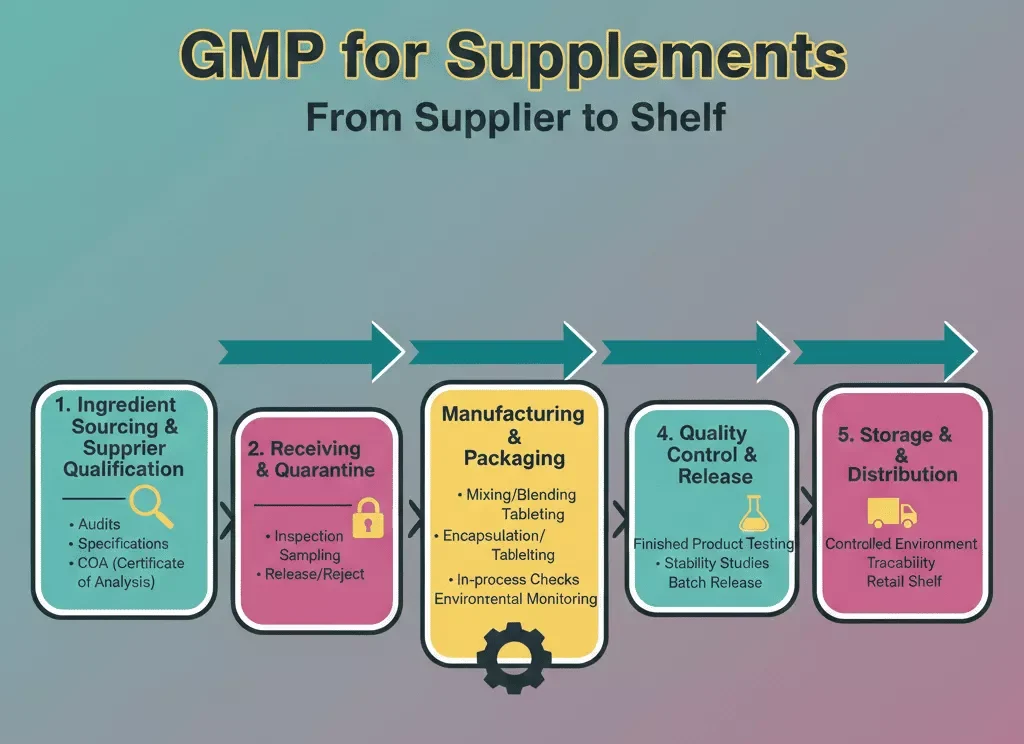
Here’s what GMP typically controls across the supplement lifecycle:

Because GMP forces documentation and control, it helps reduce “random” outcomes. Still, GMP can’t magically fix bad leadership or weak testing choices.

gmp certified supplements

What GMP certification for supplements proves

A real supplement GMP certification shows that auditors reviewed the quality system and found it meets a defined standard at the time of audit. Therefore, certification mainly proves repeatable processes and documented controls, not “perfect products forever.”

A credible GMP certification for GMP certified supplements typically proves the company can:

  • Run a documented quality management system with clear responsibilities. 
  • Control raw materials through approval, testing, and traceable receiving. 
  • Follow validated or qualified processes for mixing, filling, and packaging. 
  • Investigate deviations and complaints, then apply corrective actions. 
  • Maintain records that support audits, traceability, and recalls.  

Process Control for Supplement Manufacturing

GMP standardizes production so teams can repeat the same outcome. For example, operators follow written steps for blending, encapsulation, tableting, and bottling. Next, quality teams set in-process checks for weight variation, capsule count, and label correctness. That discipline reduces mix-ups and “oops” batches.

Internal Audits and Supplier Audits

Audits give GMP teeth. Internal audits find gaps before regulators or retailers do. Supplier audits also reduce risk upstream, since many failures start with weak ingredient control. As a result, better auditing usually means fewer surprises during investigations.

Change Control for Formulas, Suppliers, and Labels

GMP expects teams to control change, not chase it. So, a company should review and approve changes before switching suppliers, tweaking formulas, or updating labels. That matters because small changes can shift stability, potency, or allergen risk.

Lot Traceability And Recall Readiness

Lot tracking turns a scary recall into a targeted response. With lot codes and complete records, teams can trace a product back to ingredients, equipment, and operators. Therefore, they can quarantine only affected lots instead of pulling everything. FDA’s CGMP guidance highlights recordkeeping tied to what the label claims.

GMP Compliance vs Certification

“GMP compliant” and “GMP certified” sound similar, but the proof differs.

Claim type What it usually means What proof you can expect

GMP compliant (self-claim) 

The company says it follows GMP rules.
Internal SOPs, maybe a COA; often no public audit proof.

Third-party GMP certification 

An auditor assessed the facility/system against a standard.
Certificate with scope, site, dates, and certifier identity.

USP Verified 

USP reviews quality controls and tests to verify key quality attributes.
USP Verified mark + program details on what USP verifies.

NSF Certified for Sport 

NSF tests products and lots for banned substances and contaminants.
NSF steps include lot testing and banned-substance screening.

Informed-Sport 

The program tests every batch pre-release for banned substances.
Batch-by-batch testing claim + a searchable certified list.

So, GMP certification tells you the factory runs controlled processes. Meanwhile, USP/NSF/Informed programs often add stronger testing and verification signals, especially for athletes.

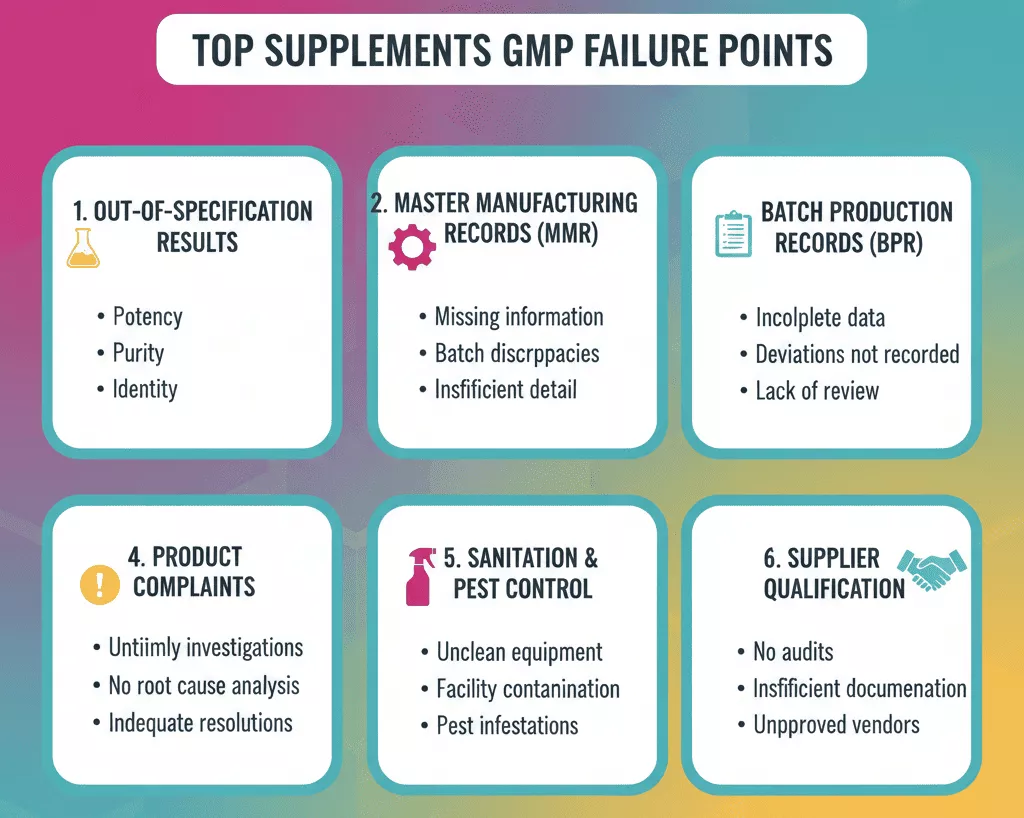
What happens when Certified Supplements fail GMP standards?

When a supplement fails GMP expectations, companies face practical and expensive outcomes. For example:

gmp certified supplements

How to know if a Supplement is GMP Certified?

You can verify GMP certified supplements quickly if you follow a repeatable method.

  1. Find the certifier name (not just “GMP”). Look for NSF, USP, or another known body.  
  2. Check the scope (facility, product line, or specific product). 
  3. Check the certificate date and validity window. Older certificates need context. 
  4. Confirm the site location matches the manufacturing address. 
  5. Use a public database or product list when available: 
  • USP provides program details for verified products.  
  • Informed-Sport provides a certified products list.  

That approach also helps you build your own GMP certified supplements list by brand and category.

Simple buying checklist (fast but effective): 

  • Choose brands that show certifier + scope + date clearly. 
  • Prefer products with USP Verified / NSF / Informed-Sport when risk stays high.  
  • Avoid “miracle” claims (rapid weight loss, sexual enhancement, extreme muscle gain). FDA flags these categories as higher risk for hidden drugs. 

Final Words

GMP certified supplements can reduce risk because GMP pushes disciplined manufacturing and traceability. Also, real certification adds accountability through external audits and documented controls. Still, no seal replaces common sense and smart verification. 

Two numbers keep this topic honest. First, 57.6% of U.S. adults use dietary supplements, so quality choices affect millions. Second, FDA has identified over a thousand tainted products with hidden drugs and chemicals, which shows why “trust me” marketing fails buyers.  

FAQ:

What does the GMP certified supplement mean?

It means an auditor assessed the manufacturer’s GMP quality system and controls. 

Are GMP-certified supplements safe?

They often lower risk, but no certification guarantees safety or perfect purity.  

Do third-party seals like NSF or USP Verified matter for GMP certified supplements

Yes, because they can add stronger verification signals beyond basic GMP audits. 

References:

Picture of Stephanie Männicke

Stephanie Männicke

Digital Marketing Especialist at Zamann Pharma Support, brings 8 years of experience in Corporate and Digital Communication. Specializing in Digital Marketing and Content Creation, Stephanie is currently focused on creating strategic content for Pharmuni's networks, especially content on topics such as recruitment, onboarding and employer branding. Outside of work, Stephanie is a mum, a crocheter and a movie fan. An avid reader and in search of expanding her knowledge, Stephanie is always looking for ways to innovate communication in the digital environment and connect people in a genuine way.

Share