

Features
Topics
Discover

Unlock the potential of your career in the Pharma industry with our online courses and qualifications.

Career Path

Pick a career path, follow its guided course roadmap, and secure industry-verified credentials in a few months.

Courses

Earn career credentials from industry leaders that demonstrate your expertise.

Good Manufacturing Practices Examples in 2025: GMP Made Simple

A good manufacturing practices example: during a packaging changeover, the team stops the line, removes old labels and leaflets, wipes surfaces, and checks hidden corners. Then a second person matches the new components to the batch record before restart.

Good Manufacturing Practices (GMP) turn this into a standard, documented control. In 2017, WHO reported that about 1 in 10 medicines in low- and middle-income countries are substandard or falsified. In 2017, WHO also estimated medication errors cost about US$42 billion each year, and its 2024 fact sheet cites about US$30.5 billion wasted on poor-quality products. 

Table of Contents

What Is are GMP (Good Manufacturing Practices) examples?

GMP means teams follow controlled steps so products stay safe and consistent. A GMP example shows actions workers repeat every day on the shop floor. It also proves control through clear records, labels, and checks.

Here are common GMP examples you can visualize:

  • Operators wash hands, wear PPE, and follow the gowning sequence.

  • Teams clear the line, remove old labels, and verify the right batch.

  • QA reviews records, logs deviations, and starts CAPA within 1 day.


GMP in one minute: control the process, document the proof, protect the patient
GMP in One Minute: Definition and Clear Example

Real-Life GMP Examples in a Factory

Workers follow GMP to keep every batch safe and consistent. Then, they use checklists to avoid mix-ups and contamination. Also, they record each step so QA can review fast. Therefore, they treat every task like a quality checkpoint.

Real-Life GMP examples include simple actions with big impact:

  • What Workers Actually Do Every Day
  • Hand Hygiene and Gowning Steps
  • Line Clearance Before Starting a Batch
  • Label Control and “Right Material” Checks
Step-by-step factory action Why it matters
Wash hands and sanitize
Reduces contamination risk
Gown in the correct sequence
Protects the product and clean area
Clear the line before the next batch
Prevents mix-ups and wrong labels
Verify “right material” and label version
Ensures correct product and traceability
Record checks in batch documents
Creates audit-ready evidence

What Workers Actually Do Every Day

Operators verify equipment ID, status label, and calibration due date before use. They run pre-use checks, set parameters, and log results in the batch record.

Then, they reconcile labels and components against the BOM and line clearance checklist.

  • Record times.

  • Perform IPC checks.

  • Report deviations.

Hand Hygiene and Gowning Steps

Workers wash hands for 20 seconds, then sanitize until dry. They inspect nails, remove jewelry, and cover cuts with a clean dressing.

  • Next, they gown in order: hair cover, mask, coat, gloves, and shoe covers.

  • They check mirror points, then enter through the airlock and sign the log.

Line Clearance Before Starting a Batch

Operators stop the line and confirm the last unit of the previous batch. They remove leftover labels, leaflets, cartons, and printed codes from the area.

  • They inspect under belts, guards, and tables for stray components

  • Wipe contact surfaces and empty bins, then close and label waste

  • Match new materials to the BOM and batch number.

  • QA signs the line clearance checklist before restart.


Label Control and “Right Material” Checks

Operators verify label artwork version, item code, and language before printing. Then, they compare batch number and expiry format to the master data.

During dispensing, they scan each component and match it to the BOM. They check status labels in the warehouse:

  • Approved
  • Quarantine

Finally, they record lot numbers and quantities in the batch record.

GMP Documentation Examples You Should Know

GMP documentation proves control and supports batch release decisions. Then, it helps teams trace each material, step, and check. You should know batch records, logbooks, and deviation reports. See the table below for key examples and what to include.

Use clear entries, real times, and complete signatures in every record. Also, attach calibration certificates and approved labels when needed. If something goes wrong, document the deviation and start CAPA.

Record type Purpose What to include
Batch Manufacturing/Packaging Record (BMR/BPR)
Shows how you made the batch
Step results, times, equipment ID, signatures, yields
Equipment Logbook
Proves correct equipment use
Equipment ID, cleaning status, use dates, maintenance notes
Cleaning Record
Confirms hygiene control
Method, agent, lot, contact time, visual check, initials
Material Receipt/Dispensing Record
Ensures traceability
Supplier/lot, status, quantities, reconciliation, scanner logs

GMP Dos and Don’ts Examples

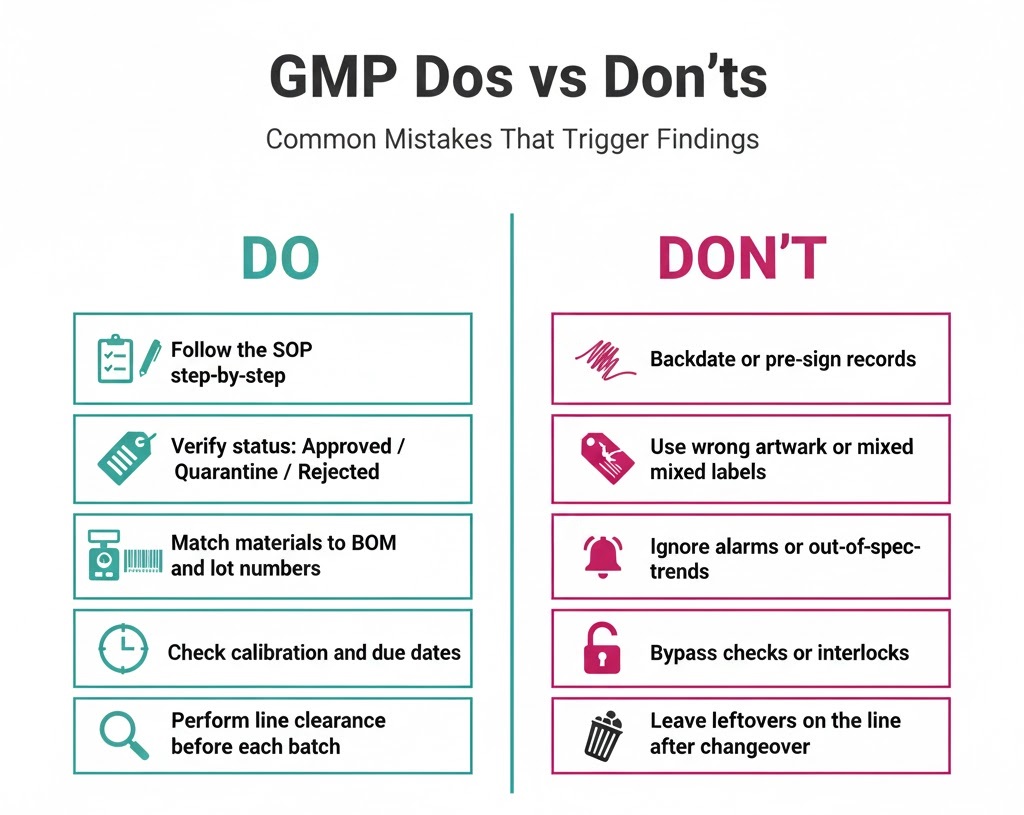
GMP dos and don’ts keep factory work consistent and inspection-ready. Do follow the SOP and record results right away. Do check material status and calibration before you start. Don’t pre-sign records or guess missing values. Don’t use unlabeled or expired materials.

GMP Dos vs Don’ts in one view avoid the mistakes that trigger findings
Save this checklist: better records, cleaner changeovers, fewer deviations

Good vs Bad Practices Side-by-Side

Good practices keep work consistent and reduce defects during every batch. They follow SOP steps, verify materials, and document actions at the point of use. Then, they confirm equipment status and control changes before production starts.

Bad practices create gaps that lead to mix-ups, rework, and findings. They skip checks, delay documentation, or ignore small signals on the line. They also use unclear labels, loose materials, or unverified settings.

  • Good practices: Verify “Approved” status • Record data immediately • Perform line clearance

  • Bad practices: Guess values later • Start without QA clearance • Mix labels or components

Final words

A good manufacturing practices example is a packaging-line changeover: stop the line, clear old labels, clean surfaces, and verify the next batch parts. Under FDA drug cGMP, 21 CFR §211.100 requires written procedures for production and process control, so teams document each check and sign before restart. 

GMP also follow EU GMP guidance in EudraLex Volume 4.  WHO estimated in 2017 that 1 in 10 medicines in low- and middle-income countries failed quality tests, so factories use line clearance, “right material” checks, and real-time batch records to cut mix-ups and protect patients. 


FAQs:

1️⃣ What documents prove GMP compliance during daily work?

Batch records, equipment logbooks, cleaning logs, and deviation/CAPA records prove control.

2️⃣ What are GMP examples in a factory?

GMP examples are repeatable actions like gowning, line clearance, and batch record entries.

3️⃣ Why does line clearance matter so much?

It prevents mix-ups between batches, especially wrong labels and wrong leaflets.

References

Picture of Ershad Moradi
Ershad Moradi

Ershad Moradi, a Content Marketing Specialist at Zamann Pharma Support, brings 6 years of experience in the pharmaceutical industry. Specializing in pharmaceutical and medical technologies, Ershad is currently focused on expanding his knowledge in marketing and improving communication in the field. Outside of work, Ershad enjoys reading and attending industry related networks to stay up-to-date on the latest advancements. With a passion for continuous learning and growth, Ershad is always looking for new opportunities to enhance his skills and contribute to pharmaceutical industry. Connect with Ershad on Facebook for more information.

GMP in the UK: 2025 Guide

GMP in UK sets the quality rules that keep medicines safe, consistent, and inspection-ready. In this 2026 guide, you will learn how MHRA enforces UK GMP requirements, what changes after Brexit still matter, and how UK GMP compares with EU GMP and PIC/S.

Read More »
PSMF in Pharmacovigilance: Beginner’s Guide for 2025

The Pharmacovigilance System Master File (PSMF) explains how a company protects patients through structured safety work. It shows regulators the people, processes, and systems behind every safety decision. In this beginner’s guide, you learn what a PSMF in pharmacovigilance includes, who needs it, and how it supports inspections and compliance.

Read More »

Share