


Features
Topics
Discover

Unlock the potential of your career in the Pharma industry with our online courses and qualifications.

Career Path

Pick a career path, follow its guided course roadmap, and secure industry-verified credentials in a few months.

Courses

Earn career credentials from industry leaders that demonstrate your expertise.

Computer System Validation in Pharma 2025 Guide 

Digital technology now drives almost every step-in drug development and manufacturing. Global pharma 4.0 solutions already reach around USD 19–20 billion and may grow past USD 80 billion within the next decade. At the same time, worldwide medicine spending moves toward USD 1.6 trillion, which raises regulatory pressure on every company. Because of this scale, Computer System Validation in pharma now sits at the core of safe, consistent, and inspection-ready operations rather than as a side task for IT. 

Regulators also look much closer at data integrity. Since 2015, the FDA roughly doubled its warning letters, and over half of the observations involve data integrity issues linked to computerized systems. Teams therefore treat CSV as a strategic tool to protect patients, avoid costly remediation, and speed up inspections.  

If you want a broader view of process, cleaning, and equipment topics that connect with CSV, you can also explore our Pharma Validation resources before you dive deeper into this guide. 

What Is Computer System Validation in Pharma?

Computer System Validation in pharma (CSV) means you plan, test, and document computerized systems so they: 

  • Work as you intend in real processes 
  • Produce accurate and reliable results over time 
  • Protect pharma data integrity across the full validation lifecycle  
  • Meet FDA CSV requirements, EU Annex 11 expectations, and GAMP 5 CSV good practice 

CSV in pharmaceuticals does not only cover software. Teams also look at: 

  • Hardware and infrastructure 
  • Interfaces and data flows 
  • People, procedures, and training 
  • Vendors and cloud providers 

Therefore, you never treat CSV as a one-off test. You treat it as a lifecycle discipline that starts with user needs and ends when you retire the system. 

Why CSV Matters in the Pharmaceutical Industry

Good pharma Computer Validation brings concrete benefits: 

Protect patients and product quality 

  • Accurate results support right batch release decisions. 
  • Reliable data reduces the chance of unsafe products. 

Reduce regulatory risk 

  • Many FDA and EU inspection findings relate to weak data integrity and poor control of computerized systems.  
  • Strong CSV demonstrates control before issues escalate. 

Support faster inspections 

  • Clear documentation lets inspectors understand how you designed, tested, and released each system. 
  • Therefore, teams spend less time searching for evidence during audits. 

Improve efficiency 

  • Validated systems reduce rework, manual checks, and spreadsheet chaos. 
  • As a result, teams gain more time for science, not fire-fighting. 

Many professionals still confuse Validation vs Qualification. Qualification normally focuses on equipment and infrastructure. Validation covers the end-to-end process, including software and its impact on data and product quality. 

Key Regulations That Govern CSV

Several core regulations define expectations for CSV in pharmaceuticals: 

You can download several reference PDFs: 

Regulation / Guideline Scope PDF download link

FDA 21 CFR Part 11 – Guidance for Industry 

Electronic records and signatures in GxP systems

EU GMP Annex 11 (current version) 

Computerized systems that support EU GMP

EU GMP Annex 11 – Draft 2025 update 

Proposed revision for computerized systems

GAMP 5 CSV whitepaper (Thermo Fisher)

Risk-based GAMP 5 validation lifecycle summary

WHO TRS 1019 Annex 3 – Validation 

General validation guidance, including computerized systems

WHO TRS 1033 Annex 4 – Data Integrity 

Data integrity for GxP computerized systems

EDQM Guideline – Validation of Computerised Systems

Validation in Official Medicines Control Laboratories

These documents shape Annex 11 compliance strategies, GAMP 5 CSV approaches, and local implementation guides. 

Key Regulations That Govern CSV

Almost every GxP process now depends on computerized systems in pharma. Consequently, you usually validate at least the following categories. 

  1. LIMS 
  2. ERP / SAP Systems 
  3. MES 
  4. QMS Software 
  5. Electronic Batch Records 

Beyond these examples, you also evaluate: 

  • Equipment software (HPLC, particle sizers, balances) 
  • Environmental monitoring systems 
  • Clinical and pharmacovigilance tools 

Whenever a system affects patient safety, product quality, or regulatory decisions, CSV applies. 

LIMS

Laboratories rely on LIMS to control every sample and result. These systems sit right at the heart of CSV in pharma, because they touch critical quality decisions and stability data every day. 

A validated LIMS also supports strong pharma data integrity. Therefore, you design, test, and maintain it with clear roles for QC, QA, and IT. 

ERP / SAP Systems

ERP or SAP systems sit across the entire value chain. They link materials, finance, planning, and sometimes quality, so they strongly influence pharma computer validation priorities. 

Because GxP functions live inside a larger ERP landscape, you scope CSV carefully. You then validate only the parts that impact GxP processes and data integrity. 

MES

Manufacturing Execution Systems sit on the shop floor and control how teams run recipes, record actions, and monitor equipment. In CSV, MES often carries a high-risk rating because it guides real operations. 

With a validated MES, you gain consistent manufacturing and strong traceability. Therefore, engineers and QA work together to design tests that reflect real production scenarios. 

QMS Software

QMS software supports the full pharmaceutical quality system. It manages deviations, CAPA, complaints, change control, and training, so it directly shapes data integrity and culture. 

When you include QMS tools inside CSV in pharmaceuticals, you ensure that every record remains complete, traceable, and secure. As a result, inspections progress faster and smoother. 

Electronic Batch Records

Electronic Batch Records (EBR) replace paper batch documentation and sit at the center of many computerized systems in pharma. They collect instructions, entries, parameters, and approvals in one digital record. 

Strong CSV in pharma always includes a deep look at EBR. You verify that each record tells the full batch story and supports safe release decisions. 

CSV Lifecycle: Step-by-Step Process

computer system validation in pharma

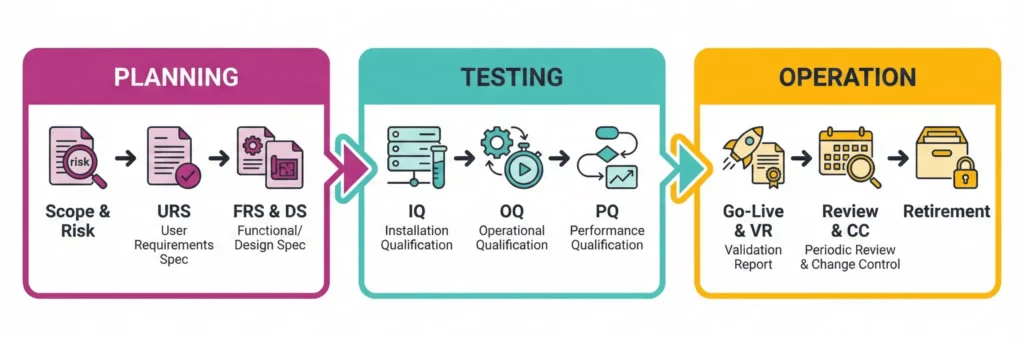
A structured validation lifecycle keeps CSV in pharma consistent and efficient. GAMP 5 recommends a lifecycle approach from concept to retirement, combined with risk-based thinking. 

You can break the CSV lifecycle into clear steps: 

1. Define Scope and Risk
  • Map the process, data, and regulatory impact. 
  • Classify the system (GAMP category) and focus on high-risk, GxP-critical functions. 
2. Write Requirements and Design the System
  • Document clear User Requirements (URS) in simple language. 
  • Translate them into functional and technical design, including data integrity and access control. 
3. Plan and Execute Testing (IQ/OQ/PQ)
  • Create a validation plan with roles, deliverables, and acceptance criteria. 
  • Perform installation checks (IQ), functional/operational tests (OQ), and real-use performance tests (PQ). 
4. Approve, Release, and Document the System
  • Review all evidence, handle deviations, and decide on fitness for use. 
  • Issue a validation report and formally release the system for GxP use. 
5. Maintain the Validated State and Retire Safely
  • Control changes, incidents, periodic reviews, and revalidation when needed. 
  • Plan retirement, migrate or archive data, and keep records accessible for the full retention period. 

Because teams follow this lifecycle, they can show inspectors a clear chain: requirements → design → testingcontrolled use. 

CSV vs. Computer Software Assurance in Pharma

Regulators now talk more about Computer Software Assurance (CSA), especially in the US. 

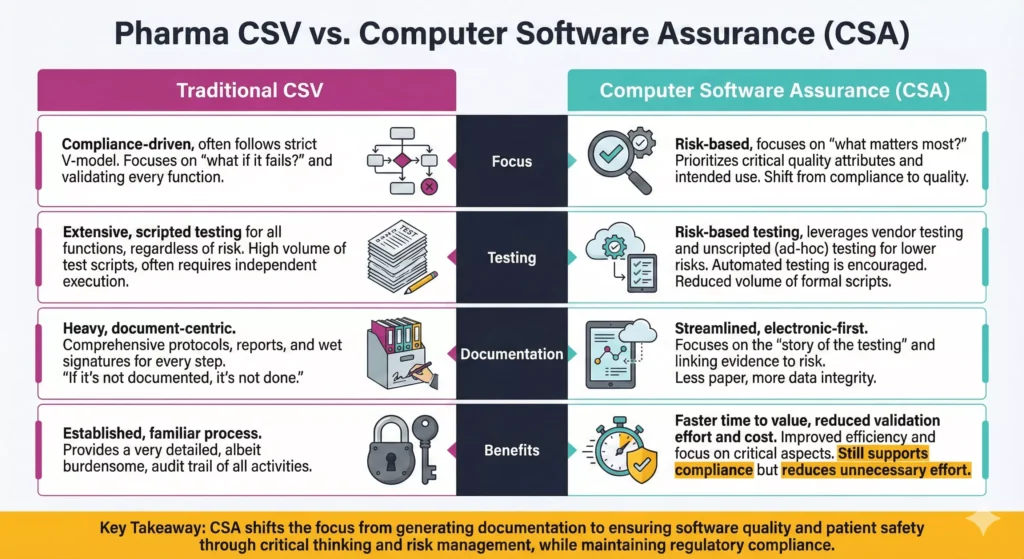
FDA and industry groups promote CSA to shift from documentation-heavy CSV to smarter, risk-based assurance that uses critical thinking and efficient testing.  

You can think about CSV vs CSA in pharma like this: 

Focus 

  • Traditional CSV often emphasizes documents and test scripts. 
  • CSA emphasizes patient risk, product quality, and system impact first. 

Testing approach 

  • CSV uses many scripted tests with step-by-step instructions. 
  • CSA encourages a mix of scripted, exploratory, and automated tests based on risk. 

Documentation 

  • CSV produces large protocols and reports for nearly every function. 
  • CSA keeps records lean for low-risk functions and rich for high-risk areas. 

Use of critical thinking 

  • CSV projects sometimes follow templates without much discussion. 
  • CSA asks teams to explain why they test, not only what they test. 

Importantly, CSA does not remove FDA CSV requirements or Annex 11 compliance. Instead, it refines how you meet them with a risk-based validation lifecycle. 

Key skills for professionals in this area include: 

  • Strong understanding of GAMP 5 CSV and CSA principles 
  • Ability to perform risk assessments on computerized systems in pharma 
  • Confidence with validation vs qualification decisions for equipment and software 
  • Practical experience with test design, automation, and documentation tools 
  • Communication skills for cross-functional work with QA, IT, and business users 
computer system validation in pharma

Final Words

Global pharma keeps growing fast. Analysts expect worldwide medicine spending to approach USD 1.6 trillion within the next few years. Digital systems also expand rapidly, with pharma IT and industry 4.0 solutions projected to climb from around USD 25–26 billion today to roughly USD 65–80 billion over the next decade. In this environment, Computer System Validation in pharma moves from technical detail to core business capability. When your CSV program links 21 CFR Part 11, EU Annex 11, and GAMP 5 with smart, risk-based practice, you protect patients, products, and revenue at the same time. 

Regulators watch these systems closely. FDA data show that warning letters have roughly doubled compared with a decade ago, and more than half involve data integrity or computerized system weaknesses. Strong CSV in pharma reduces those risks, supports smoother inspections, and builds trust with partners and authorities. At the same time, CSV skills open doors to roles such as validation engineer, IT QA specialist, and digital quality lead in a market that keeps growing every year. When you invest in robust CSV today, you secure reliable data, confident decisions, and a stronger competitive position for tomorrow. 

FAQ:

What is Computer System Validation in pharma?

CSV in pharma proves that GxP-relevant systems work as intended. You plan, test, and document each critical function across the full validation lifecycle. As a result, you gain reliable data, compliant processes, and clear evidence for inspections. 

Why does CSV matter so much in the pharmaceutical industry?

CSV in pharmaceuticals protects patients, products, and your license to operate. Validated systems reduce data integrity issues, warning letters, and costly rework. Therefore, strong CSV also supports faster audits and more confident batch-release decisions. 

Which regulations govern CSV in pharma?

Several key regulations drive pharma computer validation. FDA 21 CFR Part 11, EU GMP Annex 11, and GAMP 5 define core expectations for electronic records, signatures, and lifecycle control. In addition, WHO and local authorities publish guidance that you align with your global markets. 

References:

Picture of Stephanie Männicke

Stephanie Männicke

Digital Marketing Especialist at Zamann Pharma Support, brings 8 years of experience in Corporate and Digital Communication. Specializing in Digital Marketing and Content Creation, Stephanie is currently focused on creating strategic content for Pharmuni's networks, especially content on topics such as recruitment, onboarding and employer branding. Outside of work, Stephanie is a mum, a crocheter and a movie fan. An avid reader and in search of expanding her knowledge, Stephanie is always looking for ways to innovate communication in the digital environment and connect people in a genuine way.

Share