


Features
Topics
Discover

Unlock the potential of your career in the Pharma industry with our online courses and qualifications.

Career Path

Pick a career path, follow its guided course roadmap, and secure industry-verified credentials in a few months.

Courses

Earn career credentials from industry leaders that demonstrate your expertise.

PBRER in Pharmacovigilance: Complete 2025 Guide 

Pharmacovigilance plays a central role in medicine safety, and PBRER in Pharmacovigilance strengthens this role with structured benefit–risk evaluation across a product’s lifecycle. The Periodic Benefit-Risk Evaluation Report (PBRER) first appeared in 2012 when ICH released the E2C(R2) guideline. Since then, regulators in more than 90 countries have accepted it as the global standard for continuous safety reporting. 

Today, companies use PBRERs to present cumulative safety data, new signals, real-world findings, and updated benefit-risk conclusions. As the industry grows and safety expectations rise, regulators expect stronger evidence and clear evaluations. Therefore, professionals need to master how PBRERs work. 

What Is PBRER in Pharmacovigilance?

PBRER in PV stands for Periodic Benefit-Risk Evaluation Report. It provides a structured review of a medicine’s safety and benefits over a defined time. The report follows the ICH E2C(R2) guideline and aligns with modern global PV reporting guidelines. Instead of only listing adverse events, the PBRER explains what the data means for real patients. Therefore, it supports stronger decisions about labeling, risk minimization, and continued authorization. 

Companies treat the PBRER as a central lifecycle document. It combines cumulative safety data, clinical results, non-clinical findings, and real-world evidence from many regions. As a result, regulators receive a single, consistent picture of the product’s current profile. Teams also use the report to check alignment with the Reference Safety Information and the Risk Management Plan. Consequently, the PBRER strengthens both internal governance and external regulatory trust. 

Why PBRER in PV matters: 

  • Tracks how the benefit-risk balance evolves over time 
  • Connects signals, studies, and real-world data in one document 
  • Supports transparent communication with global health authorities 
  • Guides updates to product information, warnings, and risk minimization 
  • Builds strong evidence for continued market access and patient safety 

Evolution in Pharmacovigilance from PSUR to PBRER

The move from PSUR to PBRER in Pharmacovigilance reflects how drug-safety thinking changed over time. The original Periodic Safety Update Report (PSUR) focused mainly on listing adverse reactions and counting cases. However, as medicines reached more patients and data sources expanded, regulators saw that simple listings no longer gave enough insight. Therefore, ICH released the E2C(R2) guideline around 2012 and introduced the PBRER as a modern, benefit-risk–focused format. 

With PBRER, pharmacovigilance teams no longer just report “what happened.” They now explain what the data means for the product’s benefit-risk balance. The report connects signals, cumulative safety data, real-world evidence, clinical studies, and risk management activities. As a result, regulators can see trends, understand context, and decide whether the current labeling, warnings, and risk minimization measures still protect patients properly. 

Key ways PBRER in PV improves on PSUR: 

  • Shifts from simple safety listings to structured benefit-risk evaluation 
  • Integrates clinical, non-clinical, and real-world safety data 
  • Aligns closely with RSI and Risk Management Plans 
  • Encourages continuous, lifecycle-long safety thinking 
  • Supports clearer regulatory decisions on authorization and labeling 

Objectives of PBRER

PBRERs support multiple objectives throughout a product lifecycle. They help companies: 

These objectives allow regulators to make informed decisions on labeling, risk minimization, and product oversight.

Regulatory Requirements for PBRER in PV

Regulators require PBRERs for products with active marketing authorization. Requirements differ by region, yet most follow ICH E2C(R2). Authorities such as EMA, MHRA, and PMDA accept the harmonized structure. 

Key obligations include:

Companies must also maintain consistent timelines and high documentation quality. 

How to Prepare a High-Quality PBRER in Pharmacovigilance

You can follow a structured workflow to prepare an effective PBRER. Each step builds on the previous one to ensure accuracy and consistency. 

Step 1: Collect & Validate Safety Data

Start by gathering all relevant data sources, including:

  • Spontaneous Reports: Capture real-world adverse events that patients and HCPs submit. 
  • Clinical Trial Data: Use structured study results to understand controlled safety outcomes. 
  • Non-Clinical Findings: Include toxicology and animal data that highlight potential safety risks. 
  • Scientific Literature: Track published articles, case reports, and reviews about the product. 
  • Real-World Evidence: Add registry, claims, or database insights that reflect daily clinical use. 

Then validate each dataset before analysis. This step helps you avoid inconsistencies and supports accurate signal detection.

Step 2: Assess Signals & Ongoing Issues

Next, review all signals detected during the reporting period. Include:

  • Newly Identified Risks: Flag safety issues that you confirm for the first time. 
  • Ongoing Signals: Monitor signals still under investigation and update their status. 
  • Closed Signals: Document signals that you evaluated fully and decided to close. 
  • Regulatory Actions: Record referrals, requests, or actions that authorities initiated. 
  • Labeling Changes: Note updates to warnings, contraindications, or precautions. 

Signal management adds scientific clarity and highlights whether product risks changed over time. 

Step 3: Align Findings with RSI

Then compare new findings with the current Reference Safety Information (RSI). Ensure that: 

  • Label Consistency: Check that listed risks match the latest safety knowledge. 
  • Warning Adequacy: Review whether existing warnings still protect patients well. 
  • Contraindication Justification: Confirm that each contraindication remains clinically valid. 
  • Frequency Updates: Adjust frequency categories when new data changes risk estimates. 
  • RMP Alignment: Ensure that the Risk Management Plan reflects current safety priorities. 

This alignment prevents discrepancies and improves regulatory compliance. 

Step 4: Prepare Clinical & Non-Clinical Summaries

Summaries must present cumulative findings from: 

  • Clinical Efficacy Overview: Summarize key efficacy results that support ongoing benefit. 
  • Clinical Safety Overview: Highlight important adverse reactions and safety patterns. 
  • Observational Study Insights: Present findings from registries and non-interventional studies. 
  • Epidemiology Context: Explain background rates and disease risks for key events. 
  • Non-Clinical Safety Summary: Include relevant toxicology or mechanistic safety signals. 

Use clear language, add context, and avoid raw data overload. Summaries should highlight what changed, why it matters, and how the new data affects safety.

Step 5: Perform Benefit-Risk Evaluation

Then evaluate whether benefits continue to outweigh risks. Include:

  • Updated Benefit Profile: Describe how clinical and real-world data support effectiveness. 
  • Risk Characterization: Detail the nature, frequency, and seriousness of key risks. 
  • Population Impact: Explain how benefits and risks differ across patient subgroups. 
  • Comparator Context: Compare the product’s profile with alternative treatments. 
  • Overall Conclusion: State clearly whether the benefit–risk balance remains positive. 

This section is central to the PBRER because it supports regulatory decisions. 

Step 6: Compile, Review & Quality Check

Finally, compile all sections into the harmonized PBRER format. Then perform a rigorous quality check. Review: 

  • Structured Compilation: Assemble sections in the correct ICH E2C(R2) PBRER format.
  • Data Consistency Check: Verify that numbers, dates, and terms match across sections.
  • Clarity Review: Improve wording so regulators understand the story without confusion.
  • Cross-Document Alignment: Align PBRER content with RSI, RMP, and previous reports.
  • Final Sign-Off: Obtain expert and QA approval before sending the report to authorities.

A strong quality review reduces deficiency letters and accelerates approval. 

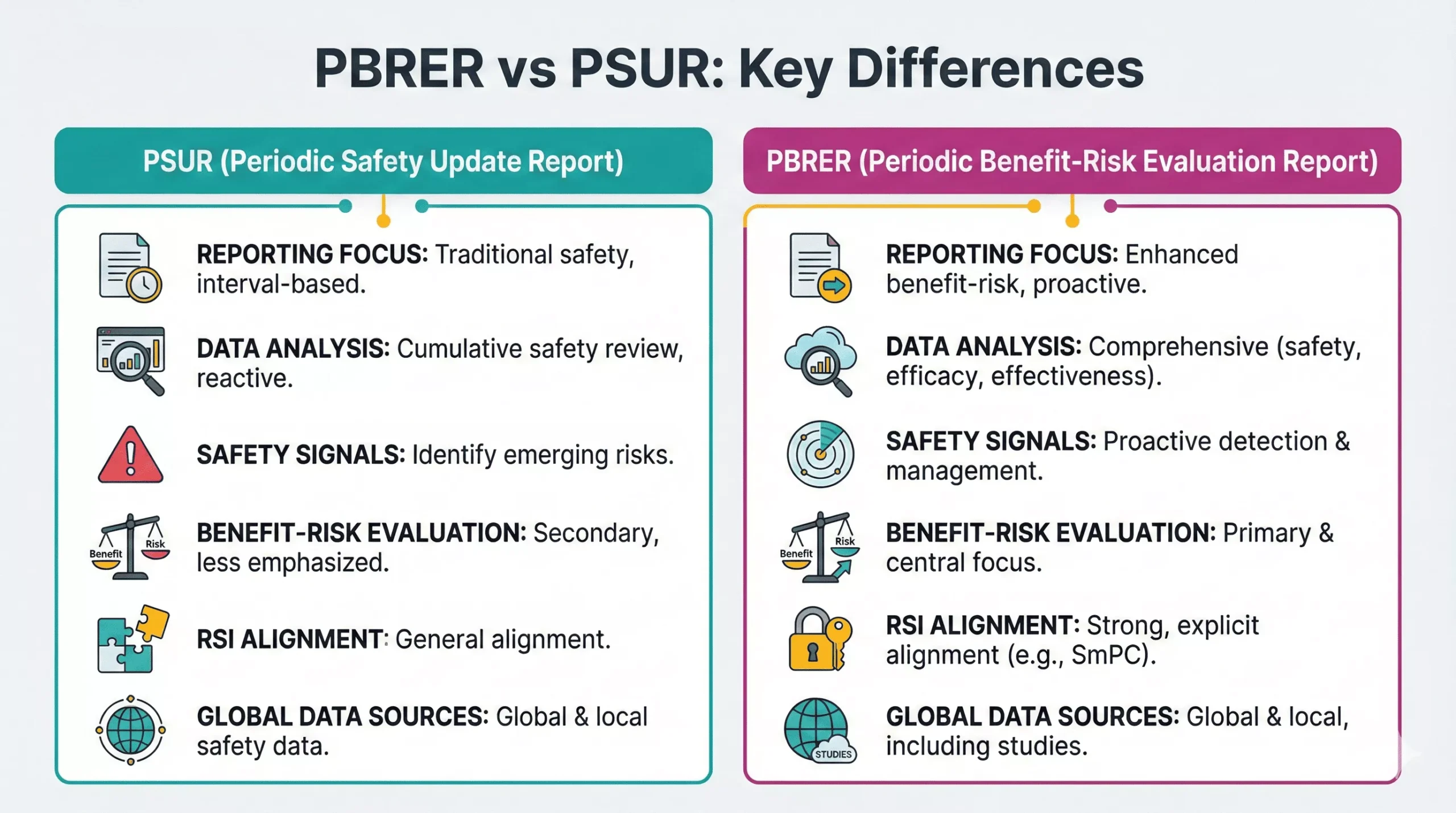
PBRER vs PSUR: Key Differences

You can understand the value of the PBRER by comparing it with the older PSUR format. The table below summarizes the major differences. 

Aspect PSUR PBRER

Focus 

Safety data
Benefit–risk evaluation

Approach 

Listing information
Interpreting and analysing data

Data Scope 

Limited cumulative data
Broad cumulative global data

Alignment 

Weak alignment with RSI
Strong alignment with RSI & RMP

Structure 

Older format
Harmonized ICH E2C(R2)

Purpose 

Detect risks
Evaluate benefit-risk profile

Because of these differences, companies now use PBRERs as the gold standard in most regions. 

Final Words

PBRER in Pharmacovigilance drives safer decision-making by combining cumulative evidence, structured analysis, and transparent benefit-risk evaluation. The demand for advanced drug-safety reporting grows every year, and global regulators continue to strengthen expectations. Today, more than 80% of safety submissions follow PBRER formats, and companies depend on strong PV teams to meet strict deadlines and rising data volumes. 

If you want to build or upgrade your skills in this field, you can explore our dedicated Pharmacovigilance Career Path. This structured learning route helps you understand core PV concepts, master regulatory reports like PBRER, and position yourself for specialist roles in drug safety and risk management. 

FAQ:

What is PBRER in Pharmacovigilance?

PBRER in PV stands for Periodic Benefit-Risk Evaluation Report. It summarizes cumulative safety data, clinical and real-world evidence, and explains the current benefit-risk profile of a product over a defined period, based on ICH E2C(R2) guidance. 

Why do regulators require PBRER?

Regulators require PBRER because they need a clear, structured view of how benefits and risks evolve over time. The report supports decisions on labeling changes, risk-minimization measures, renewals, and ongoing monitoring of product safety in real-world use. 

What are the key sections of a PBRER?

A typical PBRER in PV includes: 

  • Introductory product information 
  • Worldwide marketing authorization status 
  • Data sources and exposure data 
  • Signal and risk evaluation 
  • Benefit evaluation 
  • Overall benefit-risk evaluation and conclusions 

References:

Picture of Stephanie Männicke

Stephanie Männicke

Digital Marketing Especialist at Zamann Pharma Support, brings 8 years of experience in Corporate and Digital Communication. Specializing in Digital Marketing and Content Creation, Stephanie is currently focused on creating strategic content for Pharmuni's networks, especially content on topics such as recruitment, onboarding and employer branding. Outside of work, Stephanie is a mum, a crocheter and a movie fan. An avid reader and in search of expanding her knowledge, Stephanie is always looking for ways to innovate communication in the digital environment and connect people in a genuine way.

Share