


Europe’s pharma sector now generates more than USD 400–480 billion in annual sales and continues to grow steadily.
Because of this scale, European good manufacturing practices sit at the core of medicine safety, quality, and supply in the region. The EU GMP Guide in EudraLex Volume 4, first published in 1989, translates high-level legal principles into detailed expectations for every licensed manufacturer and importer in Europe.
Today, the European pharmaceutical market represents around 22–23% of global sales, and competition from other regions keeps growing.
Therefore, good manufacturing practices must stay aligned with science, technology, and patient expectations.
This guide explains what EU GMP are, how the structure works, where it differs from WHO GMP, and how recent changes affect different product types.
Table of Contents
What Is European Good Manufacturing Practice?
EU GMP describe the detailed quality and GMP expectations that apply to medicinal products manufactured or imported for the EU/EEA market. They sit in EudraLex Volume 4: EU Guidelines for Good Manufacturing Practice for Medicinal Products for Human and Veterinary Use.
The EU builds these rules on EU pharmaceutical legislation, ICH quality guidelines, PIC/S GMP, and WHO principles.
Manufacturers must design a pharmaceutical quality system in Europe that consistently delivers safe, effective products, supported by validated processes, controlled environments, and reliable documentation. In a market where chronic diseases, ageing populations, and new technologies drive demand, regulatory pressure on quality only increases.
Structure of the EU GMP Guide (Parts I, II, Annexes)
The EU GMP guidelines follow a clear structure so companies can locate requirements quickly:
Part I – Basic Requirements for Medicinal Products
Covers finished products for human (and until mid-2026, veterinary) use, including pharmaceutical quality system, premises, equipment, documentation, production, quality control, and outsourced activities.Part II – Basic Requirements for Active Substances (APIs)
Aligns with ICH Q7 and PIC/S PE 009-17; it sets GMP expectations for active substances used as starting materials, including supplier qualification, process control, and documentation. Public Health+1Part III – GMP-Related Documents
Contains supporting texts such as guidance on QA for non-routine activities, templates, and explanatory papers.Part IV – GMP Requirements for Advanced Therapy Medicinal Products (ATMPs)
Addresses specific risks of cell and gene therapies and replaces Annex 2 for ATMP manufacturing. Public HealthAnnexes 1–21 – Supplementary Requirements
Add extra rules for particular technologies and product types (for example Annex 1 for sterile products, Annex 21 for importation of medicinal products).
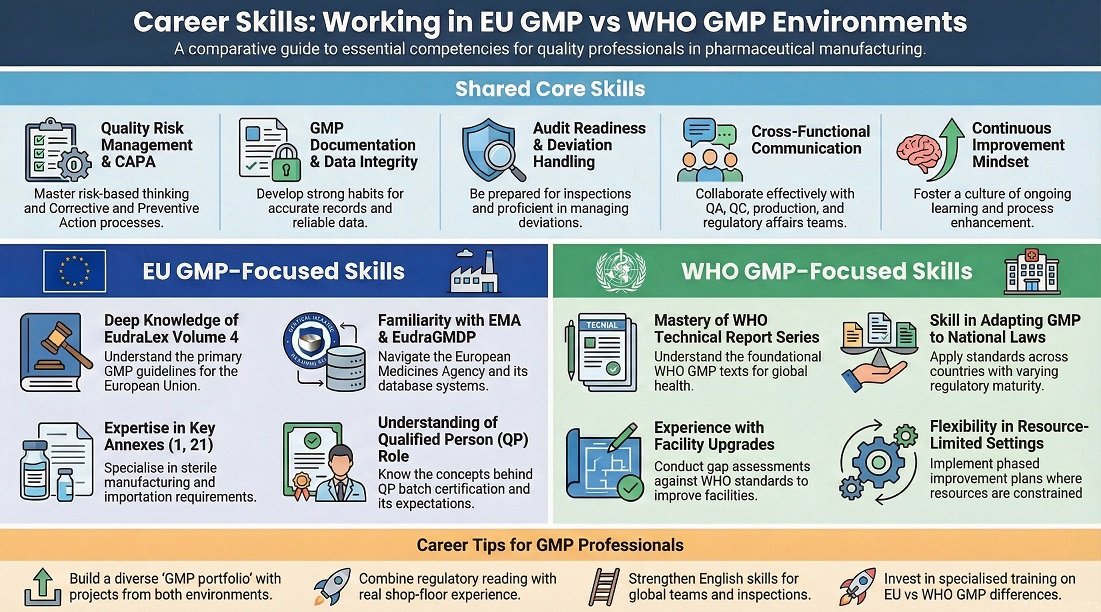
Who Must Follow EU GMP?
Any organisation that manufactures, imports, packages, tests, or certifies medicinal products for the EU/EEA market must comply with European GMP. This includes human and, until new veterinary implementing regulations fully apply, many veterinary products as well.
Use the table below as a quick reference—and as a EU GMP PDF download guide:
| Stakeholder / Site Type | EU GMP Obligation | Useful PDF / Link |
|---|---|---|
|
EU human medicinal product manufacturers |
Follow EU GMP Part I and relevant Annexes; hold manufacturing authorisation and undergo inspections. |
|
|
API manufacturers supplying the EU |
Comply with EU GMP Part II (aligned with ICH Q7 and PIC/S Part II). |
|
|
Importers / MIA holders |
Apply EU GMP, Annex 21, and have a Qualified Person certify each batch. |
|
|
ATMP manufacturers |
Implement Part IV and relevant annexes, plus ATMP-specific guidance. |
|
Difference Between EU GMP and General GMP or WHO GMP
Global regulators share the same underlying GMP principles, but European GMPintroduce specific legal and structural features. The table below compares EU GMP with more general WHO GMP guidance:
Training & Personnel Qualification Costs
| Aspect | EU GMP (Good Manufacturing Practices Europe) | WHO GMP / General GMP |
|---|---|---|
|
Legal status |
Detailed interpretation of EU legislation, mandatory for EU/EEA manufacturers and importers |
International guideline in WHO Technical Report Series, used as a global reference but adopted into national law with variations |
|
Geographic scope |
EU/EEA plus countries that align with EU GMP (for example many PIC/S members) |
Worldwide; supports low- and middle-income countries building their own GMP framework |
|
Structure |
Parts I–IV plus 21 Annexes, closely aligned with PIC/S PE 009 |
Core chapters with annexes, but different numbering and less direct link to EU legal articles |
|
Inspection model |
EMA coordinates with national inspectorates; results published in the EudraGMDP database |
Regional offices and national authorities perform inspections, often relying on WHO prequalification and collaborative procedures |
Relationship Between EU GMP, EMA, National Authorities, and ICH
European GMP do not stand alone. EMA, national authorities, and ICH all shape the framework:
The European Medicines Agency (EMA), founded in 1995, coordinates scientific evaluation, inspection networks, and GxP harmonisation across the EU.
National inspectorates in each member state perform GMP inspections and issue manufacturing or import authorisations. Results appear in the EudraGMDP database, which lists certificates and non-compliance statements.
ICH quality guidelines (Q7, Q8, Q9, Q10, and Q12) influence the EU GMP text, especially around pharmaceutical quality systems, risk management, and lifecycle approaches.
Latest Updates and What Changed
EU GMP continue to evolve. Several important updates matter for manufacturers today:
Annex 1 – Manufacture of Sterile Medicinal Products (2022 revision)
The long-awaited revised Annex 1 was published in August 2022 and came into operation on 25 August 2023, with point 8.123 on lyophiliser sterilisation postponed until 25 August 2024.Annex 21 – Importation of Medicinal Products
Annex 21, first published in February 2022, defines EU GMP expectations for companies that import medicinal products, bulk intermediates, or IMPs into the EU/EEA.GMP for veterinary products and active substances
New implementing regulations adopted in 2025 will, from mid-2026, set separate but aligned GMP rules for veterinary medicinal products and their active substances, while human medicines continue under EudraLex Volume 4.Revisions to Chapter 4 – Documentation
A 2025 consultation highlights changes that emphasise data governance, hybrid paper-digital systems, and risk-based control of documentation in European good manufacturing practices.
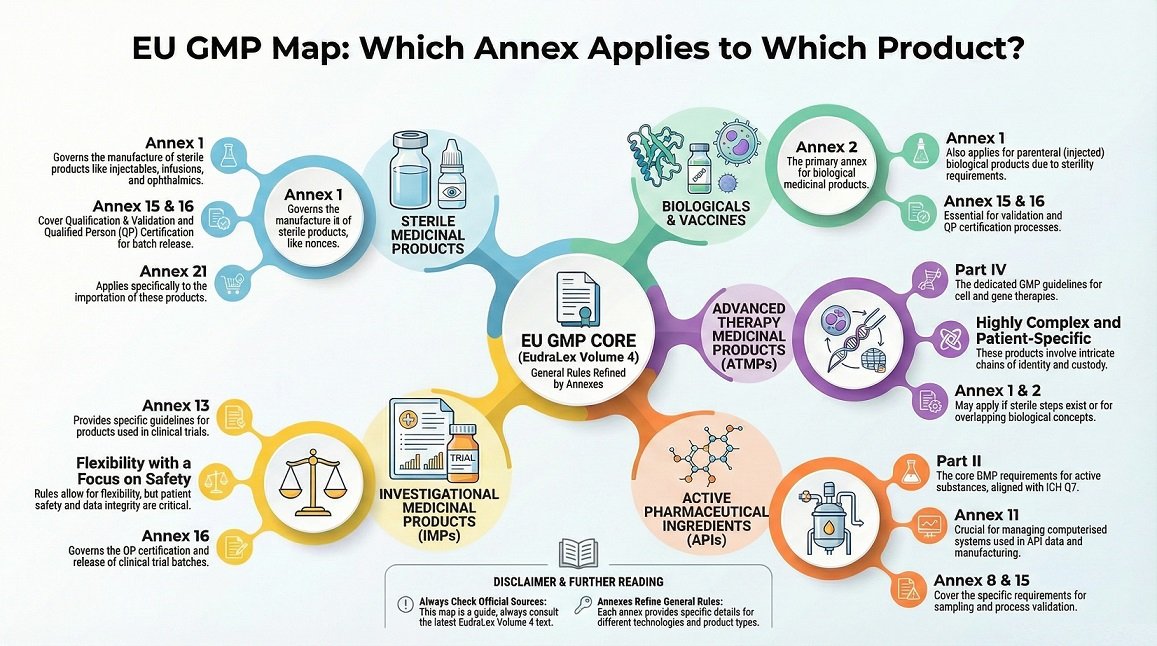
EU GMP for Different Product Types
Although the core principles stay the same, EU GMP adapt requirements for different product categories. The annexes and specialised parts help teams translate general rules into practical controls for each technology.
- EU GMP requirements for sterile products (Annex 1)
- Specific expectations for biologics, ATMPs, APIs, IMPs
- Biologics
- Advanced Therapy Medicinal Products (ATMPs)
- Active Pharmaceutical Ingredients (APIs)
- Investigational Medicinal Products (IMPs)
Final words
European good manufacturing practices form the quality backbone for USD 400 billion in annual EU pharma sales. Since the first EU GMP Guide in 1989, updates such as Annex 1 and Annex 21 have tightened contamination control, importation rules, and documentation expectations for sites worldwide.
Skilled professionals who understand EU GMP, WHO GMP, and PIC/S alignment help companies avoid costly deficiencies, recalls, and supply interruptions. To build these skills, learners should explore pharma courses that explain European GMP structure, annex requirements, and inspection trends so they can support robust quality systems and advance their careers.
FAQs
Any company that manufactures, imports, packages, tests, or certifies medicinal products for the EU/EEA market must follow EU GMP. That includes finished-dose manufacturers, API suppliers to the EU, importers/MIA holders, ATMP manufacturers, and many IMP manufacturers.
Recent updates include the revised Annex 1 for sterile products, Annex 21 for importation, and new expectations for documentation and data integrity. Together, they strengthen contamination control, supply-chain oversight, and digital documentation practices across Europe.
Start with the official EudraLex Volume 4 PDFs, then combine them with structured GMP training and real case studies. Apply the rules in your own site procedures, qualification activities, and batch documentation to build a robust pharmaceutical quality system.
References

Ershad Moradi, a Content Marketing Specialist at Zamann Pharma Support, brings 6 years of experience in the pharmaceutical industry. Specializing in pharmaceutical and medical technologies, Ershad is currently focused on expanding his knowledge in marketing and improving communication in the field. Outside of work, Ershad enjoys reading and attending industry related networks to stay up-to-date on the latest advancements. With a passion for continuous learning and growth, Ershad is always looking for new opportunities to enhance his skills and contribute to pharmaceutical industry. Connect with Ershad on Facebook for more information.

Trending Analysis in Pharma Industry 2026: Complete Market Growth & Regulatory Insights
Trending analysis in the pharmaceutical industry highlights an average 12% annual growth in manufacturing capacity and a steady increase in FDA drug approvals. Quality assurance remains paramount, with the FDA conducting over 1,200 inspections each year to ensure product safety. Staying informed through authoritative sources like IQVIA, FDA, and WHO supports better decision-making in this rapidly evolving sector.

Drug Regulatory Agencies Complete Guide 2026: Regulatory Approval & Compliance
This blog explores the vital roles of Drug Regulatory Agencies like the FDA and the EMA Regulatory Standards in ensuring the safety and efficacy of medicines globally. By reviewing thousands of applications each year, these agencies protect public health and facilitate access to life-saving drugs.

Pharma Jobs in Houston in 2026: FDA GMP Manufacturing and Salary Outlook
Houston’s life sciences sector continues to expand across pharmaceutical jobs in Houston, biotech manufacturing jobs Houston, and GMP jobs in Houston, driven by FDA inspections Texas activity, sterile manufacturing compliance standards, and growing clinical research infrastructure.