


Features
Topics
Discover

Unlock the potential of your career in the Pharma industry with our online courses and qualifications.

Career Path

Pick a career path, follow its guided course roadmap, and secure industry-verified credentials in a few months.

Courses

Earn career credentials from industry leaders that demonstrate your expertise.

Black Friday Sale: 50% OFF Annual Subscription – Nov 12 to Dec 1!

Pharma Medical Courses: Best Industry-Oriented Courses for Medical & Pharma Students (2025 Guide)

Pharma companies now hire more medical experts for roles in safety, clinical operations, and medical affairs, not only hospitals. Global pharma employment passed 5 million workers recently, and over 40% of new openings mention regulatory, PV, or data skills. In this context, pharma medical courses focus on real industry needs.

A modern Pharma Course teaches drug development, GxP, pharmacovigilance, and regulatory affairs instead of classic anatomy or biochemistry. Learners build job-ready skills for lab, QA, RA, PV, and medical affairs teams, so they move faster into industry-oriented pharma medical roles.

Table of Contents

What Are Pharma Medical Courses?

Medical affairs courses teach industry skills for medicine, not traditional MBBS subjects. They focus on how companies develop, test, approve, and monitor medicines globally. Students learn documentation, safety rules, and cross-functional teamwork instead of hospital ward rotations.

However, medical affairs training do not replace MBBS, nursing, or paramedical degrees. Instead, they add specialised skills for pharmacovigilance, medical affairs, regulatory, and clinical research. Graduates work inside pharma companies, CROs, and safety units, not hospital clinics.

Pharma Course options usually cover two main areas.

  • Industry foundations: drug lifecycle, GxP basics, data integrity, and documentation standards.

  • Role-specific skills: PV case handling, regulatory writing, medical information, or clinical trial support. Moreover, these programs shorten the learning curve and help graduates enter pharma faster. Therefore, pharma courses fit students, graduates, and working professionals seeking industry roles.

Who Can Enroll in Pharmaceutical Medical Courses?

Best Pharmaceutical medical courses focus on real industry work, not hospital-based practice. They teach drug development, safety, regulation, and documentation across the full lifecycle. Moreover, these programs help students match skills with common pharma job titles and teams.

Different learners need different pharma course combinations for strong career growth. Fresh graduates often start with GMP basics, QA, or PV introductions. However, experienced staff choose advanced medical affairs, regulatory affairs, or clinical research topics. Clear guidance avoids confusion and keeps learning tied to real pharmaceutical roles.

Use this shortlist to compare options and plan the next career step.

  • Medical Affairs Courses

  • Medical Writing Courses

  • Pharmacovigilance (PV) Courses

  • Clinical Research (CR) Courses

  • Regulatory Affairs Courses

  • QA & QC Courses (Pharma Manufacturing)

  • GMP & Industry Foundation Courses

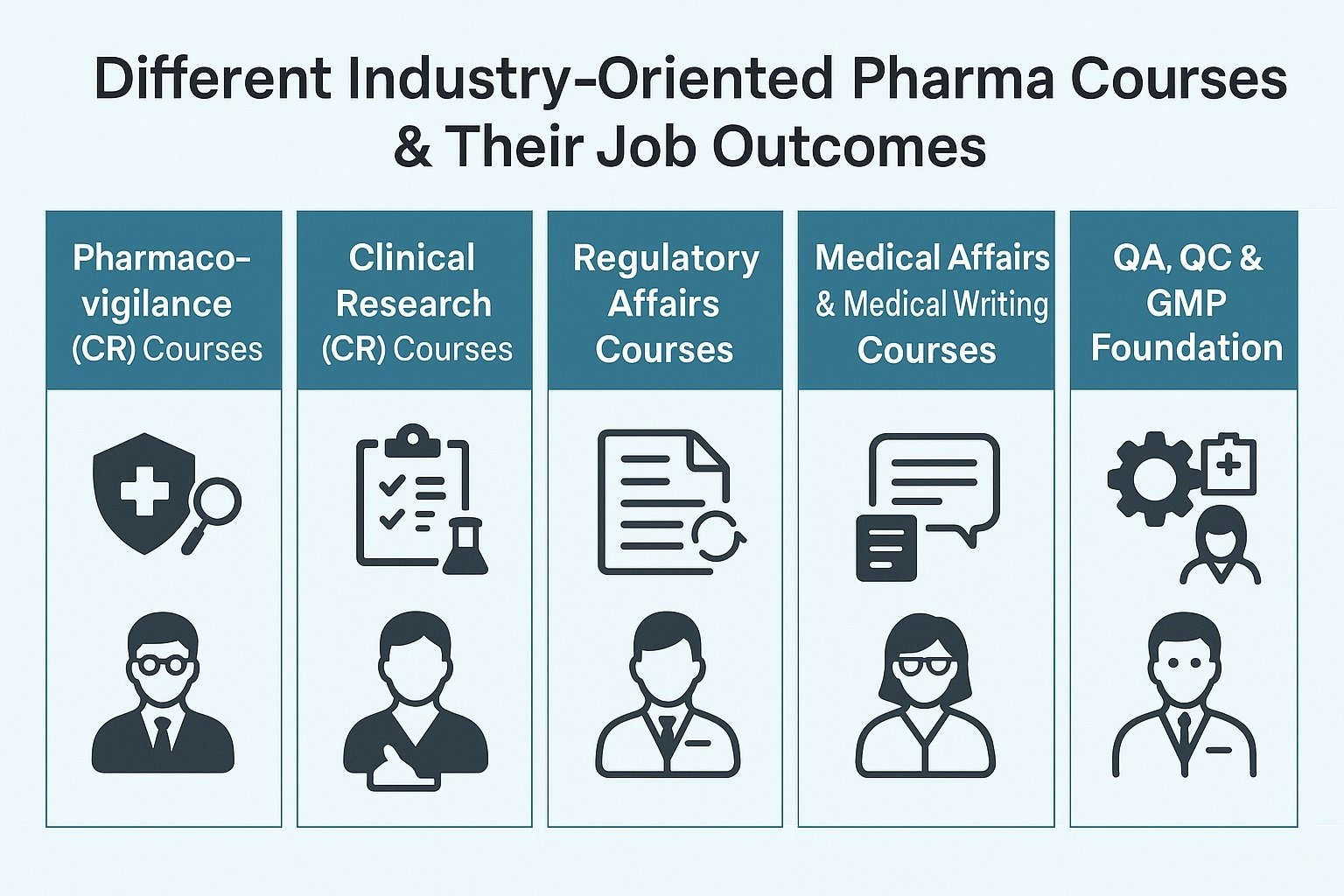
Match each pharma course with a real job path—from PV and CR to QA and GMP.
See how industry-oriented pharmaceutical medical courses translate into clear, tangible career outcomes

Medical Affairs Courses

Medical affairs courses teach how to explain complex data to non-experts. Moreover, they build skills for balanced, compliant discussions with doctors.

Key topics include:

  • Evidence-based communication

  • Clinical trial data interpretation

  • Scientific meeting and KOL engagement

  • Real-world evidence study planning skills

Medical Writing Courses

Medical writing courses teach clear scientific communication for pharma projects. Students learn structures for articles, reports, and regulatory documents.

Moreover, these courses build skills in accuracy, ethics, and style. Graduates support clinical teams by turning complex data into readable content.

Pharmacovigilance (PV) Courses

Pharmacovigilance courses teach structured drug safety monitoring for clinical trials and marketed products.
Students learn case processing, signal detection, and effective safety communication with regulators.
Moreover, these courses prepare teams for real PV roles in pharma companies.
Teams practice documentation.

  • Adverse event reporting

  • Case processing workflow

  • Signal detection basics

Clinical Research (CR) Courses

Clinical research courses explain how teams plan, run, and close global clinical trials.
Students study protocols, ethics, monitoring visits, and data quality control.
Moreover, these courses connect classroom science with real GCP and sponsor expectations.
Graduates support trial teams confidently.

Regulatory Affairs Courses

Regulatory affairs courses show how medicines gain and keep marketing authorisations.
Students learn dossier structure, labeling rules, and variation management.
Moreover, these courses link scientific data with legal requirements in major regions.
Graduates support submissions and answer authority questions effectively.

  • CTD dossier modules

  • Labeling and artwork control

  • Variations, renewals, and responses

QA & QC Courses (Pharma Manufacturing)

QA and QC courses explain quality systems in pharma manufacturing.
Students learn deviation handling, batch review, and laboratory testing basics.
Moreover, these courses explain how teams follow GMP and data integrity rules.
Graduates help sites maintain compliance and pass inspections.

GMP & Industry Foundation Courses

GMP and strong foundation courses cover core pharma manufacturing and compliance concepts.
Students learn documentation rules, change control, and simple risk assessments.
Moreover, these courses suit learners seeking entry into regulated pharma roles.
Graduates understand how plants follow GxP expectations.

  • GxP and GMP basics

  • Documentation and data integrity

  • Audit readiness and shop-floor behavior

Choosing the Right Medical Course in Pharma Industry

Choosing the right medical course starts with clear goals inside the pharma industry. Moreover, learners compare industry-ready pharma courses, pharma upskilling programs, and pharma student career skills. They check job ads, speak with mentors, and review course syllabi carefully.

However, different backgrounds need different learning paths and timelines. Pharmacy students may prioritise PV or clinical research, while doctors select medical affairs. Working professionals often target evenings or weekend formats.

  • Freshers: 1 foundation course plus 2 focused modules.

  • Juniors: 2 short programs plus 3 projects.

  • Seniors: 3 advanced pathways plus 5 leadership assignments.

Why Students Prefer Online Pharma Medical Courses

Students prefer online pharma courses because they fit study and work schedules. Learners study from home, use recordings, and repeat complex topics anytime. Moreover, flexible access helps students in smaller cities reach industry teachers.

Online formats also reduce travel costs and support part-time learning plans. Students compare courses by depth, teacher experience, and certificate value. However, they still need structure, deadlines, and guidance to finish programs successfully. 1 flexible program suits working graduates better than long, fixed campus schedules. 2 shorter modules often beat one huge course for motivation.

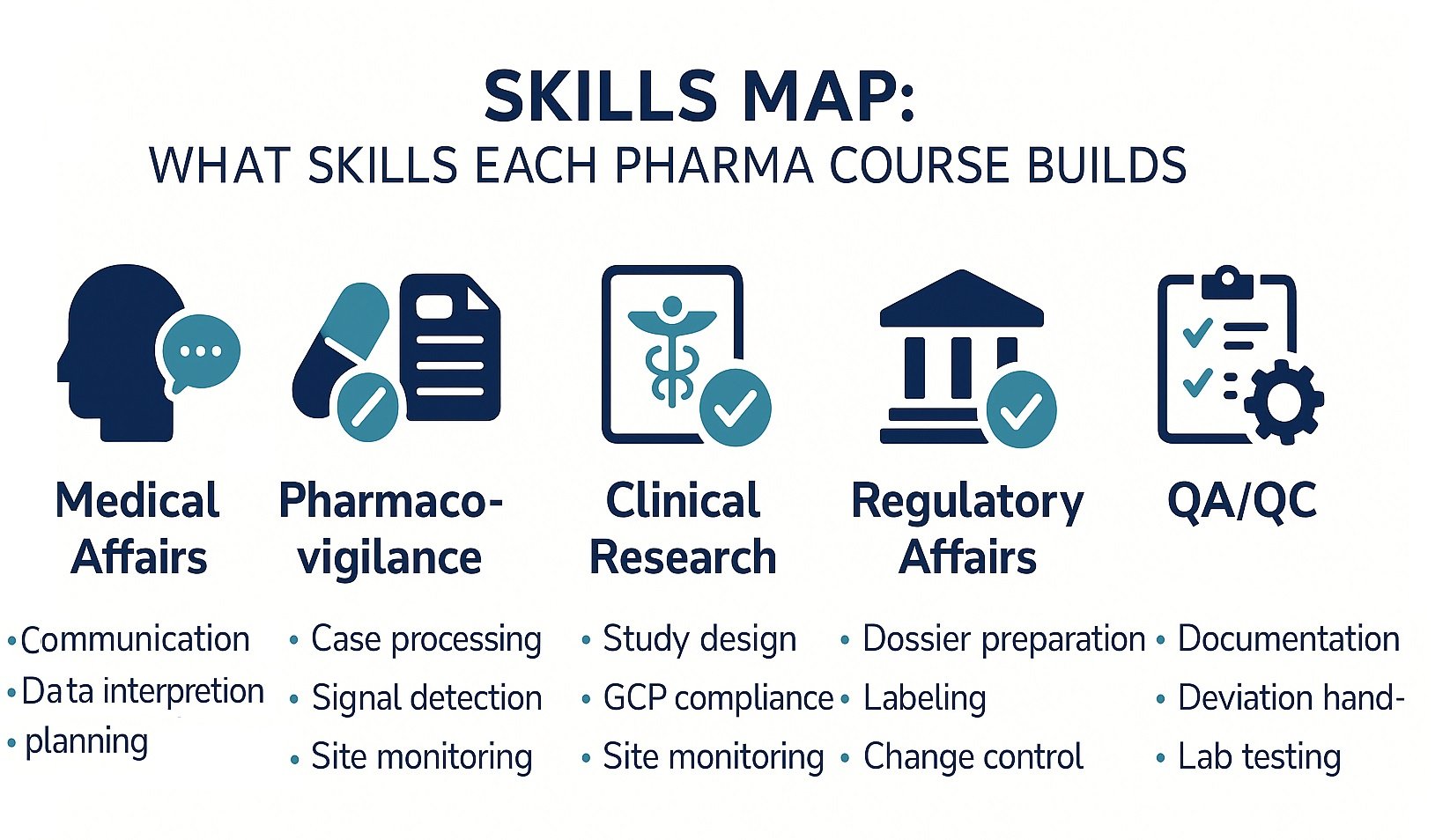
See which skills each pharma course builds so you can plan your next move clearly.
Map Medical Affairs, PV, CR, RA, and QA/QC courses to the exact skills employers want

Course Duration, Study Format & Costs

Online pharma medical courses vary in length, price, and learning style. Students compare duration, live sessions, and extra fees before they enroll. Moreover, they match course formats with field goals in PV, QA, or regulatory. Clear tables make decisions easier.

Field Typical duration Study format Relative cost
Medical Affairs
6–12 weeks
Live + recorded online
Medium–High
Pharmacovigilance (PV)
4–12 weeks
Self-paced + webinars
Medium
Clinical Research (CR)
8–16 weeks
Blended online
Medium–High
QA/QC (Pharma Manufacturing)
4–10 weeks
Self-paced modules
Medium
GMP & Industry Foundations
2–6 weeks
Short online bootcamps
Low–Medium

Final words

Pharma medical courses welcome pharmacy students, science graduates, medical graduates, and freshers. Moreover, FDA regulates about $2.7 trillion in products and 20% of consumer spending, so industry knowledge matters.

These programs cover medical affairs, medical writing, drug safety, and clinical research skills. However, they also explain regulatory pathways, QA and QC work, and GMP documentation basics, so learners understand daily tasks across departments.

When choosing, learners compare duration, online flexibility, teacher support, and total course cost. To build long-term industry careers, students explore pharma courses that match roles, schedules, and budgets. Online formats help working learners upskill without leaving current jobs.

FAQs:

1️⃣ How can a student choose the right pharma course?
  • List 3 career goals (e.g., PV, RA, QA).

  • Read 2–3 job ads and note required skills.

  • Match those skills with course modules and assessments.

  • Check if the course offers certificates and real case studies.

2️⃣ Why do pharma graduates need industry-focused training in addition to university degrees?

University teaches theory; companies expect job-ready skills. Industry courses explain FDA/EMA rules, GxP, SOPs, and documentation. Graduates who know these topics adapt faster, make fewer errors, and join project work sooner.

3️⃣ What steps help working professionals get value from online medical courses?
  • Choose one clear goal per course (promotion, role change, skill gap).

  • Block fixed study slots each week.

  • Apply each lesson to real tasks or mini projects.

  • Save notes and certificates to update CV and LinkedIn immediately.

References

Picture of Ershad Moradi
Ershad Moradi

Ershad Moradi, a Content Marketing Specialist at Zamann Pharma Support, brings 6 years of experience in the pharmaceutical industry. Specializing in pharmaceutical and medical technologies, Ershad is currently focused on expanding his knowledge in marketing and improving communication in the field. Outside of work, Ershad enjoys reading and attending industry related networks to stay up-to-date on the latest advancements. With a passion for continuous learning and growth, Ershad is always looking for new opportunities to enhance his skills and contribute to pharmaceutical industry. Connect with Ershad on Facebook for more information.

History of Good Manufacturing Practices (GMP)

Explore the history of Good Manufacturing Practices (GMP) from early drug safety disasters to modern global standards. Learn how FDA, EU, and WHO GMP rules evolved through tragedies, technology advances, and harmonised regulations to protect patients and ensure consistent pharmaceutical quality worldwide.

Read More »
Good Manufacturing Practices Requirements in 2025

Good manufacturing practices requirements shape every step from raw materials to finished medicines. This article explains core GMP standards, WHO, FDA, and EU GMP requirements, and typical GMP checklists for 2025. Moreover, it covers facilities, documentation, validation, and GMP audits. Therefore, readers see exactly what regulators expect and how to stay compliant.

Read More »

Share