


Good Manufacturing Practices (GMP) Requirements protect patients and support safe, effective medicines. GMP standards sit at the heart of every serious pharmaceutical quality system. GMP define how manufacturers design facilities, train people, control processes, and release products.
Today, regulators treat good manufacturing practices requirements as legal obligations, not suggestions. More than 100 countries now build their national GMP rules on the WHO GMP guide. Meanwhile, the FDA increased warning letters per 100 inspections by around 43% between 2019 and 2023, which shows tougher enforcement of GMP compliance requirements.
In this guide you’ll learn all GMP requirements, including facility standards, documentation rules, quality systems, personnel training, validation, and audit expectations.
Table of Contents
Core Good Manufacturing Practices Requirements Overview in 2026
At a high level, good manufacturing practices requirements always cover the same core pillars. Regulators want companies to build strong GMP quality systems that prevent defects rather than chase them later. Therefore, every site needs robust governance, qualified people, controlled facilities, and reliable documentation.
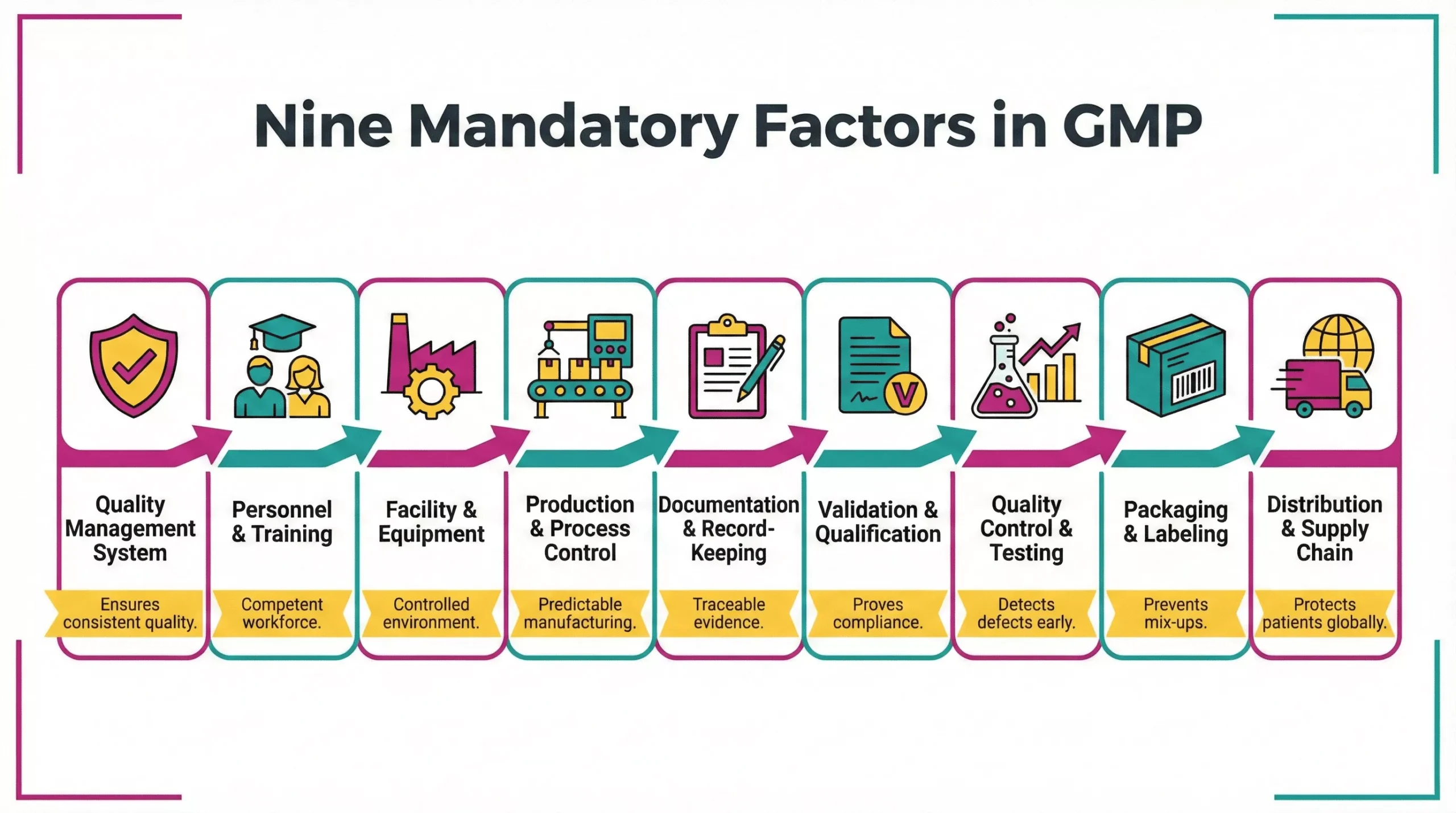
Across WHO, FDA, and EU frameworks, nine themes appear again:
- Quality Management System and senior leadership oversight.
- Personnel Qualifications, GMP training, and clear responsibilities.
- Facility and Equipment Design that supports clean, controlled operations.
- Production and Process Control, including change control and deviation handling.
- GMP Documentation and record-keeping that proves “what happened, when, and by whom.”
- GMP Validation and Qualification for processes, equipment, and systems.
- Quality Control and testing before batch release.
- Packaging and Labeling controls to prevent mix-ups and errors.
- Distribution and Supply Chain Controls, often aligned with WHO good distribution practices.
Moreover, regulators expect regular internal GMP audits, strong data integrity, and transparent responses to findings. In 2023, FDA issued 94 warning letters to drug manufacturing sites over quality problems, many linked to basic GMP documentation and process control gaps.
List of GMP Requirements
The sections below group GMP requirements into nine mandatory areas. Each area supports the others, so strong GMP compliance requirements depend on balance and consistency across the full system.
1. Quality Management System
A strong Quality Management System (QMS) sits at the center of GMP. It links strategy, operations, and continuous improvement into one clear structure. Therefore, leaders use the QMS to guide every decision that affects product quality.
- Define a written quality policy and measurable quality objectives.
- Assign clear responsibilities to production, QC, and QA teams.
- Use risk management tools to prioritize issues and actions.
- Review key quality indicators in regular management review meetings.
- Drive CAPA programs that fix root causes, not just symptoms.
2. Personnel & Training Requirements
GMP starts with competent people who understand their roles. Every employee needs the right skills, attitude, and training before handling products or data. In addition, managers must lead by example and reinforce good practices daily.
- Create role profiles that describe tasks and required competencies.
- Provide structured GMP induction and on-the-job training.
- Refresh critical training topics at planned intervals.
- Keep training records up to date and easy to check.
- Coach staff after audits, deviations, or near misses to strengthen behavior.
3. Facility & Equipment Requirements
Facilities and equipment must support clean, controlled, and efficient manufacturing. The layout should reduce contamination risks and keep flows simple. At the same time, robust utilities and maintenance plans keep systems reliable.
- Design material and personnel flows that separate clean and dirty areas.
- Install HVAC, water, and compressed air systems that fit product needs.
- Use equipment that operators can clean, calibrate, and maintain effectively.
- Plan preventive maintenance so breakdowns stay rare and predictable.
- Monitor critical environments with clear limits and action plans.
4. Production & Process Control Requirements
Production and process control requirements keep each batch within approved limits. They translate development knowledge into practical shop-floor instructions. As a result, operators follow a clear roadmap from raw material to finished product.
- Write detailed master batch records for every product and strength.
- Control raw materials through approved suppliers and specifications.
- Record critical steps in real time, not at the end of the shift.
- Investigate process deviations promptly and document conclusions.
- Use change control for any adjustment that may affect quality.
5. Documentation & Record-Keeping Requirements
Good documentation proves that the right actions happened at the right time. It also allows teams and inspectors to reconstruct each batch history. Therefore, companies must treat documents and records as core quality tools, not bureaucracy.
- Standardize formats for SOPs, logbooks, and batch records.
- Ensure entries remain legible, dated, and signed by the performer.
- Correct mistakes with single lines, explanations, and initials.
- Control document versions, so teams always use current procedures.
- Apply data integrity principles (ALCOA+) to paper and electronic records.
6. Validation & Qualification Requirements
Validation and qualification show that facilities, utilities, equipment, and processes are performed as intended. They reduce uncertainty and support confident batch release. In addition, they give regulators concrete evidence that systems stay under control.
- Define user and functional requirements before buying new systems.
- Execute IQ, OQ, and PQ protocols with approved acceptance criteria.
- Validate critical computerized systems and analytical methods.
- Re-evaluate validation status after significant changes or trends.
- Keep validation reports and raw data accessible for GMP audits.
7. Quality Control & Testing Requirements
Quality Control (QC) checks whether materials and products meet specifications. The QC lab acts as an independent gatekeeper for batch release. However, QC does not work alone; it links closely with production and QA.
- Test incoming raw and packaging materials against approved specs.
- Perform in-process controls where they prevent rework and scrap.
- Analyze finished product batches and review trends over time.
- Manage OOS and atypical results with structured investigations.
- Maintain validated methods, calibrated instruments, and reference standards.
8. Packaging & Labeling Requirements
Packaging and labeling protect the product and the patient. Errors here can cause serious safety incidents. Consequently, companies must design packaging operations that minimize mix-ups and wrong information.
- Approve and control all artwork and text before printing.
- Use line clearance procedures before each packaging is run.
- Reconcile printed components and investigate major differences.
- Implement checks for batch numbers, expiry dates, and strength.
- Add serialization or tamper-evident features where regulations require them.
9. Distribution & Supply Chain Requirements
GMP responsibilities continue after batch release. The distribution and supply chain network must preserve product quality until it reaches patients. Therefore, manufacturers need strong links to GDP principles and reliable partners.
- Qualify transport and warehouse providers with clear technical agreements.
- Control storage conditions, including temperature and humidity mapping.
- Use suitable packaging and cold-chain solutions for sensitive products.
- Track shipments and handle excursions with documented assessments.
- Review supply chain risks regularly, including counterfeit and diversion risks.
How to Apply GMP Requirements in Daily Operations
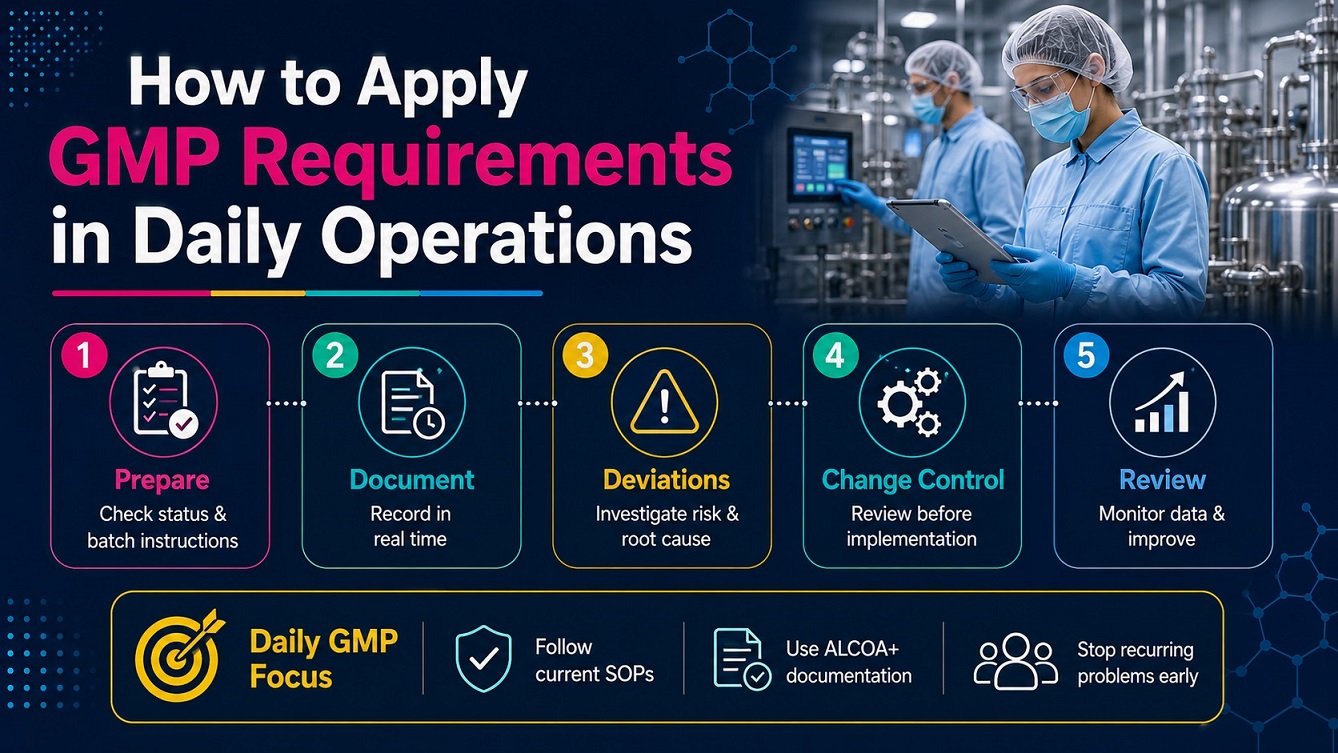
GMP requirements become effective when employees apply them during routine pharmaceutical activities. Teams must follow approved procedures while producing, testing, storing, and releasing medicines. Before starting work, operators should confirm equipment status, cleaning records, material identity, and current batch instructions.
Regular review of batch records, laboratory results, environmental data, and equipment performance helps identify problems early. These controls transform written GMP requirements into a reliable quality system that protects patients.
- Follow current SOPs and approved batch instructions.
- Record activities immediately using ALCOA+ principles.
- Investigate deviations before they become recurring problems.
WHO vs FDA vs EU GMP Requirements
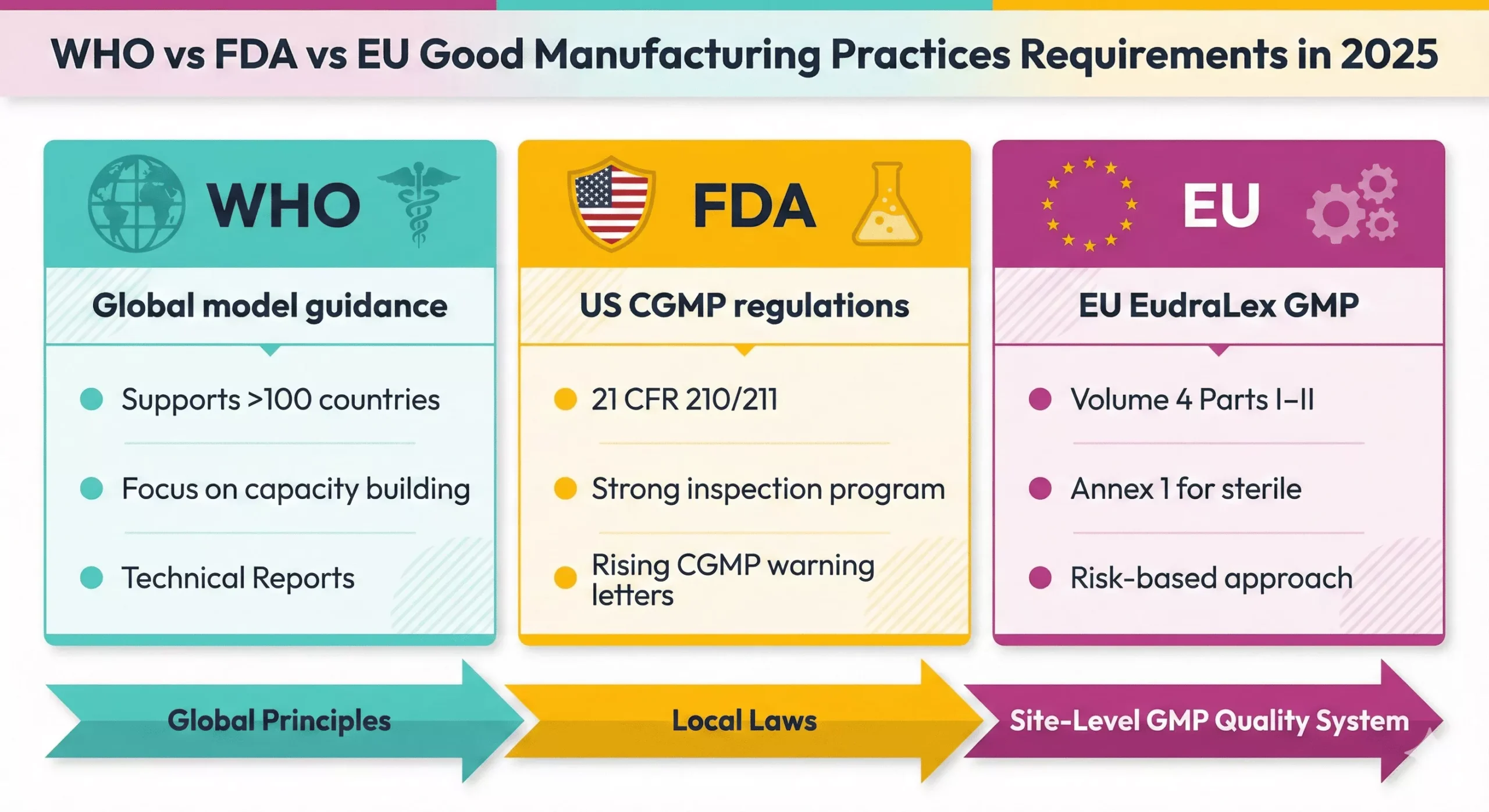
While WHO, FDA, and EU frameworks share common principles, they differ in legal status, structure, and emphasis. The table below summarizes key differences in GMP Requirements:
| Aspect | WHO GMP Requirements | FDA GMP Requirements | EU GMP Requirements (EudraLex) |
|---|---|---|---|
|
Main scope |
Global guidance for member states |
US drugs, biologics, some devices |
EU/EEA human and veterinary medicines |
|
Legal force |
Non-binding model, adopted into national law |
Binding federal regulations (21 CFR 210/211, etc.) |
Binding Directives / Regulations plus guidelines |
|
Guideline structure |
WHO Technical Reports and GMP manuals |
Regulations plus guidance documents |
EudraLex Vol. 4: Part I, Part II, Annexes |
|
Focus areas |
Foundational GMP standards and capacity building |
Detailed expectations and strong enforcement |
Risk-based control, Annex-driven specific topics |
|
Inspection model |
Prequalification, support to national authorities |
FDA inspections worldwide |
National authorities plus EMA coordination |
|
Recent trends |
Support for LMIC systems and prequalification schemes |
Rising share of CGMP-related warning letters |
Revised Annex 1 for sterile products and new rules |
WHO guidelines often serve as a reference for national regulators that build local GMP standards. FDA rules sit directly in US law, and FDA inspections worldwide enforce FDA GMP requirements. The EU relies on EudraLex Volume 4 and its annexes, including a recently updated Annex 1 that tightens controls for sterile manufacturing.
Because of this, global manufacturers usually design one integrated GMP quality system. Then they map that system against WHO GMP requirements, FDA expectations, and EU rules. A structured GMP checklist helps teams confirm coverage across all three regions.
35-slide GMP comparison guide
Final Words
Good Manufacturing Practices Requirements keep medicines safe, effective, and consistent from batch to batch. This article outlined the nine core GMP pillars: quality management, people, facilities, production control, documentation, validation, QC, packaging, and distribution. Together, these elements form a living GMP quality system that supports everyday operations and long-term compliance.
Moreover, global regulators continue to raise the bar. WHO updates its guidance, FDA tracks data from inspections and warning letters, and the EU refines annexes like Annex 1. Therefore, manufacturers need ongoing training, internal GMP audits, and regular gap assessments to keep pace with changing expectations.
If professionals want to deepen their expertise, they can explore pharma courses that focus on GMP compliance requirements, GMP audits, and GMP documentation best practices. Strong knowledge of GMP standards supports better decisions, safer products, and a more resilient pharma career.
FAQ
Good Manufacturing Practices Requirements Requirements cover nine key areas: quality management, personnel, facilities, production control, documentation, validation, QC testing, packaging, and distribution. Moreover, regulators expect companies to link these areas into one strong GMP quality system. As a result, manufacturers reduce risk and protect patients.
WHO GMP requirements offer global guidance that many countries use as a model. However, FDA GMP requirements sit directly in US law and include detailed CGMP rules and strict enforcement. EU GMP standards follow EudraLex Volume 4 and focus strongly on risk management and annexes like sterile manufacturing. Therefore, global companies map one system to all three.
Firms need clear SOPs, batch records, logbooks, cleaning records, validation reports, and training files. Moreover, they must apply data integrity principles to all GMP documentation, whether on paper or in electronic systems. Therefore, inspectors can trace who did each action, when, and why.
GMP validation shows that processes, equipment, and systems perform as expected over time. In addition, it supports consistent quality and reliable batch release decisions. Therefore, regulators treat validation data as core evidence of compliance with GMP requirements.
References

Stephanie Männicke
Digital Marketing Especialist at Zamann Pharma Support, brings 8 years of experience in Corporate and Digital Communication. Specializing in Digital Marketing and Content Creation, Stephanie is currently focused on creating strategic content for Pharmuni's networks, especially content on topics such as recruitment, onboarding and employer branding. Outside of work, Stephanie is a mum, a crocheter and a movie fan. An avid reader and in search of expanding her knowledge, Stephanie is always looking for ways to innovate communication in the digital environment and connect people in a genuine way.

Biopharma Job in 2026: Roles, Skills, Salaries & Career Paths
Discover how biopharma jobs connect research, manufacturing, quality, regulatory affairs, clinical development, and patient outcomes. Compare core skills, current salary benchmarks, career paths, and hiring

Quality Assurance Pharma Jobs in 2026: Roles, Skills, Salaries & Career Paths
Quality assurance pharma jobs connect GMP, QMS, documentation, investigations, and patient safety across pharmaceutical operations. This guide explains key QA roles, qualifications, salary benchmarks, career
Pharma Regulatory Consulting Firms 2026: Unlock Your Drug Approval Success
Pharma regulatory consulting firms provide critical expertise that accelerates drug approvals and ensures global compliance. By navigating complex regulations like FDA, EMA, and ICH,