


Features
Topics
Discover

Unlock the potential of your career in the Pharma industry with our online courses and qualifications.

Career Path

Pick a career path, follow its guided course roadmap, and secure industry-verified credentials in a few months.

Courses

Earn career credentials from industry leaders that demonstrate your expertise.

GMP Certification Cost: Complete Guide to Fees, Types & Cost Factors (2025)

GMP certification cost looks confusing at first. Different agencies, audits, and training programs all add fees. However, a clear breakdown helps plan both budget and timeline.

Most companies spend from about $10,000 to $50,000 for initial GMP training, depending on facility size, scope, and certifying body. Some complex pharma plants may pay up to $100,000 or more over the full certification cycle.

In Europe, food and beverage Good Manufacturing Practices certification often sits between €7,000 and €40,000 for the first cycle, with annual maintenance costs around €3,000–€10,000. Therefore, understanding each piece of the GMP certificate price helps teams avoid surprises. This Guide  explains cost drivers, compares certification types, and shows how training with platforms like Pharmuni can reduce the overall GMP cost in pharma.

Table of Contents

What Is GMP Certification?

Good Manufacturing Practice (GMP) defines how regulated products must be manufactured and controlled. Regulators and standards bodies use GMP to protect patients and consumers from unsafe or poor-quality medicines, devices, and related products.

In practice:

  • Regulators (such as FDA, EMA, national authorities) set legal GMP rules.

  • Certification bodies assess compliance against GMP or GMP-based standards.

  • Companies seek a GMP certificate to enter or maintain access to regulated markets.

Key Cost Components of GMP Certification

The total GMP compliance cost usually combines several elements. Each item can vary by country, sector, and plant complexity.

Key cost components include:

  • Application & Documentation Fees
  • GMP Audit & Inspection Costs
  • Training & Personnel Qualification Costs
  • Consultant / Gap-Assessment Fees
  • Certificate Issuance & Renewal Fees

Let’s look at each part in more detail.

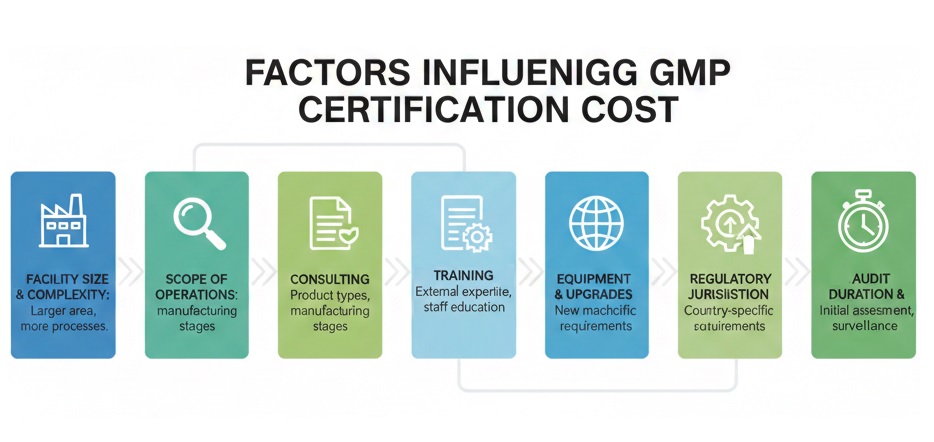
From audits to training: see the real factors that push GMP certification cost up or down
Plant size, process risk, people skills – discover what truly drives your GMP budget

Application & Documentation Fees

Authorities or certification bodies often charge a fee to:

  • Open the application file

  • Review quality manuals, SOPs, validation reports, and site data

  • Handle questions and document revisions

Typical drivers for this part of the GMP certificate price:

  • Number of products and dosage forms

  • Complexity of processes and technologies

  • Level of document organisation and completeness

Well-structured documents and clear SOPs can reduce time spent on review and therefore keep this fee in a lower range.

GMP Audit & Inspection Costs

The GMP audit fee usually forms the most visible single cost line. It covers:

  • Auditor or inspection team day rates

  • Travel and accommodation, if needed

  • Preparation and reporting time

  • Any follow-up review after CAPAs

Audit cost ranges depend on:

  • Length of the audit (one day vs. several days)

  • Size and risk level of the facility

  • Whether the audit is initial, surveillance, or re-certification


Training & Personnel Qualification Costs

Regulators expect competent and trained staff. So GMP training programs play a critical role in total GMP training cost.

Typical training options include:

  • Short online courses with quizzes and certificates of completion

  • Full GMP academies or blended programs

  • On-site classroom workshops and role-specific sessions

Main cost drivers:

  • Number of employees in scope

  • Depth and duration of each program

  • Use of external trainers vs. internal experts

This approach lowers the effective GMP training cost per learner over time.

Consultant / Gap-Assessment Fees

Many companies hire GMP consultants to run a gap analysis before the formal audit. These experts identify weaknesses, help draft CAPAs, and guide implementation.

Consultant cost varies widely. However, some guidance articles estimate that consulting, training, and system upgrades together add several thousand dollars on top of the base certification fee, often pushing the total around $10,000–$50,000.

Certificate Issuance & Renewal Fees

Many companies invest in GMP consultant cost before the formal audit. A consultant can:

  • Run a structured gap assessment

  • Map current practice to GMP audit requirements

  • Guide CAPA planning and execution

Consultant fees usually depend on:

  • Number of days on-site and remote

  • Number of sites and product lines

  • Depth of support (advice vs. hands-on documentation work)

However, targeted use of consultants works best.

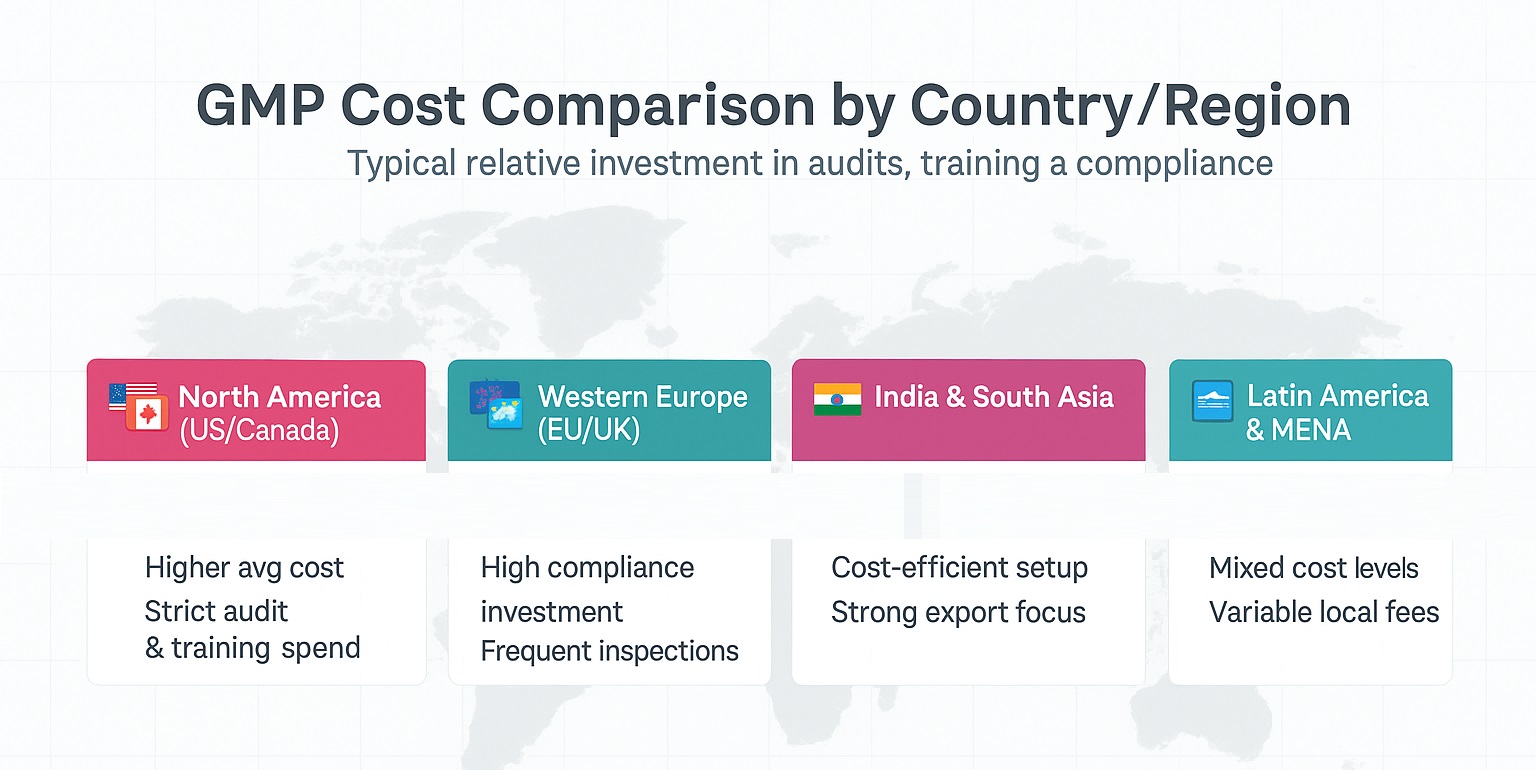
How GMP costs shift across regions – see where your compliance budget fits on the map
From North America to India: compare GMP audits, training, and consultant spend at a glance

GMP Certification Cost Comparison by Certification Type

Different organisations use different paths to prove GMP compliance. Below is an illustrative comparison of typical options and how Pharmuni fits into the picture from a training and preparation angle.

Note: Cost ranges are averages from public sources and market observation. Actual quotes depend on country, scope, and auditor day rates.

Certification / Training Type What It Includes Typical Cost Range (approx.) Best
Regulatory GMP Inspection (FDA / EMA)
Authority inspection, user fees, prep work
$20,000–$100,000+ over several years
Licensed pharma and API manufacturers
Third-Party GMP Certification
Application, document review, site audit
$7,000–$40,000 + €3,000–€10,000/yr
SMEs needing a visible GMP certificate
Professional GMP Person Certification
Individual exam and personal credential
$500–$600 exam + training
QA, QC, RA, production professionals
Typical Online GMP Training Provider
Single online GMP course with certificate
£95–$200 per learner per course
Individuals or small teams needing basic training
Pharmuni GMP Training Subscription
Multiple GMP courses, quizzes, certificates
~€399/year
Teams wanting scalable, multi-course learning

How to Reduce GMP Certification Costs

Companies can actively manage GMP compliance cost. The goal is not only to save money but also to improve quality and reduce regulatory risk.

Consider these practical steps:

  • Build a training strategy early

  • Standardise documentation and templates

  • Run a pre-audit or gap assessment

  • Plan for the full audit cycle

  • Use data to target improvements

    •  

Pharmuni can support several of these steps by offering:

  • Ready-made GMP training programs for core topics

  • Career paths for QA, production, and regulatory roles

  • Certificates of completion that support internal qualification records

Therefore, companies can cut training cost per person while improving consistency and audit readiness.

Final Words

Spending money on GMP always feels serious. Yet real data shows that smart quality investment usually pays back. One WHO-supported case study of a Nigerian manufacturer found that upgrading systems to meet WHO GMP delivered a benefit–cost ratio of about 5.3–8.5, driven by higher sales and export opportunities. Another analysis by Health Canada estimated that stronger API GMP controls could avoid product recalls worth $3.8–$15.4 million per year for generic oral solids alone. FDA reports also confirm that better quality management cuts defects, waste, and recall-related costs over time.

Therefore, the real objective is not to chase the lowest possible GMP cost in pharma. The real objective is to invest in:

  • Robust processes and documentation

  • Competent, well-trained people

  • Smart use of digital tools and online learning

Evidence also shows that focused GMP training reduces errors, deviations, and recall risk, which lowers long-term cost and protects reputation. With the GMP Basics career path, Pharmuni supports this strategy with scalable, affordable training for pharma professionals at every stage of their careers.

FAQs:

1️⃣ What factors influence GMP compliance cost the most?

Several drivers shape GMP compliance cost: facility size, number of products, level of automation, and local regulatory fees. In addition, weak documentation, poor data integrity, and frequent deviations often increase the number of audits and follow-ups. Therefore, strong daily practice usually reduces long-term spending.

2️⃣ What is included in a GMP audit fee?

A typical GMP audit fee covers

  • Auditor day rates
  • Travel
  • Preparation
  • Reporting time

Sometimes it also includes a follow-up review after CAPAs.

3️⃣ How much budget should companies plan for GMP training cost?

GMP training cost depends on training format and team size. Online GMP training programs and subscriptions usually lower the cost per learner, especially when staff complete multiple modules.

References

Picture of Ershad Moradi

Ershad Moradi

Ershad Moradi, a Content Marketing Specialist at Zamann Pharma Support, brings 6 years of experience in the pharmaceutical industry. Specializing in pharmaceutical and medical technologies, Ershad is currently focused on expanding his knowledge in marketing and improving communication in the field. Outside of work, Ershad enjoys reading and attending industry related networks to stay up-to-date on the latest advancements. With a passion for continuous learning and growth, Ershad is always looking for new opportunities to enhance his skills and contribute to pharmaceutical industry. Connect with Ershad on Facebook for more information.

Computer System Validation in Pharma 2025 Guide 

Computer System Validation in pharma keeps your digital systems reliable, compliant, and inspection ready. In this practical CSV guide for 2025, you learn core regulations (21 CFR Part 11, EU Annex 11, GAMP 5), step-by-step lifecycle activities, documentation expectations, and job-relevant skills so you protect data integrity and support safe, efficient pharmaceutical operations.

Read More »
Global PV team in action: tracking ICSRs and PBRER trends in real time.

ICH Guidelines for Pharmacovigilance: Complete E2 Series Guide (2025)

The ICH guidelines for pharmacovigilance explain how drug-safety teams collect, evaluate, and report adverse events across the product lifecycle. This guide walks you through the E2A–E2F series, shows how they support global safety standards, and explains how they link to EMA and FDA rules so you stay compliant and protect patients.

Read More »

PBRER in Pharmacovigilance: Complete 2025 Guide 

PBRER in Pharmacovigilance helps you track safety, explain benefit-risk balance, and meet global PV reporting guidelines. This guide walks you through structure, data sources, timelines, and practical steps to prepare high-quality PBRER reports for regulators and internal teams.

Read More »

Share