


Features
Topics
Discover

Unlock the potential of your career in the Pharma industry with our online courses and qualifications.

Career Path

Pick a career path, follow its guided course roadmap, and secure industry-verified credentials in a few months.

Courses

Earn career credentials from industry leaders that demonstrate your expertise.

cGMP Meaning in Pharma in 2026: Definition & GMP vs cGMP 

cgmp means current Good Manufacturing Practice in pharmaceutical manufacturing. It exists to protect a medicine’s identity, strength, quality, and purity. FDA ties these expectations to 21 CFR Part 210 and 21 CFR Part 211. This article focuses on drug manufacturing, not medical devices. Visit on Good Manufacturing Practices (GMP) to dive in. 

“Current” has a technical meaning. It signals a living, up-to-date state of control. Therefore, teams must manage modern risks on purpose. 

What Is cGMP? Meaning And Definition

Current Good Manufacturing Practice sets the baseline for how drug sites operate. It covers people, facilities, equipment, methods, materials, and records. It also covers oversight, release decisions, and lifecycle control. However, the “current” idea changes the goal. It pushes teams to update controls when science and risk change. 

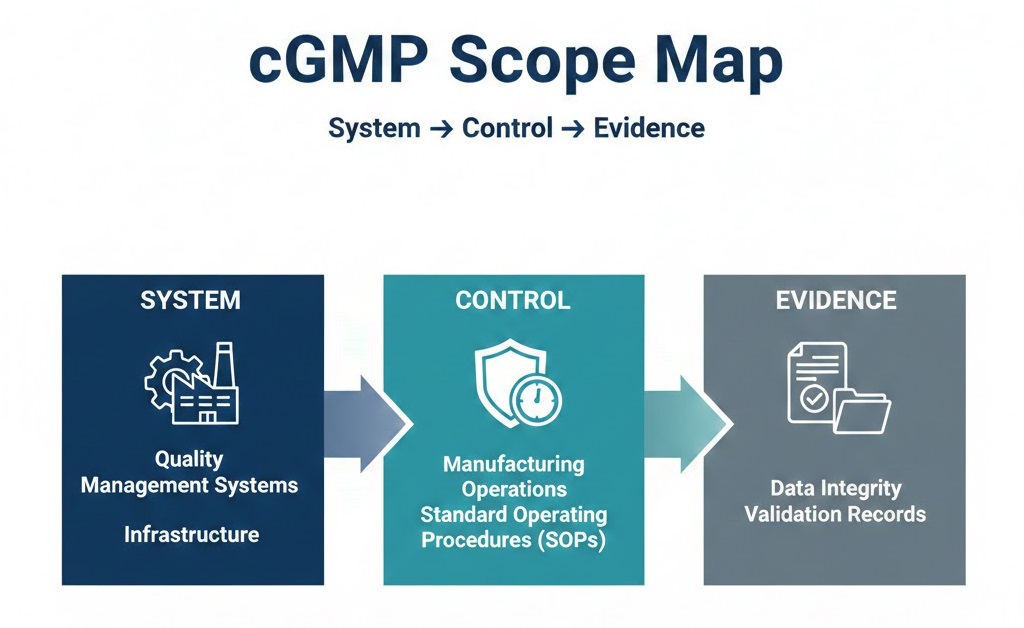
FDA current GMP regulations expect three layers: 

  • Design the system: define roles, rules, and boundaries. 
  • Run the controls: execute tasks the same way, every time. 
  • Keep evidence: prove each decision with reliable records. 
cgmp

cGMP Meaning In Simple Words

This approach builds quality into the work. You also prove control with records that auditors can trust. Final testing alone cannot protect patients. Instead, teams control inputs and process steps from start to finish. Because of that, each batch shows repeatable performance. 

cgmp

What “Current” Means In cGMP

The word “current” means your controls match today’s risks. Therefore, you watch trends and close gaps early. For example, new suppliers can add contamination hazards. Likewise, new software can add data integrity hazards. As a result, your system must evolve before failures repeat. 

Examples of “current” thinking in pharma plants include: 

Legal And Guidance Framework

FDA sets drug manufacturing requirements in 21 CFR Part 210 and 21 CFR Part 211. These parts describe minimum controls for manufacturing and quality oversight.  

In addition, ICH guidance supports risk-based thinking and strong quality systems. So, teams often use ICH Q9 for risk methods. Teams also use ICH Q10 for system design. 

Operational Coverage of cGMP

Modern GMP covers more than production steps. It includes laboratories, warehouses, labeling, utilities, and suppliers. It also includes investigations and CAPA. Because of that, compliance depends on leadership, not only operators. 

Core cGMP Principles for Compliance Execution

Strong compliance starts with clear principles. Next, teams convert principles into systems. Then they generate reliable evidence during daily work. 

Core cGMP Principles → Required System Elements
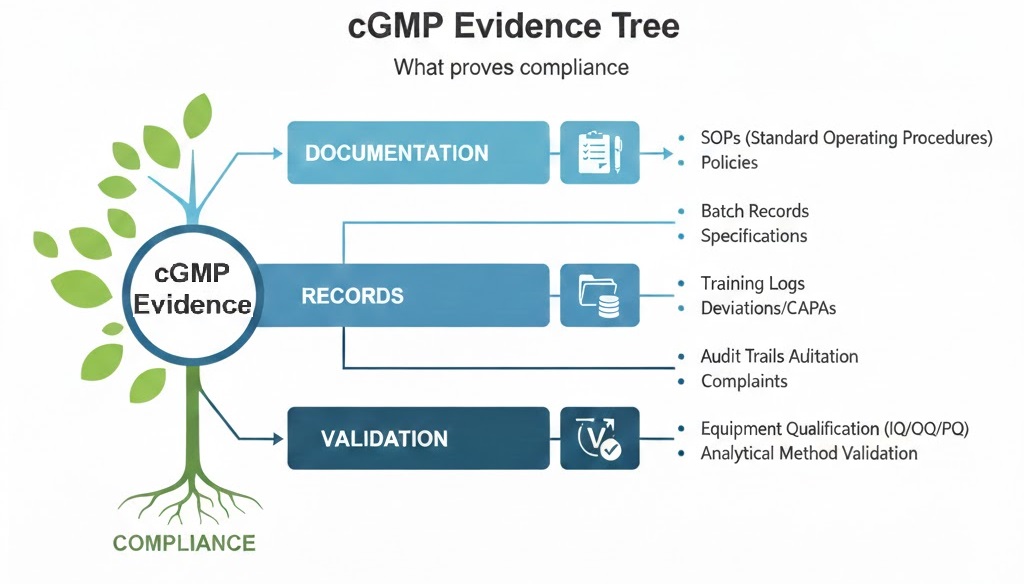
Core cGMP principle What it means in practice Required system elements Typical evidence
Quality Unit authority
Quality makes final calls on quality impact
QCU roles, independence, batch disposition process
QCU approvals, release decisions, disposition logs
Written procedures
People follow one controlled way of working
SOP lifecycle, doc control, training links
Approved SOPs, training records, change history
Build quality in
Process controls prevent defects early
CPP/CQA strategy, in-process controls
Batch records, IPC results, trend charts
Validate what matters
Processes, cleaning, and systems work as intended
Process validation, cleaning validation, CSV
Protocols, reports, deviations, approvals
Data integrity
Data stays complete, consistent, and traceable
Access control, audit trails, ALCOA+ habits
Audit trails, log reviews, incident records
Control change
Changes never “drift” into production
Change control, impact/risk assessment
Change records, approvals, effectiveness checks
Investigate and improve
Deviations trigger root cause and CAPA
Deviation system, CAPA, effectiveness review
Investigations, CAPA plans, closure evidence
Supplier control
Inputs meet specs and stay consistent
Supplier qualification, incoming testing
Audits, quality agreements, COAs, test results
Laboratory control
Lab results stay accurate and defensible
OOS/OOT handling, method control, stability
OOS reports, stability trends, method records

FDA cGMP versus other global regulations

FDA and global frameworks share the same purpose. They protect patients by reducing variation. However, each region writes rules in its own structure. Therefore, teams must map requirements with care. 

EU GMP vs FDA cGMP

EU GMP guidance sits in EudraLex Volume 4 and its annexes. FDA relies on CFR requirements and inspection outcomes. As a result, EU teams often speak in “annexes,” not CFR sections. Still, both expect lifecycle control and strong documentation. 

Here is what usually stays consistent: 

  • Quality oversight and clear responsibilities 
  • Controlled documents and trained people 
  • Risk-based validation and monitoring 

WHO GMP vs cGMP

WHO guidance supports quality alignment across many countries. It also supports procurement and public health programs. Therefore, it often stresses practical, risk-reducing controls. FDA requirements link directly to US legal enforcement for drug sites. 

cGMP Implementation Roadmap

Treat compliance as an operating model. Then you reduce drift and repeat findings. Use this roadmap as a practical sequence. 

Final words

In 2026, “current” GMP still means one thing: keep control up to date. FDA reported 972 drug quality assurance inspections in FY2024. FDA also reported that more than 62% occurred at foreign sites.  

That same FY2024 report listed 421 recalled products, and it named contamination as the most common defect group.  

The report also stated that FDA issued 105 drug-quality-related warning letters in FY2024. Therefore, teams should treat compliance as daily practice, not a one-time project. 

Quick checklist to start today: 

  • Confirm Quality Unit authority and release rules. 
  • Then tighten document control, training, and change control. 
  • Next validate critical processes, cleaning, and systems. 
  • Finally trend performance and act before issues repeat. 

FAQ:

What does “GMP certified supplements” mean?

It usually means the maker follows supplement cGMP (e.g., 21 CFR Part 111) and may also have a private audit, so always check who certified it and the scope. 

Do third-party seals matter (NSF, USP Verified, sport testing)?

Yes, because third-party seals add independent testing/auditing that can strengthen trust beyond a brand’s claims. 

What happens when a supplement fails GMP standards?

FDA actions can include warning letters, recalls, and other enforcement, because the product may be considered adulterated. 

References:

Picture of Stephanie Männicke

Stephanie Männicke

Digital Marketing Especialist at Zamann Pharma Support, brings 8 years of experience in Corporate and Digital Communication. Specializing in Digital Marketing and Content Creation, Stephanie is currently focused on creating strategic content for Pharmuni's networks, especially content on topics such as recruitment, onboarding and employer branding. Outside of work, Stephanie is a mum, a crocheter and a movie fan. An avid reader and in search of expanding her knowledge, Stephanie is always looking for ways to innovate communication in the digital environment and connect people in a genuine way.

Share