


Features
Topics
Discover

Unlock the potential of your career in the Pharma industry with our online courses and qualifications.

Career Path

Pick a career path, follow its guided course roadmap, and secure industry-verified credentials in a few months.

Courses

Earn career credentials from industry leaders that demonstrate your expertise.

GMP Tools: Practical, Audit-Ready Ways to Run and Prove Compliance

GMP Tools are practical templates and systems that help you run GMP work and prove it with evidence. They include controlled SOP templates, batch record logbooks, and checklists, plus calibration and maintenance trackers for equipment, instruments, and utilities.

In pharma, these tools turn Good Manufacturing Practices (GMP) into repeatable routines and fast audit retrieval. They also support CAPA and traceability.  WHO has received 1,500 reports of substandard or falsified products since 2013—both signal why strong documentation and equipment control matter. 

Table of Contents

What are GMP Tools?

GMP compliance tools help teams run compliance work and show proof fast. They include templates, logbooks, and trackers for daily GMP tasks. Also, they guide actions and reduce mistakes during busy production shifts.

Use GMP compliance tools to standardize work and collect clean evidence. Therefore, you find records quickly and answer auditors with confidence. Most teams start with 3 core tools: SOP templates, logbooks, and calibration logs.

  • SOP templates and controlled forms

  • Batch records and equipment logbooks

  • Calibration and maintenance trackers

Core GMP Tool Categories

Core GMP tool categories help teams work fast and stay consistent. They cover templates, logbooks, and trackers for daily compliance tasks. Also, they help you collect clean evidence for audits.

Choose categories that match your process risks and inspection needs. Therefore, you reduce errors and speed up record retrieval.


Turn Daily GMP Tools Into Audit Proof—Fast And Traceable.
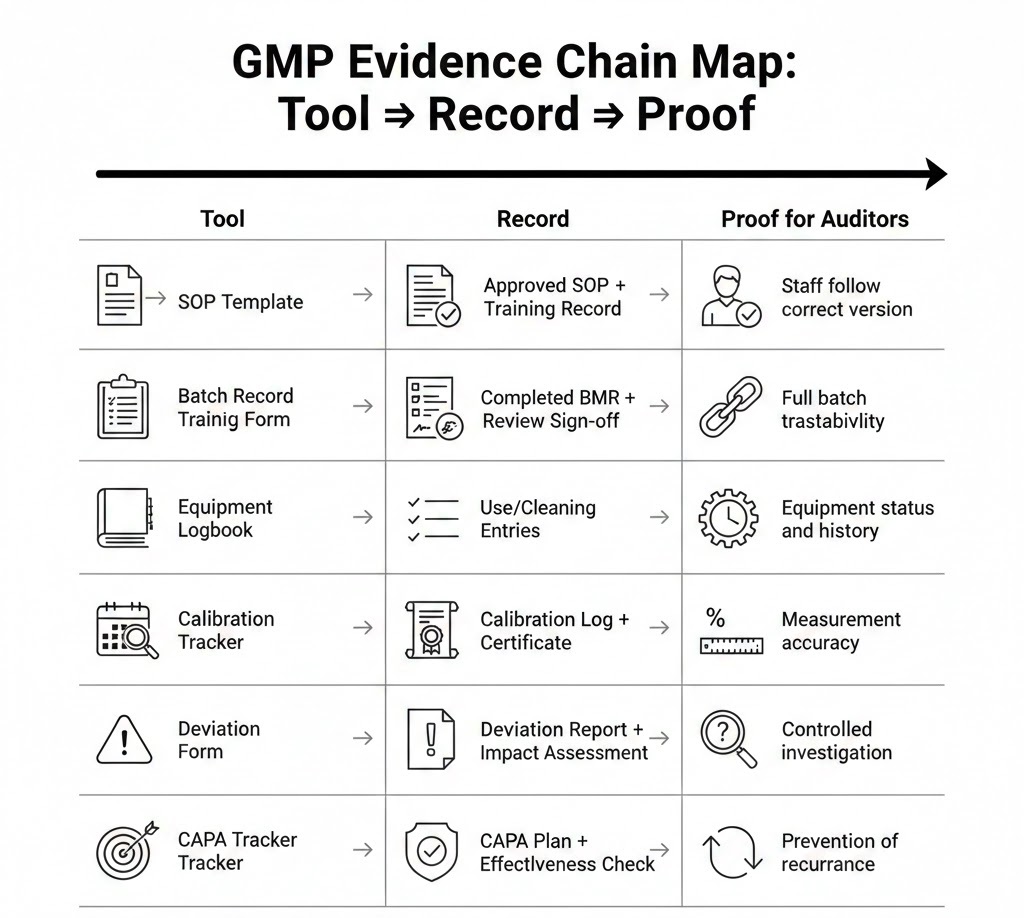
Tool → Record → Proof: Build Evidence That Auditors Trust

Key Features to Look for in GMP Tools

Core GMP compliance categories help teams work fast and stay consistent. They cover templates, logbooks, and trackers for daily compliance tasks. Also, they help you collect clean evidence for audits.

Choose categories that match your process risks and inspection needs. Therefore, you reduce errors and speed up record retrieval. 

Here are core Tools 

  • Documentation control tools
  • Execution and logbook tools
  • Calibration and maintenance tracking tools

Documentation control tools

Documentation control tools keep GMP documents accurate and traceable. They help teams use the right version and avoid repeat errors. Also, they support audits with fast retrieval and clear histories.

Use these tools to manage drafts, approvals, and periodic reviews. Therefore, you reduce findings and speed up QA decisions.


Set 2 rules: one owner per document and one approved master.

  • SOP templates with version control

  • Controlled forms with unique IDs

  • Document change request log

  • Training read-and-understand records

  • Archive and retention checklist 

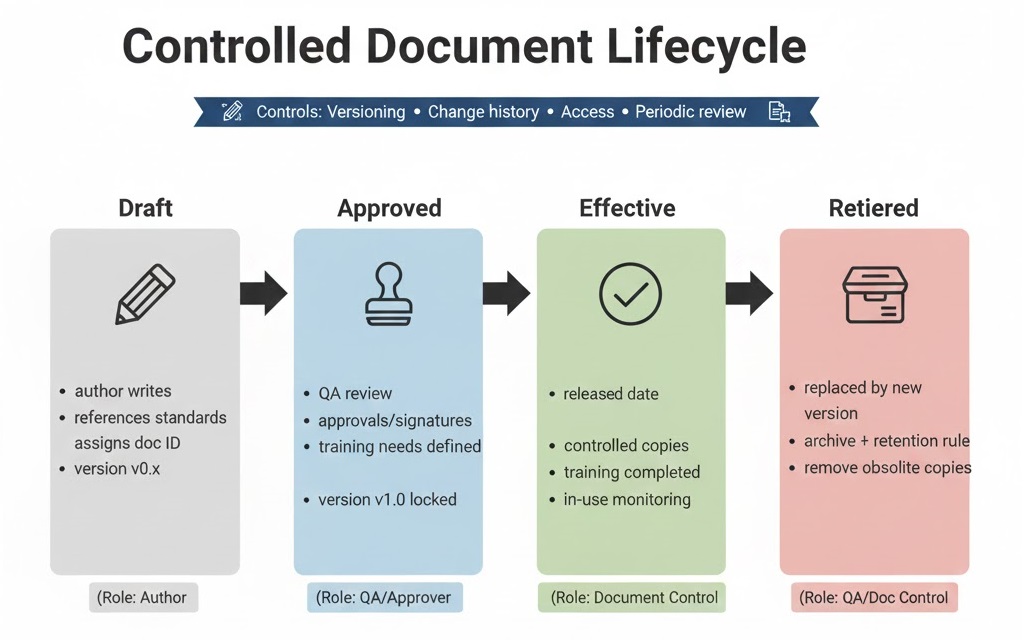
Control Every Version, Then Control Every Risk
Draft To Retired: Keep SOPs Current, Approved, And Audit-Ready

Execution and Logbook Tools

Execution and logbook tools help teams record GMP work in real time. They capture what you did, when you did it, and who did it. Also, they prevent missed steps during busy shifts and handovers.

Use them to prove traceability from materials to finished batches. Therefore, you answer audits and deviations with clear evidence.

  • Batch manufacturing record checklist

  • Equipment use and cleaning logbook

  • Line clearance checklist

  • Material status label log

  • Shift handover log 

Calibration and Maintenance Tracking Tools

Calibration and maintenance tracking tools keep equipment accurate and reliable. They help teams schedule calibration, log results, and store certificates. They also flag overdue instruments before they impact product quality.

Use these tools to plan preventive maintenance and record repairs. Therefore, you reduce downtime and protect data integrity during testing. You should link each task to an asset ID and a due date.

Deviation, CAPA, and Change Control Tools

Deviation, CAPA, and change control tools help teams manage problems and improve. They capture what went wrong, why it happened, and what you will fix. They also stop repeat issues by tracking actions to closure.

Use these tools to assess impact and document decisions quickly. Therefore, you protect patients and keep audits smooth and predictable. You should link each record to evidence, owners, and due dates.

How to Select GMP Tools that Hold Up in Audits

Calibration and maintenance tracking tools keep equipment accurate and reliable. They help teams schedule calibration, log results, and store certificates. They also flag overdue instruments before they impact product quality.

Use these tools to plan preventive maintenance and record repairs. Therefore, you reduce downtime and protect data integrity during testing. You should link each task to an asset ID and a due date.

Paper vs eQMS: When to Go Digital

Paper tools work for small sites with low change volume. QMS tools help you scale control, search, and audit trails. Also, they reduce manual errors across teams and locations.

Go digital when paper creates delays, missing links, or weak traceability. Therefore, you improve retrieval speed and strengthen compliance evidence.

  • Many SOP revisions each month

  • Frequent deviations, CAPAs, and audits

  • Multi-site operations and shared processes

  • Need for e-signatures and audit trails

  • Slow retrieval during inspections

Paper vs Hybrid vs eQMS (Audit-Readiness Comparison

Factor Paper Hybrid eQMS
Version control
Manual
Mixed
Automated
Audit trail
Weak
Partial
Strong
Approvals
Wet sign
Mixed
e-sign + workflow
Retrieval
Slow
Medium
Fast

Audit Evidence Pack: What to Compile Before an Inspection

 Compile An Audit Evidence Pack Before The Inspection. Keep Documents Current And Easy To Find. Therefore, Use A Simple Folder Structure And Assign Owners.

  • Include QMS Documents: SOPs, Training, Deviations, CAPA, Change Control.

  • Include Operational Proof: Batch Records, Logbooks, Calibration, Validation, Supplier Files.

Final Words

GMP Tools help pharma teams run compliant work and prove it with records. They include controlled templates and logbooks for SOPs, batch steps, and line clearance. They also include calibration and preventive-maintenance trackers that link each asset to due dates, results, and certificates. This cuts audit rework fast.

FDA oversight shows why this matters: in FY2024, FDA issued 105 drug quality warning letters to human drug manufacturing sites, driven largely by inspection-based actions.

Start here:

1) control SOP versions

2) standardize logbooks

3) track calibration

4) review deviations monthly

5) build a ready-to-show evidence pack. 

FAQs

1️⃣ What are GMP compliance tools?

GMP compliance tools are templates, records, and systems that help you execute GMP tasks and prove compliance with traceable evidence (documents, logs, approvals, and audits).

2️⃣ Which GMP compliance tools do auditors ask for first?

Auditors usually start with controlled SOPs, training evidence, batch records/logbooks, and calibration/maintenance records, because CGMP expects defined methods, controls, and documented execution.

3️⃣ Why do GMP inspection matter so much in pharma?

They reduce inspection risk by making evidence complete, consistent, and easy to retrieve, which matters because FDA enforcement actions include quality-related warning letters tied to inspections and records.

References

Picture of Ershad Moradi

Ershad Moradi

Ershad Moradi, a Content Marketing Specialist at Zamann Pharma Support, brings 6 years of experience in the pharmaceutical industry. Specializing in pharmaceutical and medical technologies, Ershad is currently focused on expanding his knowledge in marketing and improving communication in the field. Outside of work, Ershad enjoys reading and attending industry related networks to stay up-to-date on the latest advancements. With a passion for continuous learning and growth, Ershad is always looking for new opportunities to enhance his skills and contribute to pharmaceutical industry. Connect with Ershad on Facebook for more information.

Share