


Features
Topics
Discover

Unlock the potential of your career in the Pharma industry with our online courses and qualifications.

Career Path

Pick a career path, follow its guided course roadmap, and secure industry-verified credentials in a few months.

Courses

Earn career credentials from industry leaders that demonstrate your expertise.

Batch Record in Pharmaceutical Industry: GMP Guide 2025

GMP inspectors love Batch Record in pharmaceutical industry. They use them to confirm what you made, how you made it, and who did what. They also use them to test data integrity, traceability, and patient safety. One weak entry can trigger a deeper audit trail review and expand the inspection scope. 

Inspection volume keeps pressure high. For example, FDA’s drug quality assurance inspections increased from 522 (FY2022) to 766 (FY2023) and then 972 (FY2024). In the same year, FDA reported 2,684 surveillance inspections and 453 for-cause inspections across registered drug and device establishments. So, teams need Batch Records that stand up to fast, skeptical review. 

If you run end-to-end operations, you also manage Batch Management In Pharmaceutical Industry. Strong batch management starts with strong batch documentation. 

What Is a Batch Record in the Pharmaceutical Industry?

Batch Record in the pharmaceutical industry documents the full, executed history of one batch. It proves you followed the approved instructions and controlled the process. It also supports batch release decisions and future investigations. 

Think of it as legal + GMP evidence that shows: 

  • The approved process and materials 
  • Actual execution, step by step 
  • In-process checks and results 
  • Deviations, investigations, and approvals 
  • Packaging, labeling, and reconciliation 
  • QA disposition and release decision 

Regulators expect Batch Records for every batch. FDA, for example, requires Batch Production and Control Records and lists the information they must contain

Batch Manufacturing Record (BMR) vs Batch Production Record (BPR)

Teams often mix these terms. In practice, many sites use BMR for the “master/template” and BPR for the “executed” record. 

Topic BMR (Batch Manufacturing Record) BPR (Batch Production Record)

Purpose 

Approved master instructions
Executed proof of what happened

When used 

Before manufacturing starts
During and after manufacturing

Content type 

Process steps, targets, limits
Actual data, signatures, results

Change control 

Controlled master document updates
Controlled corrections and QA review

Output 

“How to make it”
“How we made it”
Batch Record in Pharmaceutical Industry

Regulatory and GMP Requirements for Batch Records

Across agencies, the expectations align. Regulators want records that stay complete, traceable, and reviewable. 

  1. FDA Requirements 
  2. EU GMP Requirements 
  3. WHO Requirements 

FDA Requirements

FDA expects Batch Records that capture key execution data and controls.  
Also, QA must review and approve production and control records before Batch Release, and QA must investigate unexplained discrepancies.  

Practical FDA-aligned requirements include: 

  • Use approved master instructions and controlled copies 
  • Record entries right after the action 
  • Identify operators, checkers, and dates/times 
  • Control corrections with reason and traceability 
  • Link deviations to investigation and disposition 
  • Ensure QA review happens before release 

EU GMP Requirements

EU GMP treats documentation as a core quality system element. It pushes risk-based controls for accuracy, integrity, availability, and legibility of documents. Requires contemporaneous records that keep GMP activities traceable to individuals or systems. EU guidance highlights ALCOA++ principles and strong control over paper forms, copies, and hybrid systems.  

Practical EU-aligned requirements include: 

  • Maintain document inventories and revision histories  
  • Control blank forms, loose sheets, and reconciliations  
  • Design hybrid paper-electronic systems with defined interfaces  
  • Enable batch release decisions with complete records available to the Qualified Person  

WHO Requirements

  • WHO GMP states that a batch processing record should exist for each batch and should capture data at the time each action occurs. 
  • Lists typical batch processing record elements like product name, batch number, start/finish times, responsible persons, material quantities, IPC results, yields, and signed deviation authorizations.  
  • Expects batch packaging records with line clearance checks, reconciliation, and clear identification via signature or electronic password.  
  • WHO inspection checklists explicitly include “batch manufacturing records” for verification against master documents.  

Key Sections of a Pharmaceutical Batch Record

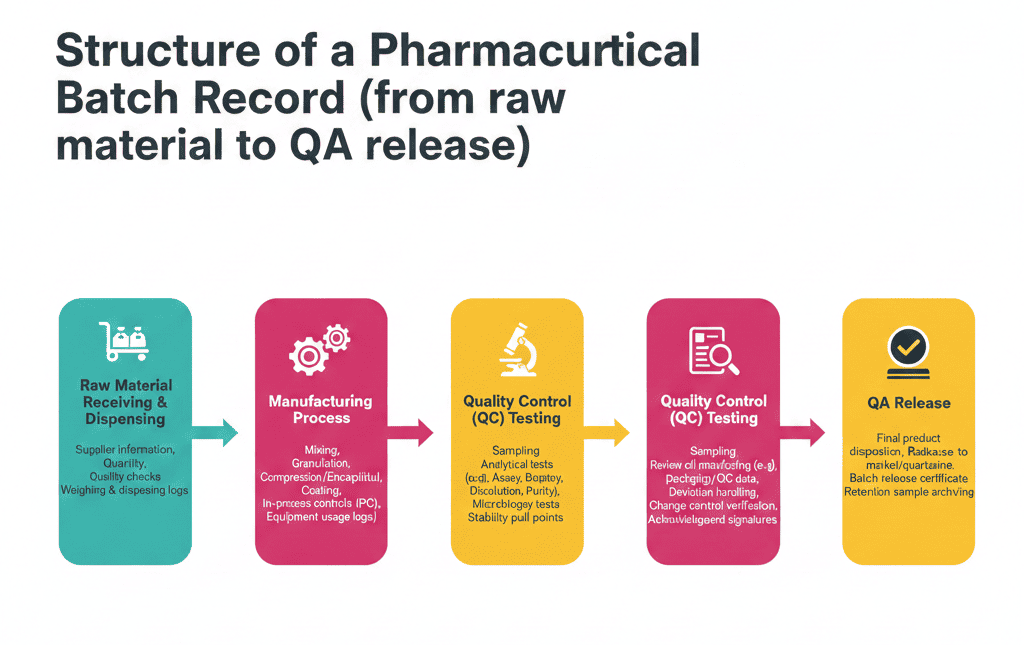
A strong Batch Record reads like a clean story. It also lets QA reconstruct events fast. 

Most sites include these sections: 

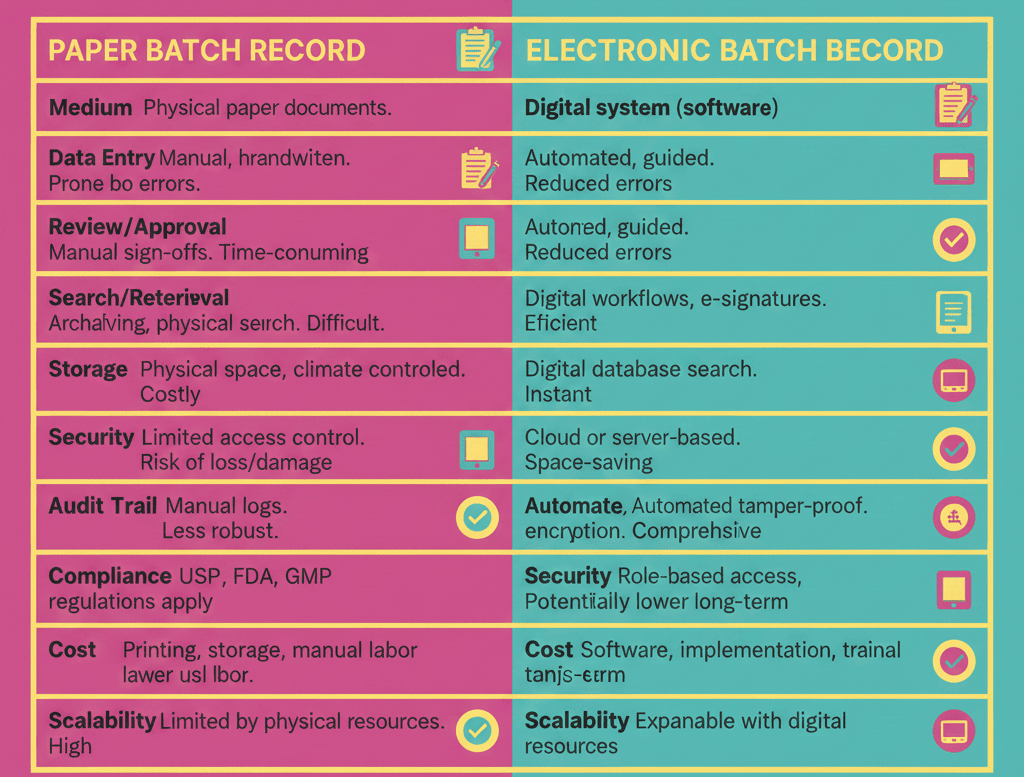
Paper Batch Records vs Electronic Batch Records (EBR)

Paper can work well, but it demands discipline. EBR can reduce human error, but it raises validation and access control expectations. 

Paper Batch Records 

  • You control them with pagination, issuance logs, and reconciliation. 
  • You rely on GDP behavior to protect integrity. 
  • You need strict correction rules and storage rules. 

Electronic Batch Records (EBR) 

  • You gain enforced workflows, calculations, and completeness checks. 
  • You need validated systems, secure access, and audit trails. 
  • You must manage master data governance and system interfaces. 

EU guidance now talks directly about hybrid systems and requires defined interfaces and risk-based controls across paper and electronic elements.  

WHO also recognizes validated computer programs as a way to reduce transcription errors in Batch Records.  

Quick comparison (good for training slides): 

Batch Record in Pharmaceutical Industry

Final words

A Batch Record in pharmaceutical industry acts as your batch’s “single source of truth.” It supports QA release, recalls, investigations, and regulatory defense. So, your record must stay complete, readable, and traceable from start to finish. 

Regulatory attention keeps rising. FDA’s drug quality assurance inspections reached 972 in FY2024, up from 766 in FY2023. Also, FDA reported 2,684 surveillance inspections and 453 for-cause inspections in FY2024 across drug and device establishments. Therefore, strong Batch Records reduces risk, shortens QA review time, and helps you exit inspections faster. 

FAQ:

What is a batch record in the pharmaceutical industry?

A batch record documents how you manufactured and controlled one specific batch. It also proves GMP compliance and supports batch release decisions. 

Why do GMP inspectors focus on batch records first?

Batch records show real execution, not just procedures. So, inspectors use them to confirm traceability and data integrity. 

What is the difference between a master batch record and an executed batch record?

The master record shows approved instructions and target limits. The executed record shows actual values, signatures, and real events. 

References:

Picture of Stephanie Männicke

Stephanie Männicke

Digital Marketing Especialist at Zamann Pharma Support, brings 8 years of experience in Corporate and Digital Communication. Specializing in Digital Marketing and Content Creation, Stephanie is currently focused on creating strategic content for Pharmuni's networks, especially content on topics such as recruitment, onboarding and employer branding. Outside of work, Stephanie is a mum, a crocheter and a movie fan. An avid reader and in search of expanding her knowledge, Stephanie is always looking for ways to innovate communication in the digital environment and connect people in a genuine way.

Share