


Features
Topics
Discover

Unlock the potential of your career in the Pharma industry with our online courses and qualifications.

Career Path

Pick a career path, follow its guided course roadmap, and secure industry-verified credentials in a few months.

Courses

Earn career credentials from industry leaders that demonstrate your expertise.

Aggregate Reporting in Pharmacovigilance a 2026 guide: PSUR, PBRER, and DSUR Explained

Teams confuse ICSRs and aggregate reports, so errors spread. Aggregate reporting in pharmacovigilance fixes this by turning many cases into trends. WHO’s VigiBase holds 40+ million reports; WHO PIDM has 160 full members. Wrong report choices risk non-compliance and missed signals for patients. 

In Pharmacovigilance, this guide defines aggregate reporting, then quickly compares ICSR vs periodic reports. It flags key audit expectations. Next, it explains PSUR and PBRER, and it helps you choose DSUR. Please cite WHO PIDM membership data and VigiBase statistics in-text. Also cite ICH E2C(R2) for PBRER and ICH E2F for DSUR.

Table of Contents

What Is Aggregate Reporting in Pharmacovigilance?

Aggregate reporting in pharmacovigilance reviews safety data across many cases over time. It summarizes patterns, exposure, and benefit–risk, not single patient stories. Teams use it to spot trends and decide risk actions earlier.

However, ICSRs report one case quickly, while aggregate reports evaluate many cases periodically. You may write PSUR/PBRER after approval, and DSUR during trials.

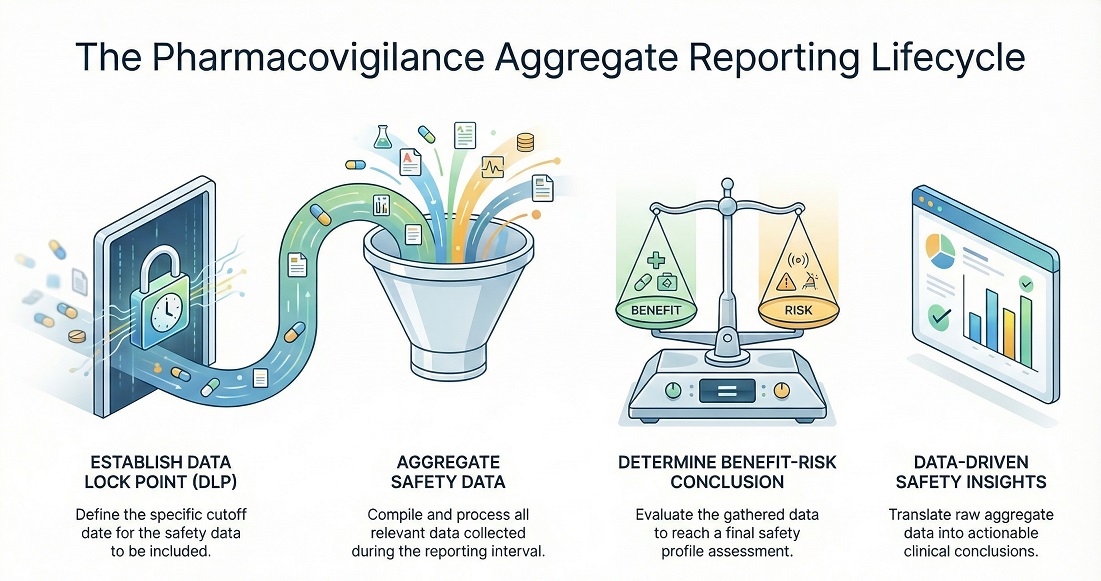
  • Define the reporting period and set a clear data lock point (DLP).

  • Combine case counts, literature, and exposure estimates to assess signals.

  • Conclude with benefit–risk, then list actions, timelines, and owners clearly.

Aggregate Reporting in PV: From DLP → Data → Benefit–Risk Conclusion” (simple flow)
Aggregate Reporting in PV : a simple flow

Aggregate Safety Report vs ICSR

An ICSR reports one patient case, fast and detailed. It captures key facts, timelines, and reporter context. Teams submit it quickly to meet legal timelines.

An aggregate safety report reviews many cases over a period. It summarizes trends, exposure, and benefit–risk conclusions. It supports signal review and risk decisions.

However, use each report for a different goal.

  • Use ICSRs for urgent, case-level reporting and rapid follow-up.

  • Use aggregate reports for periodic evaluation and clear risk actions.

Purpose, trigger, timeline, data sources, outputs, common errors in Aggregate Safety Report and ICSR

Category ICSR (Individual Case Safety Report) Aggregate Safety Report (PSUR/PBRER/DSUR)
Purpose
Report one case; enable rapid assessment and follow-up.
Evaluate cumulative safety and benefit–risk over a defined interval.
Trigger
Receive a valid case that meets reporting criteria.
Reach scheduled reporting interval for a product/study program.
Timeline
Submit promptly per local rules; update with follow-up data.
Lock data at DLP; analyze interval; submit per schedule.
Data sources
Case narrative, labs, meds, reporter details, attachments.
ICSR pool, literature, exposure estimates, trials, actions, labeling.
Outputs
Completed ICSR, case analysis, regulatory submission, query responses.
PSUR/PBRER/DSUR report, trend analysis, regulatory submission, action plan.

Key Terms Related to Aggregate Reporting

In aggregate reporting, teams use clear terms to align data and decisions. DLP sets the cutoff date for included cases and data. Reporting interval defines the time window you review, like quarterly or yearly. These terms help teams compare periods and track changes.

Therefore, benefit–risk links safety findings to clinical value for patients. It helps teams decide updates, actions, and messaging.

  • DLP: lock the dataset on a fixed date.

  • Reporting Interval: review a defined time window.

  • Benefit–Risk: weigh harms against benefits, then decide actions.

Term Number 1 : DLP in Pharmacovigilance

Data Lock Point (DLP) sets the cutoff date for PV data in a periodic report. Teams include only cases, literature, and exposure data received up to that date. Therefore, you freeze datasets, run quality checks, and start analysis right after DLP.

  • Set DLP early.

  • Track late arrivals.

  • Document data sources.

Sample: DLP = 31 Mar 2026 for Q1 safety review.

Term Number 2: Reporting Interval

A reporting interval defines the time window you review in a safety report. Teams choose it based on approvals, risk level, and regulator schedules. It keeps analyses consistent across periods and products.

Therefore, you match the interval to your DLP and submission plan. You also compare trends across intervals to spot new risks faster.

  • Pick a clear start and end date.

  • Align the interval with your DLP calendar.

  • Keep the interval consistent for trend comparisons.

Sample: Reporting interval = 01 Jan–31 Mar 2026 (Q1).

Term Number 3: Benefit–Risk

Benefit–risk in pharmacovigilance compares a product’s benefits with its known risks. Teams use it to decide label updates, risk minimization actions, and communication needs. It supports consistent decisions across regions and time periods.

Therefore, you review signals, exposure, and outcomes together. Then you state a clear conclusion and list next actions.

  • Summarize key benefits for the intended patients.

  • List main risks and any new safety signals.

  • Decide actions: monitor, update labels, or add controls.

Sample: Benefit outweighs risk; update warning for liver events.

What Is PBRER / PSUR in Pharmacovigilance?

PSUR is a periodic safety update for marketed medicines. It summarizes worldwide safety data for a defined interval. PBRER adds a structured benefit–risk evaluation to the periodic report. 

Therefore, ICH E2C(R2) sets a PBRER format for ICH regions. It asks for exposure estimates and safety actions per interval. Cite ICH E2C(R2) for PBRER and GVP Module VII for PSUR. 

Which Aggregate Report Do I Need?

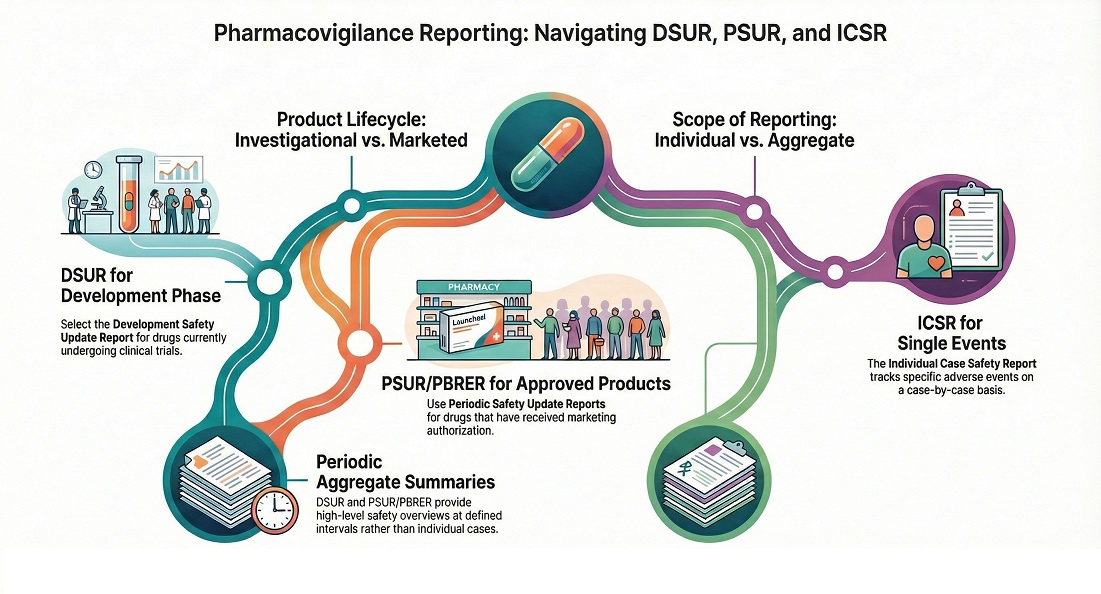
Choose the report based on product stage and region. Use DSUR during clinical trials, and use PSUR or PBRER after approval. However, align timing with your DLP and interval. Then follow SOP and regulator guidance for submissions. Therefore, check local rules before you start.

  • DSUR: ongoing trial safety, yearly. EU periodic safety update.

  • PBRER: benefit–risk focus for ICH.

  • Choose one format, avoid duplicates.

  • Document scope, data sources, and actions.

Read the PSUR in Pharmacovigilance guide now and stay inspection-ready with Pharmuni.

Which Report Do I Need
Decision Tree: DSUR vs PSUR/PBRER vs ICSR

PSUR vs PBRER difference

PSUR summarizes safety findings and trends for a set interval after marketing authorization. It supports EU periodic safety obligations and drives label updates.

PBRER follows ICH E2C(R2) and evaluates overall global benefit–risk, not just safety. However, teams often use the same dataset and narrative structure across markets.

  • PSUR aligns with EU GVP Module VII and the EURD schedule.

  • PBRER requires explicit benefit–risk conclusions per interval, including exposure and effectiveness context.

DSUR vs PSUR/PBRER

DSUR supports safety monitoring during clinical development. It summarizes trial and non-trial data for an investigational product. Teams use DSUR to manage emerging risks while studies continue.

PSUR/PBRER support periodic evaluation after marketing authorization. However, they focus on post-market exposure and real-world safety trends. Therefore, choose based on product stage and reporting obligations.

  • Use DSUR for ongoing trials and annual development updates.

  • Use PSUR/PBRER for marketed products and periodic post-approval review.

Final Words

Aggregate reporting in pharmacovigilance turns many cases into one periodic safety story. Use ICH E2C(R2) for PBRER and ICH E2F for DSUR. These standards guide benefit–risk review across defined intervals and DLPs.

Decision logic: If you submit an ICSR, report one case fast. If you write an aggregate report, evaluate trends periodically. If the product stays in trials, choose DSUR. If the product sells, use PSUR or PBRER. Next, build an SOP and a reporting calendar. List references at the end: ICH, EU GVP Module VII, and FDA 21 CFR 314.80 plus local authority guidance.

FAQs

1️⃣ When do I submit an ICSR instead of an aggregate report?

You submit an ICSR for one case and urgent timelines. You use an aggregate report to review trends over a set interval.

2️⃣ What does an aggregate report evaluate that an ICSR cannot?

It evaluates cumulative patterns, exposure, and benefit–risk conclusions. It also supports signal review and risk actions.

3️⃣ Which report fits clinical trials: DSUR or PSUR/PBRER?

Choose DSUR for products under development and ongoing trials. Choose PSUR/PBRER mainly for marketed products.

  • References (3): ICH E2C(R2) PBRER guideline.

  • EMA GVP Module VII (PSUR) guideline.

  • EMA ICH E2F DSUR scientific guideline page.


References

Picture of Ershad Moradi

Ershad Moradi

Ershad Moradi, a Content Marketing Specialist at Zamann Pharma Support, brings 6 years of experience in the pharmaceutical industry. Specializing in pharmaceutical and medical technologies, Ershad is currently focused on expanding his knowledge in marketing and improving communication in the field. Outside of work, Ershad enjoys reading and attending industry related networks to stay up-to-date on the latest advancements. With a passion for continuous learning and growth, Ershad is always looking for new opportunities to enhance his skills and contribute to pharmaceutical industry. Connect with Ershad on Facebook for more information.

Wide view of a regulated pharmaceutical manufacturing facility during a quality inspection, illustrating pharmaceutical GxP compliance, GxP inspection readiness, quality risk management, data integrity expectations, and pharmaceutical governance systems.

GxP in pharma in 2026: How Inspectors Evaluate System Control

This article explains how GxP quality systems are assessed during inspections, why gaps in governance and execution lead to repeat audit findings, and how regulated pharma operations strengthen inspection readiness through risk management, data integrity, and lifecycle compliance controls.

Read More »

Share