


Features
Topics
Discover

Unlock the potential of your career in the Pharma industry with our online courses and qualifications.

Career Path

Pick a career path, follow its guided course roadmap, and secure industry-verified credentials in a few months.

Courses

Earn career credentials from industry leaders that demonstrate your expertise.

Drug Stability Meaning in Pharma: The Simple Beginner Guide in 2026

Drug Stability prevents unsafe medicines. In pharma, drug stability means a product maintains identity, strength, quality, and purity across shelf life. WHO guidance uses long-term studies (25°C/60% RH) to set expiry dates, because degradation can cause an ineffective dose or safety risk. You’ll learn stability types and shelf-life basics.

In Pharmacovigilance, stability issues show up often as temperature excursions, complaint clusters, and recalls. WHO expectations also use accelerated data (40°C/75% RH) and 3 primary batches to confirm trends. You’ll learn how to read storage statements, what to report, and when to trigger a quality investigation.

Table of Contents

What Is Drug Stability in Pharma?

Drug Product Stability in pharma means a medicine stays safe and effective over time. It keeps its strength, purity, and quality within limits. First, then, and finally, stability links formulation, packaging, and storage conditions.

Teams study stability to set shelf life and storage labels. If stability drops, patients may face an ineffective dose. Key checks follow across 3 phases in development and supply. As a result, teams protect patients and avoid complaints.

  • Assay and impurities show chemical change.

  • Appearance and dissolution confirm physical performance.

  • Sterility and preservative tests prevent microbial growth.

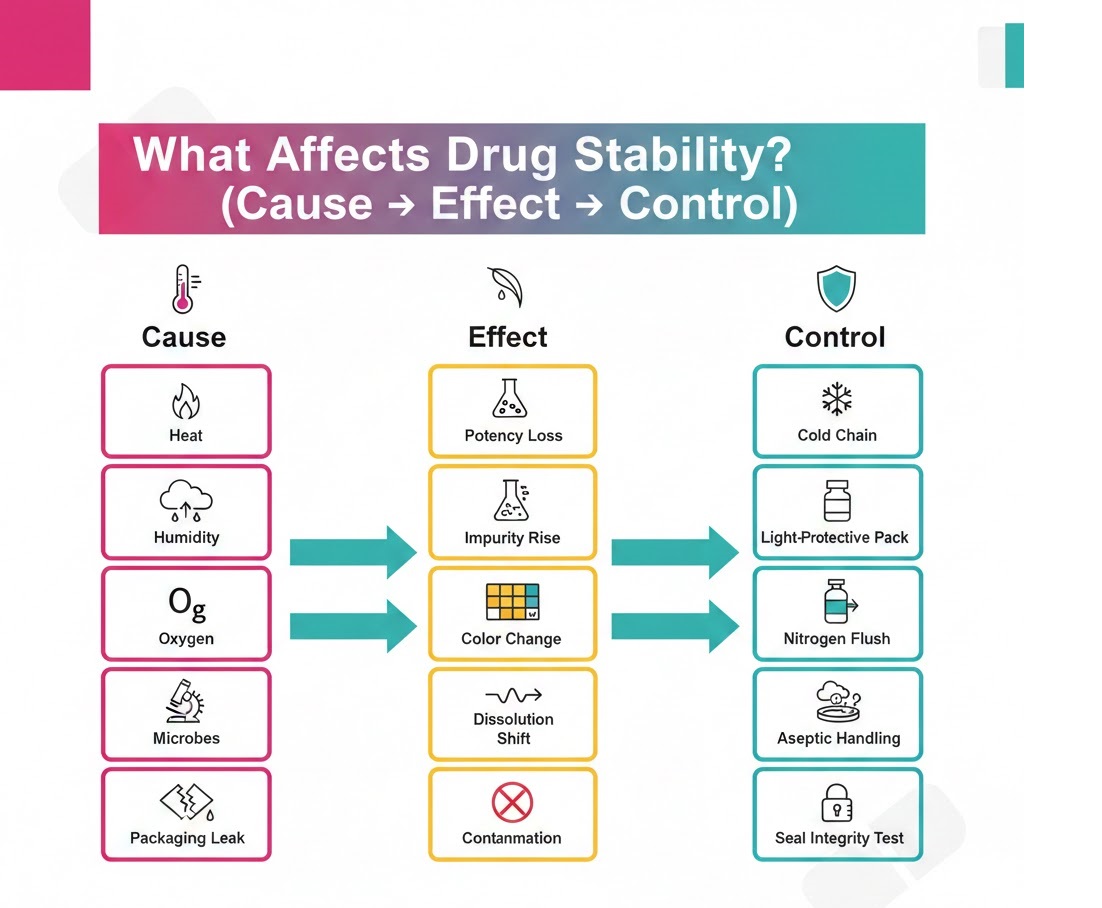
Heat, light, and humidity drive change. Controls stop failures fast.
Map the risk, see the effect, and apply the right control

Drug Stability Meaning in Simple Term

Drug Product Stability means a medicine keeps its strength, purity, and quality over time. People rely on stability so each dose works the same. It also helps you trust the expiry date on the label.

First, then, and finally, heat, light, and humidity push drugs to change. Teams often store samples at 25°C to check real-life conditions. This reduces safety risks from weak or degraded doses. You can protect stability with these simple habits. Here are diffent kind of stability studies 

  • Chemical stability (degradation, oxidation)
  • Physical stability (appearance, dissolution)
  • Microbiological stability (sterility, bioburden)
  • Container-closure impact on stability
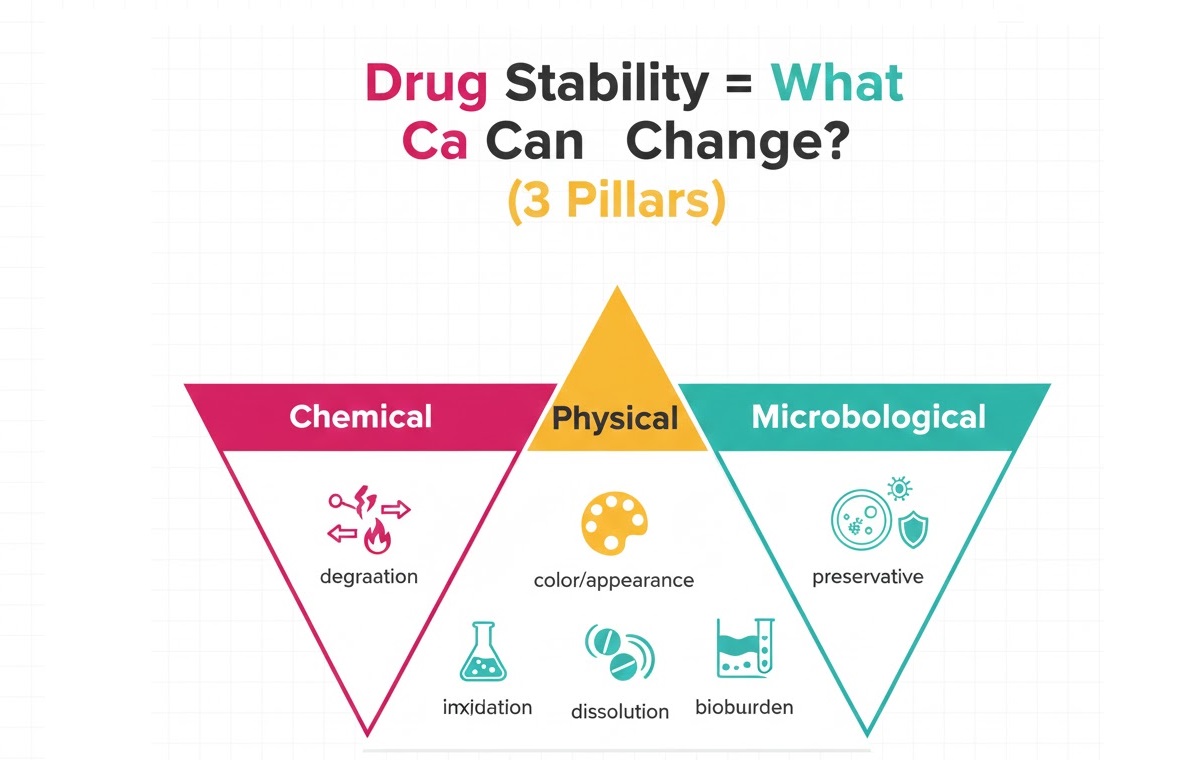
Drug Stability has three pillars: chemical, physical, and microbiological.
Track what changes, then protect potency, purity, and safety

Chemical Stability (Degradation, Oxidation)

Chemical stability means a drug keeps its chemical strength over time. Degradation lowers potency and can create harmful impurities.

First, then, and finally, oxygen, water, and heat speed up reactions. Teams often stress samples at 40°C to spot risks early. You can reduce chemical change with smart handling.

  • Protect from air exposure.

  • Avoid moisture and steam.

  • Store away from heat.

  • Keep products in original packaging.

Physical Stability (Appearance, Dissolution)

Physical stability means a drug keeps its look and performance over time. It should not clump, crack, separate, or change color.

First, then, and finally, temperature swings can change crystals and dissolution. Teams check tablets at 25°C to confirm consistent release. Simple handling protects physical stability.

  • Keep tablets dry and tightly closed.

  • Avoid shaking suspensions too hard.

Microbiological Stability (Sterility, Bioburden)

Microbiological stability means a drug stays free from harmful microbes. Sterile products must stay sterile, always. Non-sterile products must control bioburden and preservatives.

First, then, and finally, poor hygiene and warm storage increase growth risk. Teams monitor limits like 10 CFU/g for some products. Good habits reduce contamination and complaints.

  • Clean surfaces before sampling.

  • Use aseptic technique for sterile handling.

  • Close caps fast after use.

  • Store at label temperature.

Container-Closure Impact on Stability

Container-closure systems protect drug from air, moisture, and light. The wrong cap or seal can ruin shelf life fast. Leaks also raise contamination and evaporation risks.

First, then, and finally, teams test packaging for tightness and compatibility. They often run dye or vacuum leak tests at 1 mbar sensitivity. Good packaging choices reduce deviations and recalls.

  • Choose moisture-barrier bottles for tablets.

  • Use light-protective packs for sensitive drugs.

  • Verify seal integrity after filling.

  • Track closure changes through change control.

Key Drug Stability Terms You Must Know

Key drug product stability terms help you read labels and study results faster. Shelf life tells how long a drug meets quality limits. Expiry date shows the last safe use date for patients.

First, then, and finally, learn retest period for APIs and in-use stability after opening. Storage conditions link directly to these terms and protect potency. Teams commonly review data at 12 months to confirm long-term trends.

Shelf Life vs Expiry Date

Shelf life describes how long a drug stays within quality limits. Expiry date shows the final day you should use it. Shelf life supports the expiry date using stability data.

First, then, and finally, storage conditions decide if the expiry date stays valid. Many products start with 24 months based on long-term studies. Use these quick rules to avoid risk.

  • Follow the labeled storage temperature.

  • Keep the pack closed and dry.

  • Do not use after expiry.

  • Report damaged packs to QA.

Retest Period vs Expiry (API vs Drug Product)

Retest period applies to APIs stored under defined conditions. It tells when you must retest API quality before use. Expiry date applies to the finished drug product for patients.

First, then, and finally, APIs can remain usable after retesting. Drug products cannot extend expiry without approved stability data. Many APIs use 36 months retest periods, depending on data.

  • Retest APIs before manufacturing after the retest date.

  • Never ship drug product beyond its expiry.

Drug Stability vs Stability Testing: What’s the Difference?

Pharmaceutical product stability describes how long a medicine stays within quality limits. It covers potency, impurities, appearance, and microbes over time. It guides storage labels and reduces recall risk.

Pharmaceutical product stability measures stability using planned studies and lab methods. First, then, and finally, teams test at 25°C, trend results, and set expiry. It uses stability-indicating methods to detect meaningful change.

  • Stability = the product’s condition over time.

  • Stability testing = the study plan and data that proves stability clearly.

Pharmaceutical product stability vs Stability Testing (Quick Difference)
Aspect Pharmaceutical product stability Stability Testing
Meaning
The drug stays within specs over time
The studies that measure and prove stability
Focus
Product condition (potency, impurities, etc.)
Protocols, chambers, methods, timepoints
Output
Shelf life, storage claims, expiry logic
Data, trends, reports, acceptance decisions
Where used
Labeling, distribution, quality decisions
Development, submissions, lifecycle monitoring

Final Words

Drug Stability means a medicine keeps strength, purity, and quality through shelf life. ICH Q1A(R2) guides how teams prove this with planned studies. For many products, long-term conditions run at 25°C/60% RH, while accelerated runs at 40°C/75% RH. Teams sample at 0, 3, and 6 months, then extend to 12–24 months to confirm trends. Most programs start with 3 primary batches to build confidence.

This article explained types of stability, key terms, and the stability vs testing difference. You also learned what drives failures and how labels prevent risk. It reduces deviations, complaints, and recalls.

FAQs

1️⃣ What does Stability mean in pharma?

Stability means a medicine keeps strength, purity, and quality over time. It stays within specs until the expiry date.

2️⃣ How do companies set an expiry date?

They run long-term and accelerated stability studies under ICH guidance. Then they trend results and assign shelf life.

3️⃣ What should I do after a temperature excursion?

Quarantine the product and document the event. Then involve QA to assess impact using stability and excursion data.

References

Picture of Ershad Moradi

Ershad Moradi

Ershad Moradi, a Content Marketing Specialist at Zamann Pharma Support, brings 6 years of experience in the pharmaceutical industry. Specializing in pharmaceutical and medical technologies, Ershad is currently focused on expanding his knowledge in marketing and improving communication in the field. Outside of work, Ershad enjoys reading and attending industry related networks to stay up-to-date on the latest advancements. With a passion for continuous learning and growth, Ershad is always looking for new opportunities to enhance his skills and contribute to pharmaceutical industry. Connect with Ershad on Facebook for more information.

Share