


Features
Topics
Discover

Unlock the potential of your career in the Pharma industry with our online courses and qualifications.

Career Path

Pick a career path, follow its guided course roadmap, and secure industry-verified credentials in a few months.

Courses

Earn career credentials from industry leaders that demonstrate your expertise.

Adverse Drug Reactions (ADR) 2025 Guide: Definition, Examples, and Reporting Basics

Adverse Drug Reactions can occur even when patients use medicines correctly. ICH E2D lists 4 minimum case elements: an identifiable patient, reporter, suspect product, and reaction. An ADR means a harmful, unintended response at normal doses. Here, you will learn how ADRs differ from side effects and adverse events. You will also see ADR types and examples. 

Pharmacovigilance teams then judge seriousness using ICH E2A’s 6 outcomes: death, life-threatening events, hospitalization, disability, congenital anomaly, or other important medical events. They record onset, dose, and other medicines. Next, they report and follow up for missing details.

Table of Contents

What Are Adverse Drug Reactions?

Adverse Drug Reactions (ADRs) cause harm after correct medicine use. They occur at normal doses for treatment, diagnosis, or prevention.
They matter because they can trigger warnings, label updates, or new monitoring. You track ADRs by linking a drug to a new symptom. Therefore, you document 4 basics: patient, reporter, drug, reaction.
You add timing, dose, and outcome to support safer decisions.

  • ADR: harmful, unintended response at a normal dose.

  • Side effect: expected effect that may still cause discomfort.

  • Adverse event: any issue after dosing, with unclear cause.

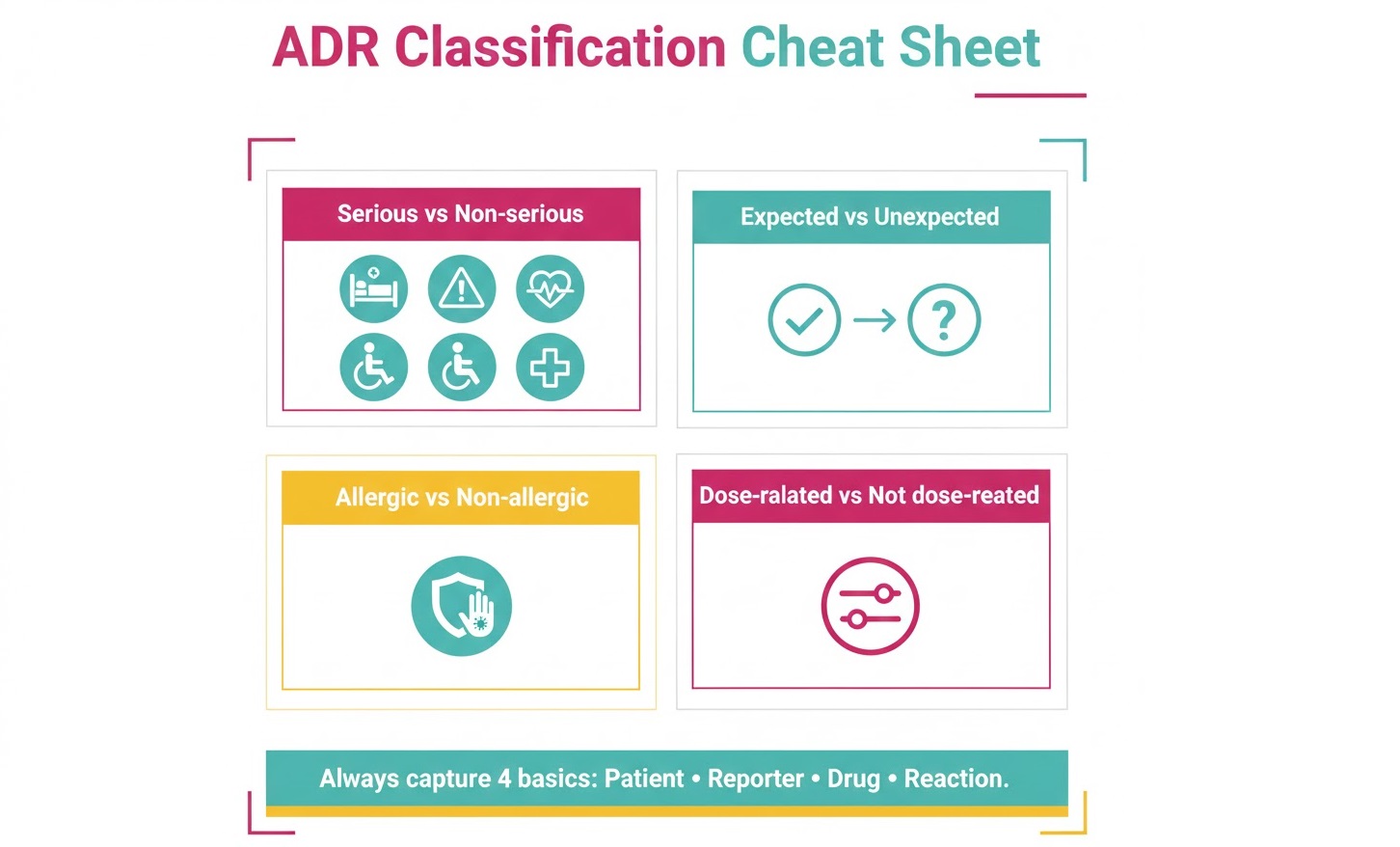
Classify ADRs faster with this simple cheat sheet. Then report serious cases quickly.
Serious or unexpected? Use this quick ADR map to decide next steps

ADR definition in simple terms

Type A ADRs are predictable and dose-dependent, such as nausea from chemotherapy. Type B ADRs are unpredictable and not dose-dependent, like an allergic reaction to a medication. Subcategories for Type A include side effects, while Type B includes idiosyncratic reactions. Type A reactions are more common and can often be managed by adjusting the dosage. 

Type C reactions, also known as ‘continuing’ reactions, can last for an extended period of time. These reactions may occur with certain medications, like bisphosphonates causing osteonecrosis of the jaw. Transitioning to Type D reactions, these ‘delayed’ reactions may not show up until sometime after taking a medication. 

Type E reactions, which are ‘end of use’ reactions, are uncommon and occur shortly after stopping a medication. These reactions can catch patients and healthcare providers off guard, as they may not expect symptoms to arise after discontinuing a drug. 

ADR vs side effect

An ADR causes harm after correct dosing at normal use. A side effect also follows dosing, but you often expect it. However, you report ADRs because they signal new or serious risk.

  • ADR: harms.

  • Side effect: expect 1 mild effect.

ADR vs adverse event

An ADR is a harmful reaction linked to a medicine at normal use. An adverse event is any medical problem after dosing, even without proof.

However, you treat adverse events as alerts until you assess causality. You review timing, dechallenge, and other drugs to decide. You also check dose changes and medical history. Then you classify the case for reporting.

  • ADR: harm with a reasonable drug link.

  • Adverse event: any issue after dosing, link unclear.

Use 1 clear reaction term and record the start date.

Serious vs non-serious ADR

A serious ADR leads to major outcomes like hospitalization or death. A non-serious ADR causes discomfort but no critical outcome.

However, you still document both types to spot patterns early. You check seriousness using 6 outcome triggers in safety work. Then you escalate serious cases fast and add follow-up questions.

  • Serious ADR: meets a seriousness outcome trigger.

  • Non-serious ADR: does not meet those triggers.


ADR vs Side Effect vs Adverse Event
ADR (Adverse Drug Reaction) Side Effect Adverse Event (AE)
Harmful, unintended reaction linked to a medicine at normal use
Unintended effect that can be expected or known
Any medical issue after dosing, with unclear cause
Requires a reasonable causal link to the drug
May occur without harm, yet still affects comfort
Does not require proof of drug causality
Often triggers reporting, especially if serious or unexpected
Report as an AE first, then assess causality
QA, QC, RA, production professionals
Example: hives 2 hours after antibiotic dose
Single online GMP course with certificate
Example: headache after dosing, cause unknown

Quick examples of common ADRs

Common ADRs affect skin, stomach, brain, liver, and kidneys. You should watch for new symptoms after a dose change. Therefore, you act quickly when symptoms escalate.

Example 1: A patient gets hives and itching after an antibiotic dose.

Example 2: A patient feels dizziness and heavy sedation after a new antihistamine. You also track nausea, diarrhea, and headache as frequent signals. 

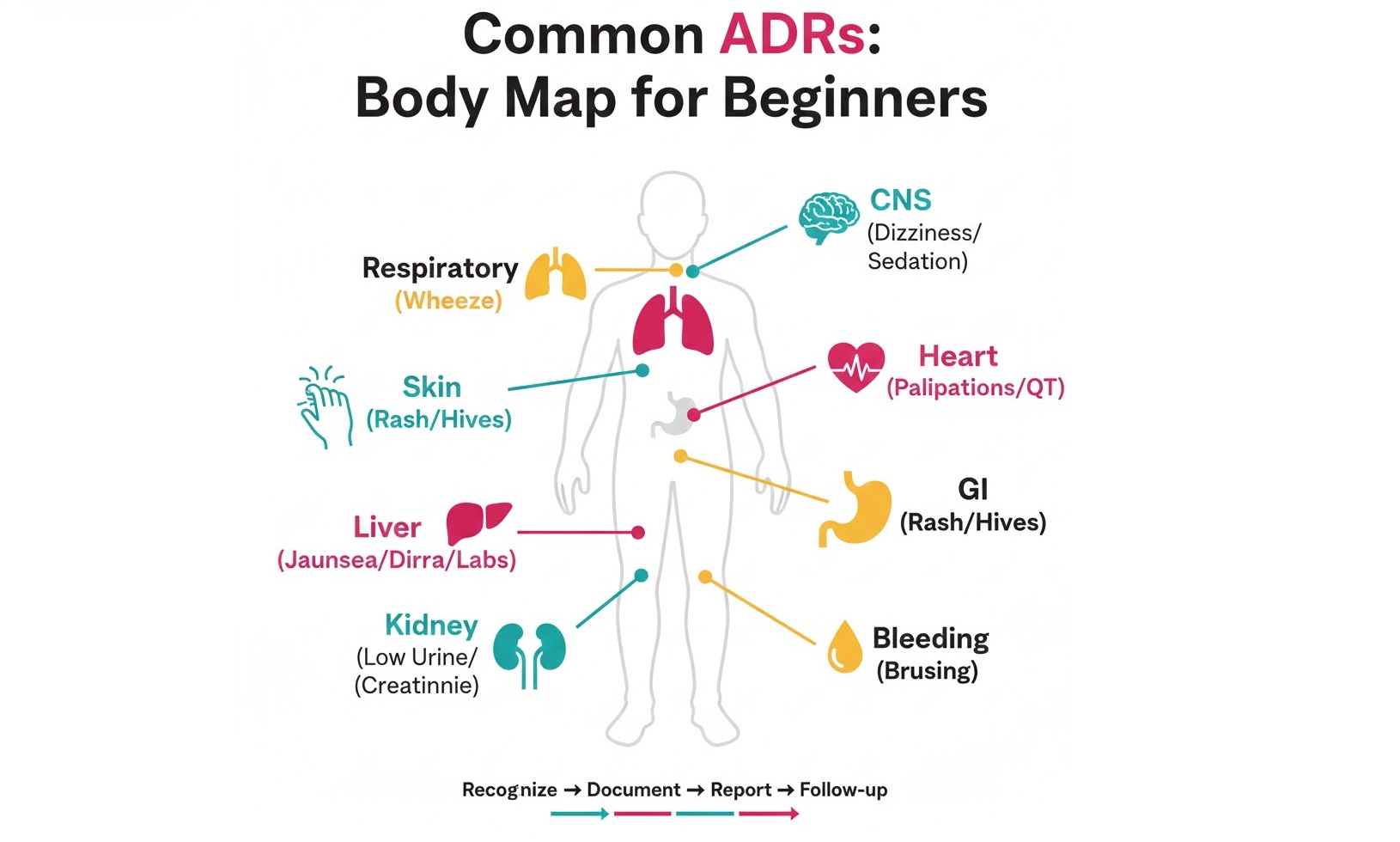
Spot common ADR patterns by body system. Therefore, you document and report faster.
Rash, nausea, dizziness, and more—use this body map to catch ADRs early

Why Adverse Drug Reactions Happen

Adverse drug reactions happen when a drug effect becomes too strong. They also happen when the body reacts unexpectedly to ingredients. Dose level, treatment duration, and patient health often drive risk. Therefore, you review age, liver function, and kidney function.

You can reduce ADR risk with smart checks before and after dosing. You review the full medication list to spot interactions early. You also adjust dose for organ impairment and frailty. Then you monitor symptoms and labs after changes.

  • High dose or fast dose increases raise risk.

  • Drug–drug interactions amplify effects or toxicity.

  • Allergies and genetics trigger unpredictable reactions.

What to Do If You Suspect an ADR

Suspect an ADR when symptoms start after a medicine change. Act fast if the patient shows breathing issues or collapse. Therefore, you assess seriousness and seek urgent care when needed. Then you document what happened in clear words.

Next, collect 4 basics: patient, reporter, drug, reaction. Add dose, dates, outcome, and other medicines. You report through your local pathway and ask for follow-up details. Record 1 key lab result when it supports the case.

  • Stop or adjust the suspect drug if clinically appropriate.

  • Treat symptoms and support the patient’s vital signs.

  • Report promptly, especially for serious or unexpected reactions.

  • Follow up to confirm recovery, rechallenge, or alternative causes.

Final words

Adverse Drug Reactions can occur even with correct medicine use. By 31 December 2024, EMA’s EudraVigilance held 29.3 million ICSRs (EMA 1). An ADR is a harmful, unintended response to a medicine. In this guide, you learn ADR differences versus side effects and adverse events. You also review common ADR types and quick examples to protect patients today. 

Finally, Keep cases clear and fast. EMA rules target 15 days for serious reports and 90 days for non-serious reports (EMA 2). Start here: capture 4 basics—patient, reporter, suspect drug, and reaction—then add timing and outcome. 

References

1️⃣ What is the difference between an ADR and a side effect?

An ADR causes harm. A side effect can be expected and mild, but it may still bother patients.

2️⃣ What makes an ADR “serious”?

Serious ADRs involve major outcomes like hospitalization, life-threatening signs, disability, or death. You should escalate these fast.

3️⃣ What information should I record when I suspect an ADR?

Record 4 basics: patient, reporter, suspect drug, and reaction. Then add dose, dates, outcome, and other medicines.

Picture of Ershad Moradi

Ershad Moradi

Ershad Moradi, a Content Marketing Specialist at Zamann Pharma Support, brings 6 years of experience in the pharmaceutical industry. Specializing in pharmaceutical and medical technologies, Ershad is currently focused on expanding his knowledge in marketing and improving communication in the field. Outside of work, Ershad enjoys reading and attending industry related networks to stay up-to-date on the latest advancements. With a passion for continuous learning and growth, Ershad is always looking for new opportunities to enhance his skills and contribute to pharmaceutical industry. Connect with Ershad on Facebook for more information.

pharmaceutical analytical method development (

Method Validation in Pharma: 5 Steps to Accurate, GMP-Compliant Results in 2025

Method Validation in Pharma proves your analytical results stay accurate and GMP-ready in [year. First, you define scope, risk, and acceptance criteria. Then, you confirm specificity, accuracy, precision, and linearity. Next, you set LOD/LOQ and verify robustness under small method changes. Finally, you document everything for audits and stronger scientific rigor.

Read More »

CIOMS in Pharmacovigilance: A Complete 2025 Guide

CIOMS guidelines help pharmacovigilance teams report, assess, and share safety data consistently. They support clear case processing, signal detection, and periodic reporting across regions. Use CIOMS forms and standards to reduce errors, align with regulators, and improve patient safety decisions.

Read More »
Market Access in pharma

Market Access Pharma Courses: Skills, Frameworks & Real-World Applications (2025 Guide)

Market access decides whether patients can actually get a medicine. So, it blends value evidence, pricing logic, reimbursement, and stakeholder alignment. In this blog, you will learn the core market access skills, the main frameworks used in pharma, and how teams apply them in real launches. You will also see how HEOR, payer needs, and local policy rules shape access decisions. Finally, you will learn how structured Market Access Pharma Courses turn theory into practical, job-ready capability.

Read More »

Share