


Features
Topics
Discover

Unlock the potential of your career in the Pharma industry with our online courses and qualifications.

Career Path

Pick a career path, follow its guided course roadmap, and secure industry-verified credentials in a few months.

Courses

Earn career credentials from industry leaders that demonstrate your expertise.

Data Safety Monitoring guide in 2026: DSMB, Plans, and Compliance

Data Safety Monitoring (DSM) is trial-phase safety oversight that reviews accumulating data to protect participants. It preserves trial integrity by controlling blinding and recommending actions such as continue, modify, pause, or stop. FDA guidance explains when a DMC helps and how it should operate; ICH E6(R3) reinforces risk-based sponsor oversight.

Pharmacovigilance extends the same mindset after approval. WHO’s Programme for International Drug Monitoring, launched in 1968, feeds VigiBase with over 35 million ICSR reports (July 2023). In Europe, EMA’s 2005 DMC guideline and its 2020 Q&A clarify independence, open/closed sessions, and how sponsors implement DMC decisions.

Table of Contents

What Is Data Safety Monitoring

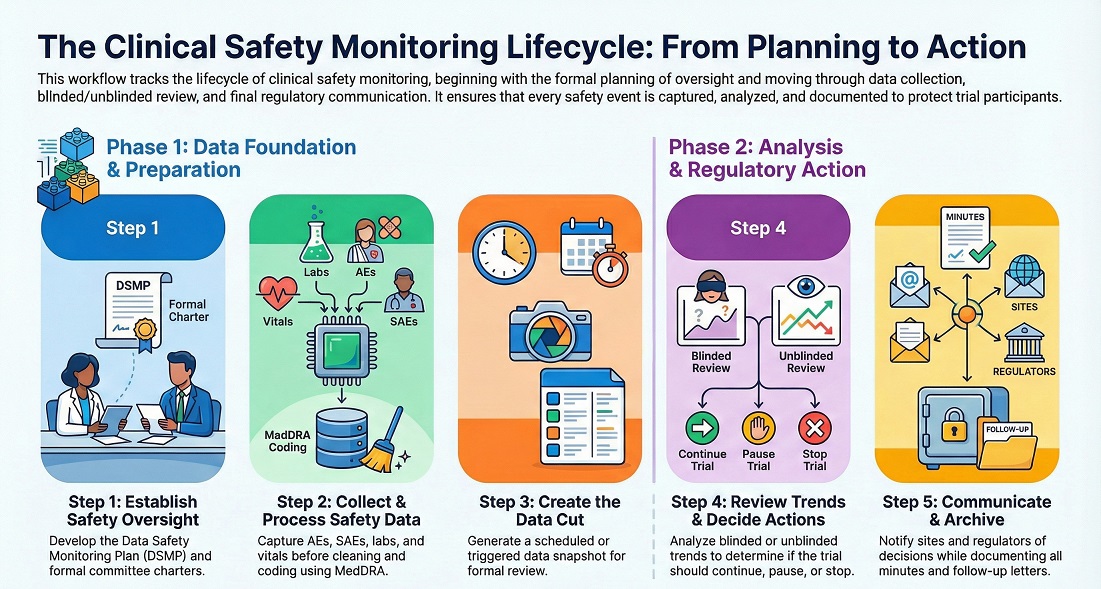
DSM guides safety oversight during a clinical trial. A DSMB or safety team reviews AEs, labs, and trends. The team meets on set dates and after urgent signals. Therefore, the team protects participants before harm spreads.

The team keeps blinding rules intact and documents every recommendation. It alerts sponsors and sites and asks for fast follow-up on serious cases within hours. It supports benefit–risk decisions and recommends clear next steps:

  • continue recruitment and dosing

  • modify protocol, dose, or monitoring

  • pause or stop the trial for safety

Data Safety Monitoring Workflow
DSM Workflow

How to Build the Required Documents for Data Safety Monitoring

Start with a Safety Monitoring Plan (DSMP) that matches trial risk. Define safety endpoints, review frequency, and escalation triggers. Assign owners for data review, medical assessment, and decision sign-off. Then set blinding rules and a secure data flow for interim cuts.

Next, write a DSMB charter that governs meetings and recommendations. Include these sections:

  • membership, independence, and conflict checks

  • open and closed sessions, quorum, and voting

  • report templates, minutes, and decision letters

  • follow-up actions, deviations, and document archiving

DSMB/DMC vs Medical Monitor vs Sponsor Safety Committee vs Risk-Based Monitoring

DSMB/DMC Medical Monitor Sponsor Safety Committee Risk-Based Monitoring (RBM)
Independent safety oversight
Clinical safety review
Risk-focused monitoring
Licensed pharma and API manufacturers
Sometimes unblinded (controlled)
Usually blinded
Usually blinded
Blinded
Output: recommendations
Output: medical guidance
Output: action decisions
Output: monitoring actions
Best for: high-risk / interim
Best for: all trials
Best for: complex programs
Best for: efficient oversight

Safety Monitoring Plan Template (DSMP): Minimum Required Sections

Use a Safety Monitoring Plan (DSMP) to control safety oversight and actions. It defines what you track, when you review, and who decides. Therefore, it prevents delays and supports clear benefit–risk decisions.

Include these minimum DSMP sections:

  • Safety Endpoints, Thresholds, and Escalation Rules

  • Roles, Responsibilities, and Communication Pathways

  • Data Flow, Data Cuts, and Confidentiality/Blinding Controls

  • Documentation Package (Reports, Minutes, Decisions, Archiving)

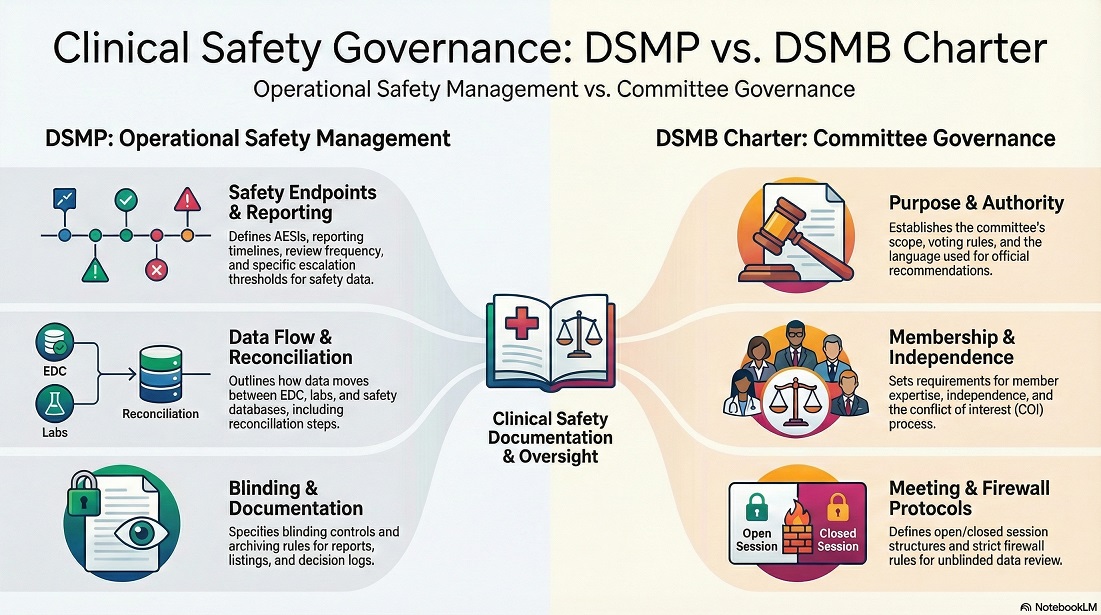
Clinical Safety Governance DSMP vs DSMB Charter

Section 1: Safety Endpoints, Thresholds, and Escalation Rules

Section 1 defines which safety endpoints you track during the trial. It lists key risks, AESIs, labs, and vital sign limits. Therefore, the team spots harm early and acts faster.

It also sets clear thresholds and escalation rules for decisions. Include two essentials:

  • numeric triggers for review, pause, or stop decisions

  • escalation steps, owners, and response timelines

Section 2: Roles, Responsibilities, and Communication Pathways

Section 2 defines who does what in safety oversight. It assigns tasks across sponsor safety, investigators, and the DSMB. Therefore, teams avoid gaps and act faster during safety signals.

It also sets communication pathways and escalation routes. Include these essentials:

  • who reviews AEs and classifies seriousness

  • who confirms causality and expectedness

  • who notifies sites and regulators

  • who approves DSMB recommendations

  • how teams document decisions and timelines

Section 3: Data Flow, Data Cuts, and Confidentiality/Blinding Controls

Section 3 explains how safety data moves from sites to reviewers. It defines sources like EDC, labs, and safety databases. Therefore, teams align on data timing and avoid missing key events.

It also sets data cuts and protects confidentiality and blinding. Include these controls:

  • who prepares data cuts and when

  • who can view unblinded outputs

  • how you use firewalls and secure sharing rules

Section 4: Documentation Package (Reports, Minutes, Decisions, Archiving)

Section 4 defines the documents that prove safety oversight. Teams write DSMB reports, safety listings, and decision letters. These records show what the team saw and why it acted.

Therefore, store minutes with dates, attendees, and votes. Keep version control for plans and charters. Archive files in a secure system with retention rules. Enable quick retrieval for audits and inspections. Review the archive quarterly and always fix gaps.

Regulatory Compliance Expectations for Data Safety Monitoring

Regulators expect DSM to follow written plans and clear governance across all sites. Sponsors define roles, protect blinding, and document decisions per FDA and EMA.

Sponsors apply ICH E6(R3) risk-based oversight and track safety signals across sites. They keep an audit-ready trail under 21 CFR 312, including minutes and letters in TMF. Therefore, they report SAEs quickly, then escalate pauses or protocol changes when thresholds trigger.

FDA Guidance and Common Inspection Focus Areas

FDA DMC guidance tells sponsors how to run independent safety oversight. Inspectors review your DSMP, DSMB charter, meeting agendas, and decision letters consistently. They also confirm COI checks, quorum rules, and timely SAE escalation. 

Therefore, document every data cut, protect blinding firewalls, and track follow-up actions. Align roles for sponsors, investigators, and monitors under 21 CFR 312. Use these two PDFs to match FDA expectations and support audits. 

Download FDA Draft Guidance (PDF): Use of Data Monitoring Committees in Clinical Trials 
Download FDA BIMO Compliance Program (PDF): CP 7348.811 Clinical Investigators and Sponsor-Investigators

ICH E6 Safety Monitoring Requirements and Sponsor Responsibilities

ICH E6(R3) requires sponsors to plan safety monitoring across the trial lifecycle. Sponsors set thresholds, review frequency, and escalation routes for emerging risks, by phase. They train sites, verify reporting, and keep oversight documentation current, audit-ready. 

Therefore, sponsors protect blinding, manage unblinded access, and document DMC decisions. They track AEs and SAEs, then act quickly within defined timelines. Use this PDF guideline for sponsor responsibilities and monitoring expectations. 

Download Now ICH E6(R3) Good Clinical Practice Guide PDF Here

When a DSMB is Required or Strongly Recommended

Use a DSMB for high-risk trials with serious outcomes or vulnerable participants. Phase 3, multi-country studies and blinded designs benefit most from independent oversight.

Therefore, add a DSMB when you plan 2 interim looks or adaptive changes. Also use one for many sites and complex supply chains. Document the rationale in protocol, DSMP, and charter. Then review safety signals on set dates, from day one, and document follow-up.

Final Words

Data Safety Monitoring keeps trial participants safe by reviewing accumulating AE data, labs, and trends across sites and over time, continuously. It protects trial integrity by controlling unblinded access and recording DSMB recommendations. ICH E6(R3) expects a quality system with risk-based oversight, documented decisions, and defined responsibilities. 

Apply Good Manufacturing Practices(GMP) discipline to trial oversight: controlled documents, traceability, and secure access. Checklist:

1- finalize DSMP+charter;

2- set thresholds and interim data cuts;

3- store minutes and decision letters;

4- track follow-up actions to closure. Keep confidentiality firewalls and audit-ready evidence for FDA and EMA reviewers. 

FAQs

1️⃣ When do teams use a DSMB/DMC?

Teams use one for higher-risk trials, complex designs, or planned interim reviews. Independent oversight helps teams act fast on emerging harm signals.

2️⃣ What separates a DSMB/DMC from a medical monitor?

A DSMB/DMC works independently and can review unblinded trends under strict controls. A medical monitor supports sponsor safety review and operational follow-up.

3️⃣ What belongs in the DSMP vs the DSMB charter?

The DSMP defines safety endpoints, thresholds, reviews, and escalation routes. The charter defines committee governance, meetings, voting, and confidentiality rules.

References

Picture of Ershad Moradi

Ershad Moradi

Ershad Moradi, a Content Marketing Specialist at Zamann Pharma Support, brings 6 years of experience in the pharmaceutical industry. Specializing in pharmaceutical and medical technologies, Ershad is currently focused on expanding his knowledge in marketing and improving communication in the field. Outside of work, Ershad enjoys reading and attending industry related networks to stay up-to-date on the latest advancements. With a passion for continuous learning and growth, Ershad is always looking for new opportunities to enhance his skills and contribute to pharmaceutical industry. Connect with Ershad on Facebook for more information.

Share