


Features
Topics
Discover

Unlock the potential of your career in the Pharma industry with our online courses and qualifications.

Career Path

Pick a career path, follow its guided course roadmap, and secure industry-verified credentials in a few months.

Courses

Earn career credentials from industry leaders that demonstrate your expertise.

GxP Regulations in Pharma: GMP, GDP, GLP & GCP Explained (2026)

Regulatory data indicates that more than 40 percent of FDA inspection observations stem from documentation gaps, training failures, or weaknesses in data integrity controls. Inspectors often trace these issues back to systemic failures in how quality frameworks align with GxP Regulations and broader pharma regulation across regulated pharmaceutical operations.

From early research to commercial distribution, organizations rely on structured quality principles to protect patient safety and product consistency. When these principles operate in silos or lack oversight, compliance risks escalate rapidly. This reality explains why a unified approach to Good Practice frameworks remains essential.

At a fundamental level, these frameworks define how critical activities should be designed, documented, and controlled. Regulators expect to see them embedded into everyday decisions rather than treated as theoretical compliance concepts.

Table of Contents

What Are GxP Regulations? Definition and Scope in Pharma

These Good Practice guidelines govern regulated pharmaceutical activities and connect quality, safety, and data integrity expectations across the entire product lifecycle, rather than functioning as a single law.

These guidelines apply to manufacturing, laboratory testing, clinical research, distribution, and supporting quality systems. Together, they define how regulated work should be planned, executed, reviewed, and documented. Regulatory authorities expect organizations to apply these principles consistently, regardless of company size, product type, or geographic location.

Importantly, this framework does not replace national or regional laws. Instead, it provides a structured way to interpret regulatory expectations and translate them into operational controls that inspectors can verify.

Why GxP Regulations and Compliance Matter for Pharma Quality

Strong compliance protects patients by ensuring medicines remain safe, effective, and consistent over time. It also protects organizations from enforcement actions that disrupt supply chains, delay approvals, and erode regulatory trust.

When companies effectively implement robust Good Practice frameworks, they gain measurable operational advantages.

  • Reduced inspection findings and fewer repeat observations
  • Greater confidence in submitted, audited, and archived data
  • Clear accountability across manufacturing, laboratory, and distribution functions

As a result, compliance functions not only as a regulatory obligation but also as a practical risk management system that supports sustainable operations.

Core GxP Regulations for Compliance

Four Good Practice areas form the foundation of modern regulated quality systems:

  • Good Manufacturing Practice (GMP)
  • Good Distribution Practice (GDP)
  • Good Laboratory Practice (GLP)
  • Good Clinical Practice (GCP)

Each area addresses a distinct risk profile while contributing to a single, integrated quality framework that regulators expect organizations to maintain.

GMP Requirements for Regulated Manufacturing Operations

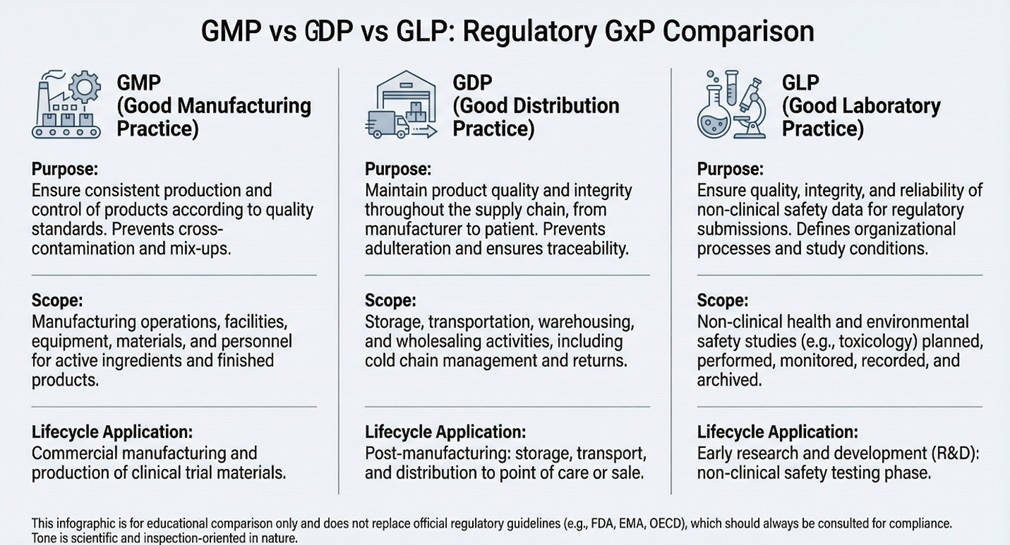
The following visual compares GMP, GDP, and GLP, clarifying their scope and application across the product lifecycle.

GMP, GDP, and GLP: Make quality, records, and data audit-ready.
GMP, GDP, and GLP: Build compliance that regulators can verify

GMP defines how medicinal products are manufactured and controlled. It governs facility design, equipment qualification, process validation, cleaning validation, and in-process controls. GMP provides the backbone for commercial production, batch release, and ongoing product quality assurance.

Aspect GMP GDP GLP GCP
Primary focus
Manufacturing
Distribution
Laboratory studies
Clinical trials
Key risks
Contamination, mix-ups
Storage failures
Data reliability
Subject safety
Regulatory emphasis
Process control
Supply-chain integrity
Study validity
Ethical conduct

This comparison highlights how each practice targets different operational risks while supporting consistent quality outcomes throughout the product lifecycle.

ongoing product quality assurance.

ِDownload Official GMP guidance Here: ICH Q7 – PDF

GDP and GLP Roles Within Regulated Operations

GDP and GLP support different but equally critical segments of regulated activities. GDP focuses on maintaining product quality during storage, transportation, and distribution. It ensures that temperature control, traceability, and handling conditions preserve product integrity after manufacturing.

GLP, in contrast, governs non-clinical laboratory studies and analytical testing. Its primary objective is to ensure laboratory data remains reliable, reproducible, and traceable for regulatory decisions.

Together, GDP and GLP form essential links between manufacturing, development, and downstream supply-chain controls.

GCP Requirements Within Regulated Clinical Operations

GCP governs how clinical trials are designed, conducted, monitored, and reported. Its primary objective is to protect trial participants while ensuring the credibility and traceability of clinical data submitted to regulators.

Within regulated clinical operations, GCP introduces controls related to investigator responsibilities, informed consent management, protocol compliance, and oversight of clinical sites.

Documentation Control Expectations in Regulated Operations

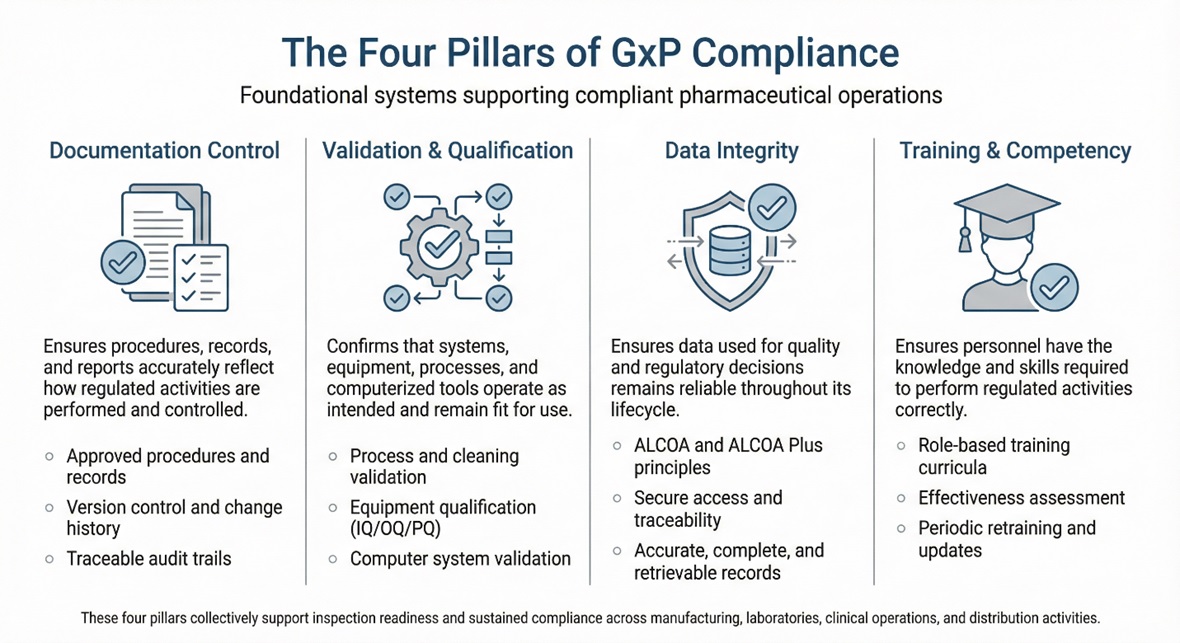
Controlled documentation underpins every regulated activity. Without reliable records, organizations cannot demonstrate compliance or defend quality decisions during inspections. Effective documentation systems ensure:

  • Approved version control and traceable change history
  • Alignment between procedures, executed records, and training materials
  • Clear audit trails that support inspection review

Many documentation requirements appear in regulatory guidance documents, which authorities commonly publish as downloadable PDF files for industry use.

Data Integrity Principles (ALCOA and ALCOA Plus) in Regulated Operations

Data integrity ensures that recorded information remains trustworthy throughout its lifecycle. Regulated quality systems rely on the ALCOA principles:

  • Attributable
  • Legible
  • Contemporaneous
  • Original
  • Accurate

ALCOA Plus extends these principles to include completeness, consistency, endurance, and availability. Together, they guide how regulated data should be generated, reviewed, stored, and retrieved during inspections or submissions.

Training and Competency Requirements for GxP Compliance

The following visual illustrates documentation, validation, data integrity, and training as the foundational pillars supporting GxP compliance.

GxP compliance: Do it right, document it well, prove it fast.
GxP compliance: Protect patients with controlled processes and trusted data

Training connects written procedures to real-world execution. Even well-designed systems fail when personnel lack the skills or awareness to apply them consistently. Within regulated quality frameworks, organizations must demonstrate that employees remain qualified for their assigned roles.

Effective training programs typically follow three structured steps:

  1. Define role-based curricula aligned with operational responsibilities
  2. Verify understanding through assessments or observed performance
  3. Refresh training following procedural changes, deviations, or periodic review

This approach supports sustainable compliance across manufacturing sites, laboratories, clinical teams, and supply-chain functions.

Final Words

Industry benchmarks consistently show that organizations with mature quality systems experience 30–40% fewer repeat inspection observations and significantly shorter remediation timelines. These outcomes reflect sustained alignment between operational practices and regulatory expectations defined by GxP Regulations throughout the product lifecycle.

Compliance resilience does not come from isolated actions. It develops when quality principles extend seamlessly across manufacturing, laboratories, clinical activities, and distribution networks. When organizations embed these expectations into everyday decision-making, inspections become more predictable and far less disruptive.

For professionals responsible for regulated activities, strengthening this capability is a practical necessity. Those who invest time in building a structured understanding of regulatory frameworks often find it easier to anticipate inspection focus areas and maintain compliance as requirements evolve.

FAQ

1️⃣ How do inspectors assess whether quality systems meet GxP expectations?

Inspectors review controlled documentation, role-based training records, and data integrity safeguards to confirm that activities supporting medicinal products operate as defined.

2️⃣ Which area typically generates the most inspection observations?

Manufacturing operations and documentation controls often drive the highest number of findings because they directly affect product quality and batch release decisions.

3️⃣ Can one quality system support GMP, GDP, GLP, and GCP activities?

Yes. Many regulated organizations operate a single integrated quality management system, provided responsibilities and risk controls remain clearly defined.

4️⃣ Why does data integrity receive such strong regulatory focus?

Because inspection outcomes, regulatory submissions, and clinical decisions all depend on complete, traceable, and reliable data.

5️⃣ How often should training be refreshed in regulated environments?

Training should update after procedural changes, significant deviations, or audit findings and be reviewed periodically based on role criticality.

Picture of Mahtab Shardi

Mahtab Shardi

Mahtab is a pharmaceutical professional with a Master’s degree in Physical Chemistry and over five years of experience in laboratory and QC roles. Mahtab contributes reliable, well-structured pharmaceutical content to Pharmuni, helping turn complex scientific topics into clear, practical insights for industry professionals and students.

Share