


Critical GMP inspections reveal recurring trends: outdated or poorly controlled SOPs often lead to repeated findings. One facility recorded over 25 deviations in a single quarter linked to inconsistencies in procedure execution. A robust SOP Checklist now serves as a live audit of procedural compliance, execution accountability, and operational discipline, reflecting broader expectations in pharma quality assurance and showing inspectors whether procedural risks are actively mitigated rather than tolerated.
What Is an SOP Checklist in a GMP Environment
A structured procedural verification tool helps organizations confirm that standard operating procedures pharma remain current, approved, and consistently implemented. It ensures that every operational step is documented, responsibilities are clearly defined, and deviations stay traceable across the procedure lifecycle. During inspections, regulators rely on SOP inspection readiness and GMP documentation control to determine whether routine activities operate under sustained control rather than informal practice.
The following visual summarizes how a structured checklist ensures inspection readiness and operational consistency across pharma facilities.
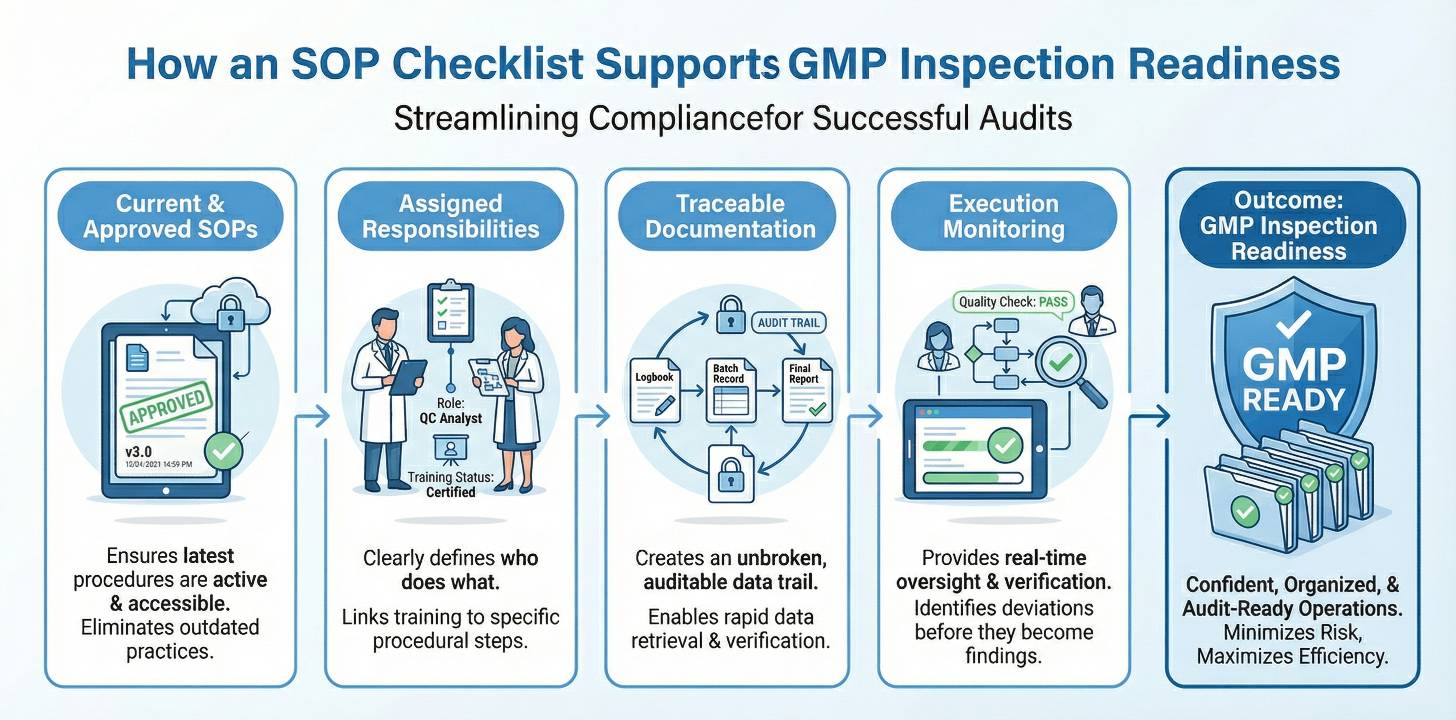
What Is an SOP Checklist in a GMP Environment
A structured procedural verification tool helps organizations confirm that standard operating procedures pharma remain current, approved, and consistently implemented. It ensures that every operational step is documented, responsibilities are clearly defined, and deviations stay traceable across the procedure lifecycle. During inspections, regulators rely on SOP inspection readiness and GMP documentation control to determine whether routine activities operate under sustained control rather than informal practice.
Why SOP Checklists Matter for Inspection Outcomes
Inspectors assess GMP SOP checklists as a reflection of organizational discipline. They examine version control, training linkage, execution consistency, and availability of SOPs. Missing or outdated items often trigger findings, as they indicate gaps in regulatory compliance and operational readiness. Using a checklist helps QA and QC teams demonstrate preventive control over routine activities, reducing inspection friction.
What Inspectors Evaluate in a SOP Compliance Checklist
Inspectors use SOP audit checklists to evaluate whether procedures are effectively executed, accountable, and inspection-ready. They focus on real-world application rather than documentation alone, verifying that procedures cover the full scope of operations, define clear responsibilities, emphasize critical steps, and generate traceable evidence aligned with GMP documentation control and SOP lifecycle management.
We will discuss:
- Scope Coverage and Process Boundaries
- Role Clarity and Execution Accountability
- Control Points and Critical Steps
- Documentation, Evidence, and Traceability
Each of these areas ensures that SOPs are more than paperwork—they are practical tools for maintaining GMP compliance, minimizing inspection risks, and demonstrating operational maturity.
Scope Coverage and Process Boundaries
Inspectors verify that the checklist truly reflects real GMP operations rather than theoretical workflows. Each procedure must clearly define which activities fall within scope and which do not. Clear boundaries help ensure that all critical processes receive proper oversight while preventing overlap, duplication, or gaps that could weaken overall process control.
Role Clarity and Execution Accountability
Clear assignment of responsibilities is essential for effective execution. Inspectors assess whether roles are explicitly defined and whether individuals understand their accountability during routine operations. They also look for coordination between departments, as unclear ownership often leads to missed steps, delayed actions, or unaddressed deviations.
Control Points and Critical Steps
Well-designed checklists emphasize high-risk control points instead of listing generic tasks. Inspectors expect critical steps to stand out, allowing them to quickly evaluate where failures could occur and how preventive measures are applied. This focus demonstrates risk awareness and strengthens confidence in operational control.
Documentation, Evidence, and Traceability
Checklist execution must be supported by complete, inspection-ready records. Inspectors review logs, approvals, and follow-up actions to confirm activities were performed as intended. Strong traceability allows inspectors to reconstruct events, verify compliance, and assess whether issues trigger timely and appropriate responses.
How Structured Procedures Improve Inspection Readiness
This infographic highlights common SOP gaps that inspectors detect and how these gaps translate into inspection findings
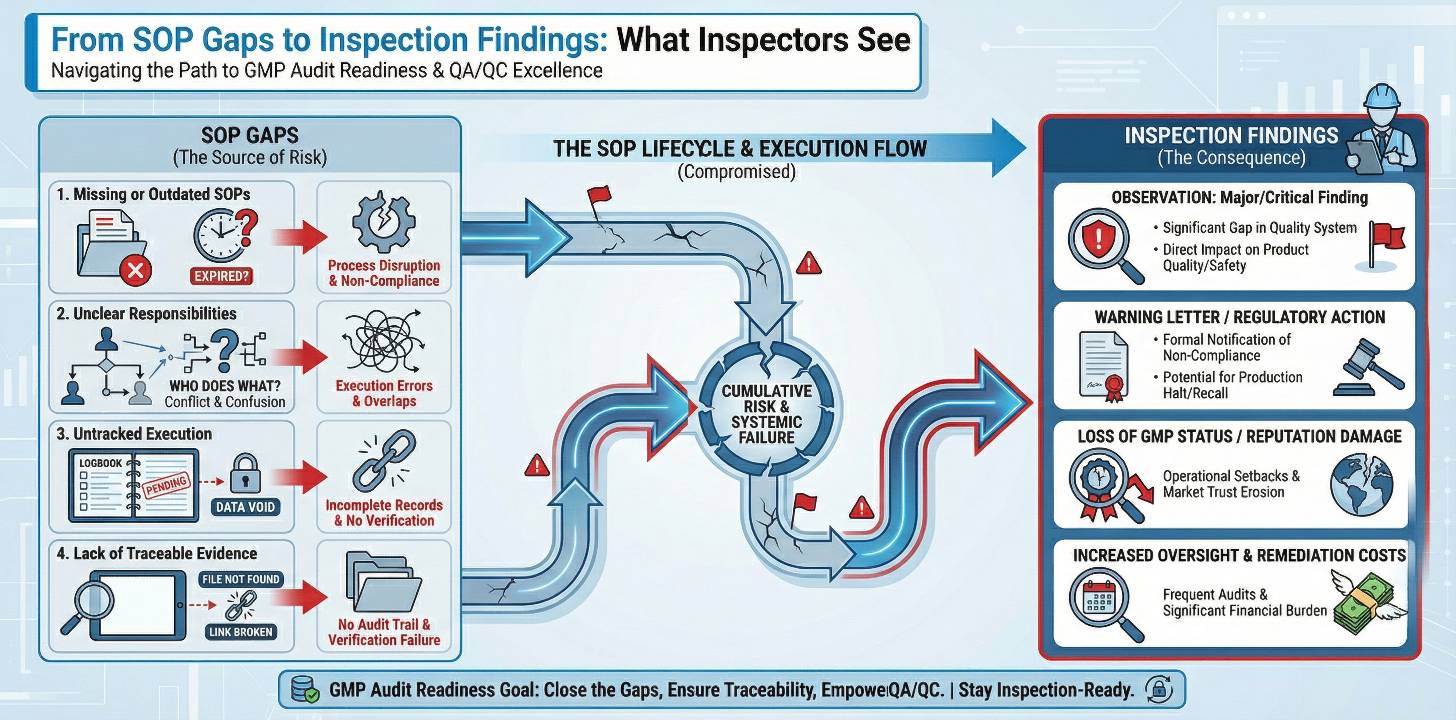
Well-structured procedures and disciplined documentation practices help organizations demonstrate consistent operational control and minimize inspection challenges by:
- Ensuring activities are performed consistently and in line with approved expectations
- Providing clear, traceable records that support decisions and actions
- Reducing ambiguity and reliance on individual interpretation during audits
- Enabling faster, more confident responses to inspector questions
- Demonstrating a culture of routine control rather than reactive compliance
Common Documentation Gaps Identified During GMP Inspections
During GMP inspections, regulators consistently identify documentation and procedure-related weaknesses that signal deficiencies in quality system control rather than isolated errors. These gaps often persist across inspections because they are systemic, insufficiently remediated, or poorly governed. Inspectors interpret recurring documentation issues as evidence of weak SOP lifecycle management, ineffective GMP documentation control, and inadequate oversight of standard operating procedures within the pharmaceutical quality system.
The most common gaps relate to outdated or inconsistently applied SOPs, incomplete records, poor change control traceability, and weak linkage between procedures, training, and execution. When documentation does not accurately reflect current practices or when records fail to demonstrate consistent adherence inspectors are likely to issue repeat GMP findings.
Frequent Documentation Gaps and Their Inspection Impact
| Documentation Gap | Typical Inspector Observation | Why It Leads to Repeat GMP Findings |
|---|---|---|
|
Outdated SOPs |
Procedures not aligned with current operations or regulations |
Indicates failure in SOP lifecycle management and change control |
|
Incomplete or missing records |
Batch records, logs, or deviations lack required data |
Prevents verification of GMP compliance and traceability |
|
Poor version control |
Multiple SOP versions in use across departments |
Signals weak GMP documentation control |
|
SOP–training misalignment |
Personnel trained on obsolete or incorrect procedures |
Demonstrates ineffective quality system procedures |
|
Inconsistent execution vs. SOP |
Actual practices differ from documented procedures |
Suggests SOPs are not operationally embedded |
|
Inadequate deviation documentation |
Root causes and CAPAs poorly defined or generic |
Fails to address systemic issues, leading to repeat findings |
|
Weak audit trail |
Changes not properly justified or approved |
Undermines data integrity and inspection readiness |
From an inspection perspective, these gaps collectively suggest that SOPs function as static documents rather than active compliance tools. Addressing them requires not only document updates, but also stronger governance, clearer accountability, and continuous verification that procedures are both followed and fit for purpose.
Final Words
Facilities with well-maintained procedures report 40–50% fewer inspection findings than peers. For example, one site reduced recurring SOP deviations from 18 events per quarter to just 2 after linking checklists with training and corrective action follow-ups. This demonstrates how a SOP Checklist functions as a practical tool for inspection readiness, regulatory compliance, and operational excellence.
FAQs
Inspectors focus on version control, role clarity, execution accountability, critical steps, and traceable documentation. Missing evidence in any of these areas often triggers findings.
Recurring issues usually stem from outdated SOPs, incomplete scope coverage, or lack of linkage between procedures and personnel training. Without systemic updates, risks persist.
Maintain updated SOPs, link each SOP to trained staff, highlight critical steps, ensure traceable evidence, and integrate checklists into routine audits. This approach demonstrates consistent GMP control.
References

Mahtab Shardi
Mahtab is a pharmaceutical professional with a Master’s degree in Physical Chemistry and over five years of experience in laboratory and QC roles. Mahtab contributes reliable, well-structured pharmaceutical content to Pharmuni, helping turn complex scientific topics into clear, practical insights for industry professionals and students.

eCTD Submission in 2026: Process, Modules, Validation and eCTD 4.0
Learn how regulatory teams structure CTD modules, manage lifecycle sequences, apply metadata, and perform eCTD validation. This guide also explains eCTD 4.0 changes, common technical risks, and practical checks that support efficient, review-ready regulatory dossiers.

Post Approval Changes in Pharma in 2026: Types, ICH Q12 and Change Management
Post-approval changes can affect manufacturing, quality, validation, and regulatory commitments throughout a product’s lifecycle. This guide explains change classification, ICH Q12, FDA and EU reporting pathways, PACMPs, and practical controls that help teams implement changes with confidence

Swab vs Rinse Sampling in Pharma 2026: Critical GMP Guide
Swab and rinse sampling answer different cleaning-validation questions. This guide compares their recovery behavior, equipment suitability, analytical needs, residue localization, and GMP expectations. Learn when each method works best, when limitations matter, and when a combined sampling strategy provides stronger evidence for validation.