Md rakibul I completed this course and earned a Pharmuni certificate.
Advanced Cleaning Validation: Residue Limits and Sampling
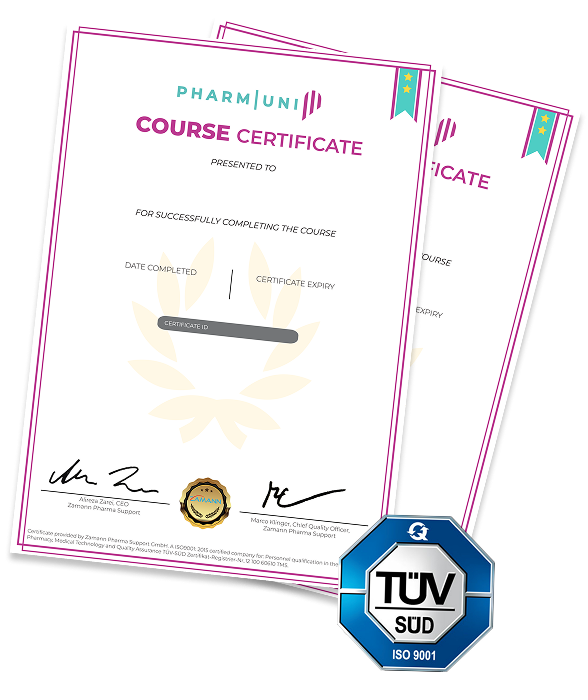
ISO 9001
Quality Management System
Certificate Registration No.: 12 100 60610 TMS
About the Advanced Cleaning Validation: Residue Limits and Sampling
Residue limits and sampling strategies form the scientific foundation of cleaning validation. When exposure assumptions shift, hazard profiles intensify, or analytical margins narrow, routine approaches are no longer sufficient. Decisions must be grounded in structured reasoning, measurable capability, and defensible control logic.
This advanced-level course is designed Senior QA professionals, Validation Leads, and experienced GMP specialists responsible for technical oversight of cleaning validation programs.
Key topics include:
• Governing exposure assumptions in shared equipment and flexible sequencing environments
• Assessing how hazard classification and dose assumptions influence residue limits
• Evaluating allocation of limits across equipment trains and distribution effects
• Interpreting analytical capability in relation to calculated acceptance criteria
• Applying risk-based reasoning to worst-case sampling location and method selection
• Analyzing recovery efficiency and data reliability when exposure margins are narrow
Through applied scenarios and structured technical analysis, participants will strengthen their ability to critically assess residue limit logic, sampling justification, and analytical reliability in complex manufacturing environments.
This course is intended for professionals who already understand cleaning validation fundamentals and seek to deepen their expertise in advanced residue control and defensible sampling strategy.
Upon successful completion of this course, the learner has demonstrated the ability to:
Learning Objective 1
Describe how the physicochemical properties of residues determine cleaning performance, recovery, and detection capability
Learning Objective 2
Determine when residue limits should be re-evaluated using exposure-based governance principles
Learning Objective 3
Select sampling strategies using risk-based reasoning for different equipment types and residue conditions
Learning Objective 4
Assess the impact of changes in toxicological classification, dosing assumptions, and analytical capability on residue limit justification
Learning Objective 5
Interpret analytical sensitivity and recovery performance when evaluating cleaning results
Learning Objective 6
Relate toxicology data, exposure assumptions, sampling design, and acceptance criteria within a cleaning validation framework