Aggregate Report Writing in Pharmacovigilance
Aggregate Report Writing in Pharmacovigilance
Version 1.0
Released on 08/09/2025
An advanced course on creating inspection-ready aggregate reports (PSUR, PBRER, DSUR) that meet EMA, FDA, and PMDA requirements through robust planning, quality control, and regulatory response strategies.
- English
- Available on app
- + Certificate

Version 1.0
Released on 08/09/2025
4.5
(4 Reviews)
Aggregate Report Writing in Pharmacovigilance
Subscribe to Pharmuni Premium
- All courses and career paths
- All quizzes and certificates
- All learning tools and assessments
- Cancel anytime
About the Aggregate Report Writing in Pharmacovigilance
Aggregate Report Writing in Pharmacovigilance introduces the advanced knowledge and applied strategies needed to plan, write, and review aggregate safety reports for medicinal products. This course explains how reports such as PSURs, PBRERs, and DSURs support ongoing pharmacovigilance by bringing together safety data over time and helping regulators assess whether a medicine’s benefits continue to outweigh its risks.
You will gain a practical understanding of the foundations of aggregate reporting, the differences between major report types, benefit–risk evaluation methods, regulatory submission planning, and cross-functional coordination. The course explores regional regulatory expectations, data cut-off dates and database lock points, consistency across periodic reports, quality control, and how signal detection findings and regulatory feedback are incorporated into future reporting cycles.
The course focuses on key aspects of aggregate reporting in practice, including:
• The purpose and structure of PSURs, PBRERs, and DSURs
• How to perform and present a structured benefit–risk evaluation
• How to plan submission timelines and coordinate multi-region reporting activities
• How to apply quality control and respond to regulatory feedback in aggregate reporting workflows
Through structured explanations and practical examples, this course helps you understand how high-quality aggregate reports support compliance, transparency, and ongoing benefit–risk evaluation in pharmacovigilance. It is best suited to professionals working in pharmacovigilance, medical writing, regulatory affairs, or related roles who want to strengthen their skills in advanced aggregate reporting.
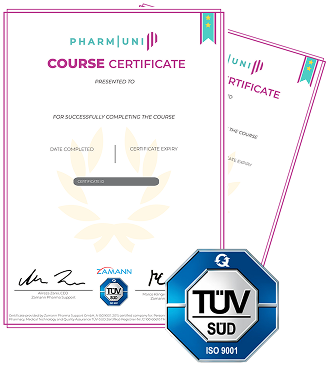
Certificate provided by Zamann Pharma Support GmbH, an ISO 9001:2015 certified company for personnel qualification in the fields of Pharmacy, Medical Technology, and Quality Assurance. Certification body: TÜV SÜD Certificate Registration No.: 12 100 60610 TMS
Pharmuni Certificate
Zamann Pharma Support GmbH
Personnel qualification in the field of pharmacy, medical technology and quality assurance.
Consulting service in the field of pharmacy, medical technology and quality assurance.
Your Learning Objectives
Through a combination of case studies, skills checks, videos, and visual explanations, this course will guide you step by step toward building the competencies needed for effective aggregate report writing. By the end of this course, learners will be able to:
Learning Objective 1
Differentiate between PSUR, PBRER, and DSUR by comparing their structure, content, and regulatory purpose under EMA, FDA, and ICH guidelines.
Learning Objective 2
Evaluate pharmacovigilance safety data to perform a balanced benefit–risk assessment that meets international regulatory expectations.
Learning Objective 3
Design submission timelines and schedules for EMA, FDA, and PMDA aggregate report requirements, aligning with global regulatory review processes.
Learning Objective 4
Coordinate cross-functional stakeholders (RA, QA, Clinical, PV, Medical Writing) to collect and compile data for pharmacovigilance and regulatory reports.
Learning Objective 5
Apply quality control measures to prevent common errors and compliance issues in aggregate reporting and periodic safety submissions.
Learning Objective 6
Integrate signal detection outcomes into PSURs, PBRERs, and DSURs to create inspection-ready periodic reports.
Learning Objective 7
Revise aggregate reporting strategies in response to EMA/FDA regulatory authority feedback to maintain compliance and improve future submissions.
About the author


This course is included in these career paths
Discover tailored career paths designed to help you grow in the pharmaceutical industry. Whether you're just starting out or looking to specialize, find the roles, skills, and learning steps that align with your goals.
Benefits of this Course
Get valuable resources, and ISO backed certification through our assessment of your knowledge and access global jobs only for Pharmuni alumni.
- Downloadable Resources
- Fast-Tracked Qualification
- Exclusive Assessment Quiz
- Skill Tree Levelup
- Customer Support
- Sharable & Downloadable Certification
Learner Reviews
FAQs
How will this course help in advancing my career?
By completing this course, you will build a stronger understanding of how aggregate reports are planned, written, and maintained to support global pharmacovigilance compliance. This can help you contribute more confidently to periodic reporting activities, strengthen your readiness for safety writing and submission-focused roles, and improve your ability to support regulator-facing pharmacovigilance work.
Who is this course suitable for?
This course is suitable for professionals working in pharmacovigilance, medical writing, regulatory affairs, or safety reporting who want a stronger understanding of advanced aggregate report preparation. It is particularly valuable for learners involved in periodic reporting, benefit–risk assessment, or global safety submission activities.
What topics are covered in the Aggregate Report Writing in Pharmacovigilance course?
This course introduces the key principles of aggregate reporting, including:
- The purpose, structure, and differences between PSURs, PBRERs, and DSURs
- How to perform structured benefit–risk evaluations
- Submission planning, timelines, and multi-region coordination
- Quality control, signal integration, and regulatory response strategies
What resources and learning materials are provided in the course?
The course includes:
- Structured lessons with supporting text
- Practical examples and case studies on periodic reporting and submission planning
- Explanations of report structures, benefit–risk methods, and regulatory coordination concepts
- Visual and concept-based learning elements to support understanding
- A certificate of completion upon successfully finishing the course
Can I learn at my own pace?
Yes, the course is fully self-paced. You can begin at any time, progress through the material at your own speed, and revisit content whenever needed while you have an active subscription.
Sawarni S
5
Reviewed on 20th Sept. 2026
very well structured and easy to understand course
Seyed ershad M
5
Reviewed on 18th Sept. 2025
Excellent course! It simplified complex concepts of aggregate report writing and made them easy to apply in real-world pharmacovigilance.