Introduction to Good Distribution Practices
Introduction to Good Distribution Practices
Version 1.0
Released on 23/07/2025
Discover how cold chain failures occur in pharma logistics and how GDP principles help prevent product loss with monitoring, alerts, and compliance strategies.
- English
- Available on app
- + Certificate

Version 1.0
Released on 23/07/2025
Introduction to Good Distribution Practices
Subscribe to Pharmuni Premium
- All courses and career paths
- All quizzes and certificates
- All learning tools and assessments
- Cancel anytime
About the Introduction to Good Distribution Practices
Introduction to Good Distribution Practices explains how pharmaceutical products must be stored, transported, and handled in a controlled way to protect their quality, safety, and efficacy throughout the supply chain. This course introduces the principles of GDP and shows how quality assurance, traceability, storage conditions, transport controls, and risk management work together to support compliant pharmaceutical distribution.
You will gain a practical understanding of how GDP applies across the pharmaceutical supply chain, from manufacturers and wholesalers to logistics providers and storage facilities. The course explores the role of GDP in protecting product quality, the relationship between QA and GDP, traceability systems for recalls, cold chain and storage controls, transport and handling expectations, and common distribution risks such as temperature excursions, shock damage, delays, and contamination.
The course focuses on key aspects of Good Distribution Practices in practice, including:
• The core principles and purpose of GDP in pharmaceutical distribution
• Quality assurance, training, and traceability across the supply chain
• Storage, cold chain management, and GDP-compliant transport handling
• Common distribution risks and strategies to prevent product loss or compliance failures
Through structured explanations and practical examples, this course helps learners understand how distribution controls support product integrity and patient safety after products leave manufacturing. It is best suited to professionals working in logistics, warehousing, quality assurance, supply chain management, regulatory compliance, or pharmaceutical distribution activities.
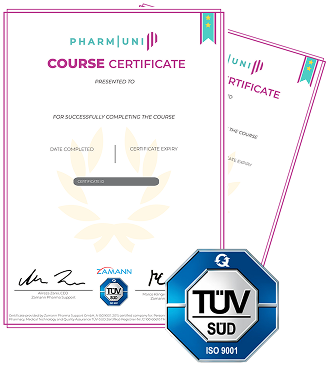
Certificate provided by Zamann Pharma Support GmbH, an ISO 9001:2015 certified company for personnel qualification in the fields of Pharmacy, Medical Technology, and Quality Assurance. Certification body: TÜV SÜD Certificate Registration No.: 12 100 60610 TMS
Pharmuni Certificate
Zamann Pharma Support GmbH
Personnel qualification in the field of pharmacy, medical technology and quality assurance.
Consulting service in the field of pharmacy, medical technology and quality assurance.
Your Learning Objectives
This course will help you understand the unique requirements of pharmaceutical distribution compared to general logistics. It will build your awareness of how quality assurance, traceability, storage, transport, and risk management all contribute to Good Distribution Practice (GDP) compliance. Throughout the course, you will also learn from real-life industry examples and gain insights on how to avoid common pitfalls. By the end of this course you will be able to:
Learning Objective 1
Explain the core principles and critical role of Good Distribution Practices in maintaining pharmaceutical quality and safety
Learning Objective 2
Describe how Quality Assurance supports the implementation and monitoring of GDP standards.
Learning Objective 3
Identify and outline the key components of traceability systems used to enable product tracking and effective recalls.
Learning Objective 4
Describe best practices for managing storage environments and cold chain logistics to preserve product integrity.
Learning Objective 5
Explain GDP-compliant transport and handling procedures that ensure the safe movement of pharmaceutical goods.
Learning Objective 6
Identify common risks in pharmaceutical distribution and describe mitigation strategies aligned with GDP
About the author

Benefits of this Course
Get valuable resources, and ISO backed certification through our assessment of your knowledge and access global jobs only for Pharmuni alumni.
- Downloadable Resources
- Fast-Tracked Qualification
- Exclusive Assessment Quiz
- Skill Tree Levelup
- Customer Support
- Sharable & Downloadable Certification
Learner Reviews
FAQs
Who is this course suitable for?
This course is suitable for professionals involved in pharmaceutical storage, transport, logistics, supply chain, or quality-related distribution activities. It is particularly valuable for learners who need to understand how GDP helps protect product quality and patient safety after manufacturing.
How will this course help in advancing my career?
By completing this course, you will build a stronger understanding of how pharmaceutical distribution is controlled under GDP expectations and why this matters for quality, compliance, and supply continuity. This can help you contribute more confidently to distribution-related processes and strengthen your readiness for roles involving GDP operations, cold chain handling, quality oversight, or supply chain compliance.
What topics are covered in the Introduction to Good Distribution Practices course?
This course introduces the key principles of GDP, including:
- What GDP is and why it matters in pharmaceutical distribution
- Quality assurance, documentation, and staff training in GDP environments
- Traceability, recalls, storage conditions, and cold chain controls
- Transport risks, handling practices, and mitigation strategies across the supply chain
What resources and learning materials are provided in the course?
The course includes:
- Structured lessons with supporting text
- Practical examples and case studies from pharmaceutical distribution
- Explanations of GDP, traceability, cold chain, transport, and risk concepts
- Visual and concept-based learning elements to support understanding
- A certificate of completion upon successfully finishing the course
Can I learn at your own pace?
Yes, the course is fully self-paced. You can begin at any time, progress through the material at your own speed, and revisit content whenever needed while you have an active subscription.
Zolfa mamdouh M
5
Reviewed on 30th Sept. 2026
amazing
Sagar P
5
Reviewed on 24th July 2025
I recently completed the Good Distribution Practice (GDP) course and found it to be highly informative and well-structured and which made understanding the concepts much smoother. Best part is real-time case studies, additional quizzes after each chapter were a great way to learning and maintain interest throughout the course. Overall, it was an excellent learning experience and I would definitely recommend it to others in the industry.